Showing posts with label Places. Show all posts

Monday, November 28, 2011

A Dirty, Poorly Lighted Place

By: wallyir

Location, location, location.  As it is in real estate, so it is in narrative, and ever will be in gaming.  Amen.

Recently, Noisms reflected on the tensions between story logic and logistics in role-play gaming and he touched on the weakness of the GNS typology as a theoretical framework for understanding gaming.  In the past when I have entered into such discussions on messageboards, I have advocated the superiority of what we learned about analyzing fictional elements in our school days over GNS went it comes to understanding the RPG.  Noisms' dichotomy brought to my mind a perfect example of why this is so: logistics, or the resources and goods available to the PCs, should be determined by the location.  It's not so much against story logic as it should be a part of story logic.

But, a voice cries, a game is about having fun.  What's fun about tying logistics to location?  First, as C. Kutalik has recently reminded us, "The deepest and most satisfying fantasy worlds are often rooted in a profound sense of place."  This is a truth worthy of regular reminders.  The more captivating and seemingly real the setting in which the characters enact the action, the more enjoyable is one of the key elements that our understanding of story tells us is essential.  It matters that we are much more likely to find the rare sun orchid elixir in a desert city of Thuvia, whence it originates, than in a stone giant lair in the Iron Peaks.  The more players know what they can predict to find in a place, the more they can inhabit their characters and direct them to look for certain things, and be surprised when they do find something unlikely.  Verisimilitude enables them to imagine the place in their minds is a real place, distinct from other places, and to manipulate the imaginary environment as if it were a real place subject to real characters.

For an example of an inspiring location, see /Matt of Asshat Paladins' recent post about the Majlis al-Jinn.  Following the links he gives to nourish the imagination on the images and descriptions of the place should inspire a place that is as different in the logistics as it is in feel or flavor from another imaginary location inspired by alpine villages.  If the jinn are worshiped by nomadic, superstitious halflings who call their land Ma-sheret and whose most valuable resource is water that springs in the caves controlled by the jinn and the alpine villages are built by dwarven herders, woodsmen, and mountaineers who pursue the PCs for killing a mountain ram, their totemic animal for whom the Big Horns mountain range is named, then the players will never mistake Ma-sheret for the Big Horns, even though their characters adventured in both areas and hired local short humanoids to be their guides in both.

Because of the way we relate to location and how location determines logistics, questions such as, "Why do dungeons look the way they look?" matter.  Again, in my own case, when people say, "mega-dungeon," the first thing that comes to my mind is a place almost none of you have heard of: The Maze Zorg, built by the Mag Cabal in an area of natural caverns below jungles in the world of my college DM, Orbregg.    The fact that the natural caverns were expanded by extensive mining and mechanical expertise by githzerai working for the cabal of evil wizards for specific purposes (cowing the drugged members of a cult they ran on one side and giving them a protected hiding place from the protagonists on the other) gives it a different shape and feel in my imagination than the futuristic underworld of H. G. Wells' morlocks.  It would matter which underworld I were in as a character when it came to what I would look for in terms of tools, machines, or traps.

If Tolkien is right in picking out the sub-creation of a secondary world as being the essence of mythopoesis, then we should not be surprised that location would be preeminent among elements that we must give attention in the playing of a fantasy RPG.  This is true on the meta, world level, and it is true as one begins in a clean, well-lighted tavern called The Green Dragon and ends in a dark, dirty dungeon below the ruins of the Tower of Zenopus.  As you ramble on your mythopoeic wanderings, I bid you godspeed this Monday.  And when you find a place worth marking, I hope you will raise a cairn or write a traveler's note to guide the rest of us and let us know what it was that made that site real, compelling, magical.

Friday, September 23, 2011

Great Blogs of Fire!

Front Cover by Aaron Arocho

Judges Guild products were not on my radar back in the '80s, probably because my game store was Toys 'R' Us*, so I have only been catching up with their offerings in the past year or so.  (Happily, during this time, a flood of them has reappeared in the second hand market.)  So I knew nothing about Geoff Dale's Inferno until the recent post by James Maliszewski.  (My reading of OSR blogs was more irregular two years ago when Brunomac wrote about the module.)  I am very excited to get my hands on a copy of this reworking of Dante's first four levels of Hell.  There is a revised pdf of it on RPGNOW.  Sadly, it is not available for Print-on-Demand, and the pdf is highly priced in my judgment, so I'll hold out for a print copy.  If you follow the link above to Grognardia to learn more, check out the comments.  Geoff Dale weighs in there, and he sounds as thoughtful as he is creative.  It sounds like he is also working on finishing the Inferno and writing a Gazetteer of Hell, which is exciting.  Talk about perseverance!  Gamers and mythopoets of all kinds who have not read Dante's Inferno will do themselves a favor by remedying this deficiency.  I'm a religion scholar and not a scholar of the Italian language, but perhaps an attractive copy like the affordable B&N hardback, along with some aids of note, commentary, and illustrations (famously, Gustave Dore's and William Blake's) would help folks to get into it.  I haven't played video or computer games in years, but this certainly tempted me.  Anybody played it?

In parting, here is some hellishly good free reading.  Readers of the blog likely know that I am a fan of J. Matthew Stater's Land of Nod, and in particular, his fantasy Asia, Mu-Pan.  As if that wasn't enough, he had to turn his sights on another one of my favorite settings to contemplate, Hell.  I pointed out some of his initial posts over a week ago, but characteristically Matt keeps cranking them out.  I find his numbering of the posts a little confusing, but he's added a tag, so keep up with his infernal posting here.

Back cover of Dale's Inferno in the original Judges Guild version.


 * Yes, young folks, there was a time you could get all TSR's stuff at Toys 'R' Us.  Those of us who grew up in the 70s/early 80s lived in a magical time.

Monday, September 12, 2011

A Round-Up of Cool -- and Very Hot -- Links


Things have been a little busy in Obscureland, so today's Mythopoeic Monday will round up a passel of great links that I wouldn't want folks to miss.

Someone reminded me of one of my favorite Dragon covers of all time.  Am I the only person who thinks we did not get enough Daniel Horne illustrations in D&D products?  I sure hope that brunette survived the undead frost giant attack.  That last arrow doesn't fill me with confidence, but for the magical aura.

Check out Belched from the Depths for some really fabulously painted old school looking miniatures.  For some reason, I've been unable to leave comments there, but I want to spread the love for those beauts that are getting shown off over there.

Can we hear too much about Dave Gross or Master of Devils?  You know my answer.  For that matter, we can never have enough Black Gate, either.  If you missed these Gross posts over at BG, I recommend you catch up:
http://www.blackgate.com/2011/07/23/black-gate-interviews-dave-gross-part-one/
http://www.blackgate.com/2011/07/30/black-gate-interviews-dave-gross-part-two/
http://www.blackgate.com/2011/08/19/a-review-of-master-of-devils/
If you are done with Gross' latest Pathfinder Tale, you can be entertained by the series he has going on the Paizo blog, A Passage to Absalom.  Those can also tide you over if you are waiting for his blog to fire back up again...but that's assuming that you are caught up on all his Asian fantasy film recommendations.

My Pet Arts
A blog with cool old images of architecture and dress/costumes that you might miss because of the name.  A great source for setting inspirations.

Appreciators of fine photography ought to take a look at the amazing images by Trey Ratcliff at Stuck in Customs. Almost every update to his photoblog causes injury to my jaw.

The latest from Siren's Call reviews a fascinating-looking book about a Venetian legend (or did it happen?) by di Robilant, as well as a history of the aquarium (although, I strongly question the statement that the Victorian imagination viewed the ocean as "a cursed, dark world where terrifying monsters lurked, devouring anything in sight."  That certainly sounds like the prevailing view from ancient times into the early 19th century, which then would have been destroyed by the dominance of two very different Victorian currents -- Romanticism and the Scientific Revolution.)

If you like to learn from history and are looking for something to listen to, check out this audio interview of a classicist who has written on the battle of Cannae.

I've also fallen behind on my Clockwork Gnome Publishing updates.  The latest announcement is a book of swarms for Pathfinder by Mike Welham.  I'm not sure if I've given up on a campaign to add one more "o" to the title of the book or not.

Check out Butterfrog's Gallery at DeviantArt by clicking the unholy symbol above!

HELL YEAH!
Give me a copy of Milton's Paradise Lost, Dante's Inferno, Ed Greenwood's articles on Hell in Dragon, and the original Monster Manual, and you have got Theodric out for the day, doodling (don't ask: when I give them to artists to be translated, they seem to find them illegible) and taking notes happily.  Thus I have been mighty-satisfied to see a hellish upsurge in the blogosphere of late.  J. Matt Stater started a series (1 and 2) on Hell which spurred Tim Brannan to look back at some of his past re-imaginings (1 and 2) and make further reflections.  In a case of felicitous timing, Talysman of The Nine and Thirty Kingdoms recently started a series on Our Infernal Neighbors (1, 2, 3, and 4).  I love the smell of brimstone in the morning.  Happy rambling (and surfing!) until next time.

Book of the Damned 2, cover by Eva Widermann

Friday, April 29, 2011

Y is for Yggdrasil

Originally, I envisioned dedicating today's entry to two mythic creatures: the yale and the yeti.  For you see, this is one of my secret wacky plans!  I will open a chain of pubs.  A chain with exactly two locations.  In New Haven, Connecticut, I will open the Yeti & Yale pub with a Himalayan theme.  Meanwhile, in some Himalayan country (not Tibet, sadly.  Damn Commies!), I will open a Yale-themed pub called the Yale & Yeti.  Wouldn't you like to see a stuffed yeti dressed in Yale blue at the door?  Maybe be waited on by Yale students doing their semester in Asia?  But I wasn't able to get original art lined up for the blog in time, and I already had gotten into this setting-building trend here towards the end of our A-Z project, so maybe I should do more with that.  Thus we have Y is for Yggdrasil, but if I find a way to work yales and yetis into the world-building...well, I make no promises.

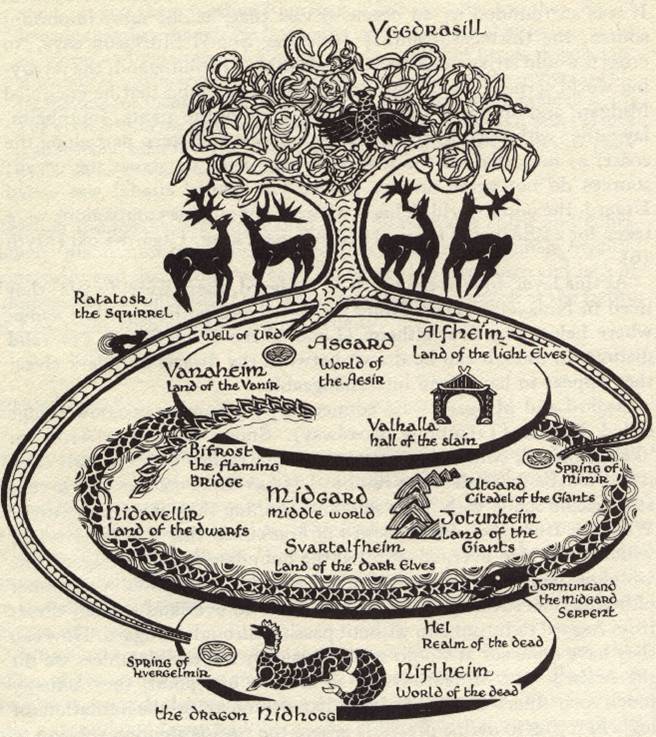
Link: A Collection of Attempts to Diagram the Norse Cosmology

There is uncertainty about the origin and meaning of the name of the Norse world tree.  The dominant hypothesis at the moment seems to be that it means "Ygg's horse"; Ygg being another name for Odin meaning "terror" or "terrible one".  The name may be intended to be a colorful term for gallows.  The tree seems to be either an ash or a yew.  This gives rise to a particularly grim thought: If the name of the world tree is Terror's Gallows, it seems that the nine worlds were hung there to die.  This fits nicely with the conception that all these worlds are temporary, to be destroyed on the day of Ragnarok in the final battle.

Here's a quick review of the Nine Worlds, by Norse name, as I have begun to organize them.
  1. Ásgarð – Home of one group of gods, the Aesir, and their hall for heroes
  2. Vanaheim – Home of another group of gods, the Vanir.
  3. Álfheim – Home of the elves
  4. Miðgarð – Plane of humanity and mundane beings
  5. Jötunheim – Home of the giants
  6. Svartálfaheim (or Niðavellir) – Home of the dwarves and lower faeriedom
  7. Hel – Home of the Dead
  8. Niflheim – Plane of Water
  9. Muspellsheim – Plane of Fire
1-3 Are the upper planes, 4-5 are the middle planes, and 7-9 are the underworlds.  Six could be a problem, let's come back to it.  In keeping with my work so far, I am beginning with Norse inspiration and then taking them in whatever direction they need to go.  There will probably be a tendency to go next to Judeo-Christian sources next, but I will also be drawing heavily from the D&D pastiche, whose sources are listed in suggested reading lists or appendices.

Let's start with the three upper worlds.  I like the idea that the elves are other-worldly, and that they are an alien presence in the middle world of men.  Drawing from the old D&D books, I will take the idea of alignment, and particularly of a conflict between Law and Chaos (thank you, Michael Moorcock!)  I like the pulpy feel that this can give a setting.  This has the advantage here of fitting with two different groupings of gods in Norse cosmology, the Aesir and the Vanir, the latter who had been largely displaced by the time of our sources, who at one time warred.  A lot of folks identify elves with Chaos, so that would leave gods of Law and gods of Neutrality or Balance.  I would go in another direction, however, and identify the Elves as the beings of Neutrality/Balance in a struggle between the Law-beings, centered on a renamed Asgard (Loggard?  Ullgard or Ullurgard?) and the Chaos-beings, centered on Freehome (or a requisitioned and similarly renamed Vanaheim).  The Law-beings have obviously succeeded in appealing to humans, promising their heroic allies a place of reward in an afterlife hall of the brave.  I also want to resist the equation of Law with Good and Chaos with Evil, and keep morality and righteousness as potential separate issues from this struggle.

Middle world is dominated by humans, but also the crux in the struggle between the two opposing alignments of higher beings.  This decision is good for adventuring.  Initial research suggests that "gard" means "farm."  Is farming a part of what distinguishes Midworld from the surrounding realms?  On the edge of Midworld is Giantdom.  Are the mountains the home of the giants?  The barrier against giants or humans?  Or do the mountains just get progressively higher and more inhabited by bigger giants?

The sixth realm is starting to look like a problem to me.  Let's just call it Faerie.  Clearly, it's related to Elfhome in the Overworld.  Let's take the old idea that elves can't be resurrected, but that they can be reincarnated.  Is it a cycle?  Is there a progression, like in Hinduism?  Are elves the top of the fae reincarnation ladder?  This seems likely to me.  Maybe some elves have abandoned the cause of Balance or maybe that is something they have to evolve towards, and that when they finally attain it, they becomes elves.  Does this lower Faerie fit as part of the Underworld?  Or should it become part of the Middleworld?  If it is a part of the former, then that gives a reason for elves to be visitors to Middleworld: to help guide their less evolved kin toward Elfhome.  I think I like this idea, plus the symmetry of three levels and three realms in each is nice.  Up to this point, I have not dealt with where halflings would fit in this setting.  As it is developing, I wonder if it wouldn't be better to drop some of the Tolkienesque associations and make them a fae race.  Otherwise, they are farmers and more like little humans.  It is possible, of course to have a mundane, miniature human race. One could look to pygmy peoples and the mythological portrayals of them for further inspiration.

I have already given the Underworld the most extensive treatment, so let's step back and see how things look at this point, and let's start by strengthening the three tiers and drop the divisions of worlds between them:

The Overworld:  The Dominion of Law, the Fields of Freedom, Elfhome.

The (Middle) World: The Cultivated Lands of Man, The Uncultivated Lands of Faerie, The Giant March.  As I describe it so, I begin to think that the giants and the Chaos-beings are in league: on the side of Chaos to minimize access of Law, on the giants' side to have an opportunity to enslave the smaller races.

The Underworld: In this setting, the Underworld is largely of primordial elements, the main exception being the realm of the dead.  An important question to address next would be, to what extent does the struggle between Law and Chaos extend to the Underworld, and how do the three realms below fit in it?  Are the dead unaligned?  Are the other two realms internally divided into camps of Law and Chaos?  Fire giants and hellhounds (L) versus Efreet, Salamanders, and Red Dragons (C), for example?

Ygg's Tree
As I look back over the experimental structure delineated so far, I wonder if more could be made of the image of the tree.  In what way could we now go back and view the Overworld in terms of the canopy, Middle World  as the trunk, and the Underworld as the roots?  By a continual process of zooming in and dealing with very concrete details and zooming out to see how things are coming together in the big picture, I keep returning to what is accounted for, and what is left to be accounted for.  In this way, questions multiple.  Are clerics both of Law and of Chaos?  In this setting, should they turn different kind of outsiders based on their alignment?  Where does magic come from?  Is it a feature of the Tree itself?  Should treants (=ents) and dryads be given special treatment in this setting?  Maybe the fae races were the original races of this world before some outer power chose it as a prison for these warring factions of Law and Chaos.  Is this outer power Ygg?  Or is Ygg the original of the fae races?  I like the pulpy feel of the name, Ygg.  Maybe this universe should be called Ygg's Tree.  Maybe when one looks up from Middle World at night, instead of seeing the Milky Way, one see a nebula that looks like the foliage of a celestial tree, giving the tree identification a visual focus.  In the threefold world of Ygg, an intelligent race of tusked, magical caprids discuss philosophy, while in the mountains, clerics call yetis to protect their shrines against the ravages of marauding giants...

See Collection Linked Above
EDIT: Broken picture fixed.  Seems like this has been happening recently.

Wednesday, April 27, 2011

W is for Wells

Norns at the Wyrd Well by L. B. Hansen
Wells, springs, fountains, sources -- places where water comes bubbling up from the depths into the upper world to support human life have been identified as holy places from time immemorial.*  This is true of the Norse sources we have been drawing as well.  In the Marvel diagram of the Nine Worlds I linked a few days back, three wells are shown: Urðarbrunnr, Mímisbrunnr, and Hvergelmir.  These wells or springs have suggestive, even mysterious places in Norse mythology that we only have a very partial knowledge of today.  But they provide a powerful mythic image -- conveniently appropriate to the letter of the day! -- for us to continue our exercise in world-building.  Keeping the original names is probably a little much for my preferences, so I would bring them over something like this:

Wyrd's Well (Urðarbrunnr) Running between the Home of Heroes and the Home of the Dead, attended by the three Norns, though named for some reason after only one of them, Wyrd.  This well is connected to the fate of all who are born and die in the Nine Worlds.  I'd hate to think what a sip from or a dip in this well might do...but it might be a likely preparation for a descent to the dead.  This raises the questions of who the three norns are, and the relation of other fey water women (nymphs, nixies, swanmays) to this trio, Bygone, Necessity, and Wyrd.

Mimir's Well (Mímisbrunnr) At the farthest roots of the World Tree, reaching down to depths no one knows (into the chaos of the void?).  This well demands a significant sacrifice for access to its wisdom.  This sounds like the perfect magnet for a magic-user who wants to lay it all on the line for access to a secret or great power.  If you keep the association with Mimir's head, wouldn't you like to see the well bubbling forth from his mouth?  Further inspirational images would be of the great stone heads in Angkor Wat and Mesoamerica that are entwined in tree roots, as Mimir's head would be in the roots of Yggdrasil.

Mimir by Trishkell

Boiling Springs (Hvergelmir) Between the Plane of Fire and the Plane of Water, it is the source of the clouds and mists over the Plane of Water.  Doesn't sound inviting, does it?  Perhaps it is simply the passage between the two planes and the armies of fire and water elementals flinging themselves into combat and dying create the boiling spring.

Such mythic locations as these wells could be the object of a quest, the gate to a quest, guarded by terrible guardians or a dungeon, or a location in a megadungeon; in any of these, a nexus between the elements of the setting and the characters' plot-lines promising an unforgettable gaming experience if utilized to their potential.

The Norns by J. L. Lund


*For Jungians, these are symbols of the Unconscious itself, welling up into Consciousness.

Tuesday, April 26, 2011

V is for the Veneration of Ancestors

Photo by Mitch Young


Given the importance of ancestral rites for ancient societies such as the Egyptian and the Roman, and the widespread persistence of them in African and East Asian societies, as well as the form that it takes in the cult of the saints, I am dissatisfied with the ancestors' almost total absence from religion in role-playing settings.  Yesterday's work on an Underworld (here and here) made me think about the destiny of the dead in that incipient setting.  Hel assumes Valhalla: one place for those who die as heroes, another for those who die of sickness or old age.  The fact that my mind has been in the native Chinese religions in recent weeks (and perhaps my own Christianity) creates some dissatisfaction with the majority of people being ignominiously consigned to hel.

For this setting, I would introduce a division in hel for the mediocre majority from the miserably damned: the Valley of the Shadow of Death for most dead, and the Pit of Perdition for the wicked.  While the heroic dead could be called upon for aid like patron saints, the mass of the dead could be placated with ancestral rites.  This would be an explanation for the rites, and neglect of the rites that would reconcile them to their fate would be one major cause of the curse of the undead.  Perhaps the appropriate rites could even insure an eventual reincarnation for the mediocre dead to give them another shot at glory.  There could also be occasions where spirit possession would be part of the rites.  This cosmological detail could give rise to interesting ties with certain spells in the game and new possibilities for adventuring plots.  In short, it is full of world-building and role-playing potential.

For a very elaborate and public practice of ancestral rites, see the Korean festival of Jongmyo Jerye.

Monday, April 25, 2011

U is for Underworld II

Part II: Denizens of the Underworld


Looking at the Norse Nine Worlds,* four seem to clearly fall into the realm of the Underworld:
  1. Svartalfheim: Home of the Black Elves
  2. Hel: Home of the Dead
  3. Niflheim: Home of the Mists
  4. Muspelheim: Home of Fire
Turning to the creatures listed in the Moldvay and Cook books, I've sorted those that seem to obviously fit into these four, though a few may call for further comment.

Svartalfheim is identified with the dwarves explicitly in Norse mythology.  We might also stick the gnomes here, as relatives of the dwarves.  But all the other creatures that traditionally have a connection with the elves, that fit in an Underworld setting better than a higher concept of Elfland, arguably belong here: bugbears, goblins, hobgoblins, kobolds, and orcs.  These traditional enemies of dwarves and gnomes suggest an underground realm that is full of conflict and warfare.

Hel is the realm of the dead who are not great heroes.  It is also where one would expect the undead to originate and generally dwell.

Niflheim is wet and cold, a realm of mists.  Here the white dragon, water elemental, and frost salamander would best dwell.  Though there is a an over-world location for giants, the frost giants would also fit well here.

Muspelheim, the realm of flame, is the natural home for fire giants, efreet, fire elementals, red dragons, hell hounds, and fire salamanders.

What does an Underworld divided into such regions suggest?  For one, the further down one goes in the Underworld, the worse things get.  Svartalfheim, one might be tempted to call it the Underdark, the Feydark, or Underfaerie is a realm that is dominated by evil humanoids, but still has dwarves and gnomes in it (although, the dwarves are more morally ambiguous or even evil in Norse literature than they are in traditional high fantasy).  Hel is the realm of the mass of the dead, but also of the evil undead.  To avoid later associations with Hell, one might rename it the Kingdom of Death or the Deadlands or the Hollow or the Valley of the Shadow of Death or some such.  It could be ruled over by a Queen like Hela or Persephone.  Niflheim sounds like an elemental plane of water, but the best that one can hope for in sea with lands and mountains of ice, covered by mists, is moral neutrality: the giants and dragons are evil.  Muspelheim is the elemental plane of fire, where again the neutral elementals seem outnumbered by very evil races.  Passages between these domains would perhaps be by means of wells, which were significant in Norse mythology, or by means of the roots of Yggdrasil, itself.

A megadungeon complex might well cross through multiple of these Underworld domains, which hardy adventurers  would brave as they trace surface evils to their sources or seek treasures of the Underworld, but Angela's comment on part I brings to mind another possibility that has often been overlooked -- very strangely given its prominence in the myths.  In games that have allowed the resurrection of characters, this has often been the availability and affordability of the spell for the raising of player characters of major NPCs.  But what if the spell was just one component that was necessary?  What if the party had to make a trip into the realm of Death to reunite body and soul with the spell?  Keep in mind that the god Pluto and Plutus, or the god of wealth, were often identified as the same god.  This would keep resurrection from being too common in game and also work character death and resurrection into story in a more direct way.

An initial identification of four regions of the Underworld in this way marks the beginning of the (sub)creation of a distinctive campaign setting, suggestive of further elements, such as the purpose of quests and the way that certain magic works.

*There is no universal system of imagining the arrangement of these worlds in Norse literature.  This one makes sense to me.  There might be an argument for locating the realm of the giants (Jotunheim) as a whole in the Underworld, but it does not make sense to me to put giants of hill, stone, cloud, and storm there (not to mention ogres and trolls), as much as to put the home of the frost giants in Niflheim, just as the fire giants are in Muspelheim.

U is for Underworld I

Part I: World-Building from the Underworld Up


One of the most important elements of world-building for my money is the Underworld.  Rich treasure troves of traditional material await the mythopoet here: demonic hordes, devilish hierarchies, hungry shades, imprisoned spirits -- on and on the list goes.  All this can be mined, no matter where you fall on the re-usage continuum from pastiche to alchemical transformation.  For today's  mythopoeic experiment, I will draw on recent mythological elements brought up on this blog, so Norse and Judeo-Christian elements will predominate.  To populate them, I will confine myself to creatures from the Moldvay and Cook D&D books.  This will give us some more perimeters to structure our creativity.

Since for the purposes of this experiment I am drawing on gaming materials, we'll assume that this is an Underworld for an RPG campaign.  Starting with the Underworld is especially a good beginning for a fantasy RPG world because of the traditional importance of the dungeon, which is where the World and the Underworld start to blend together as one slowly descends into the Underworld.  (For more about this, see the resources linked here.)  We'll assume a traditional three-tiered universe of Overworld, World, and Underworld.  Since we already have the World Tree (Yggdrasil) in play, the three worlds will be joined together by this cosmic tree, which will allow for heroes and monsters to travel between planar locations. 

With part II, we'll jump right into building the Underworld by rummaging around in our inspiration hoard.