The end of last week brought me my Paizo subscriptions box, and among the contents was the newest volume of the Pathfinder Tales: Dave Gross' Queen of Thorns. Even with a lot to do, I gobbled it up over the weekend.
This, the third offering from Gross in the PF Tales line crowns him as the undisputed king of the line, and should secure a wider reading for the Jeggare/Virholt novels. (Be sure to start with the "Pawns of Hell" serial fiction that introduced the characters in The Council of Thieves Adventure Path.) What is it that fuels my bold claims? Perhaps Gross has some competition when it comes to energetic plots and world evocation, but when it comes to character development that is satisfying and sophisticated, there is no beating the arc of development that he has traversed so far with Varian Jeggare and Radovan Virholt. It is hard to beat in any contemporary fantasy of which I am aware -- in a class with James Enge in Blood of Ambrose, Zelazny in the first Amber series, and Howard Andrew Jones in The Desert of Souls. (A couple of Vance's characters in the Lyonnesse series get close and perhaps Vlad Taltos in Steve Brust's novels will rise to this level -- I've only made it through the first set of the Taltos series, so I'm undecided in that case.)
If you have been holding off from Pathfinder Tales, dive in and read these three together first. If you have been looking for a fantasy series that will take you on a varied ride with compelling characters and amazing changes of scenery, look no further -- Gross will take you from Golarion's analogue of silverscreen Transylvania to its fantasy Orient (major martial arts films homages) to its Faerie in this last volume. Just try and beat that.
I keep trying to think of something to be more critical of, but I'm afraid Gross has pulled an A+ on the Mythopoeic Obscura grading scale. Disputers are directed to the paladin below.
Showing posts with label Faerie. Show all posts
Tuesday, November 6, 2012
Friday, June 22, 2012
Artist Appreciation: Anna Christenson
![]() |
| Yes, a hot elf chick to kick-off the weekend and shamelessly pander Google hits. |
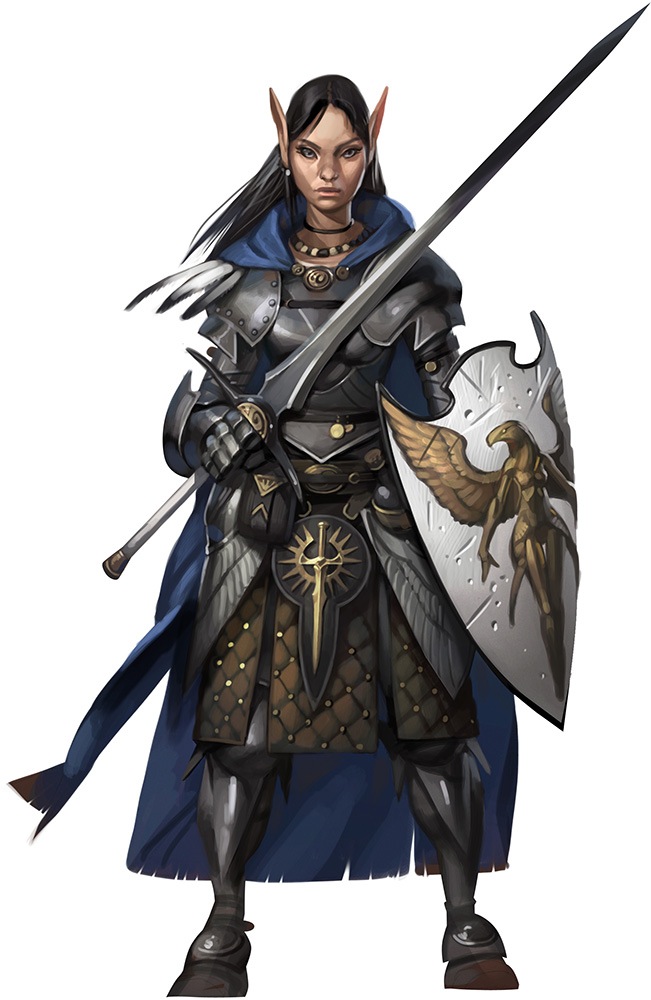
I had seen one of her works (above), but now I have identified her and her body of work. She has been a busy gal, producing quality gaming illustrations for a number of companies before her work for her Paizo. I also particularly like the pieces she's produced for the Dragon Empires, Golarion's oriental analogue. If you don't know about Anna Christenson's art, check out DeviantArt, her site, and her blog. I look forward to seeing more of her contributions.
Saturday, June 16, 2012
Bring Me the Heart of Snow White
Or better yet, Charlize Theron in a slinky evil queen gown. Rawr.
What do you do in a world dangerously lacking in meaning because you are overworked and it will be nine months before Game of Thrones season 2 comes out on Bluray? Go see Snow White and the Huntsman. At least, that's what I would have done, if I hadn't promised Mrs. Obscure that I would wait until she was in town so we could see it together. Finally, last night, I got to see it.
The story goes like this: Thor finally returns to earth and Natalie Portman is dead. In his grief, he becomes an alcoholic. (Is that even possible when drinking only mead?) The evil queen (she made it impossible for me to pretend she was just misunderstood. And I REALLY wanted to. And I prefer brunettes. Such is the power of Charlize.) promised Thor she would bring Natalie Portman back, if only he'd bring her that chick from Twilight. The one who is not a good actress, but is very good at doing things with her face. To be fair, I think she could be a good actress and I might like her in a role that didn't annoy the bejeebers out of me, but she is not ready for the demands that this role strived for. (The plot writing also failed these high ideals, so she's not alone to blame.) Any way, Thor goes into the super creepy hallucinogenic woods after the Twilight chick, who, even when she's dirty, now has a much better wardrobe than she used to have. They meet a troll. Possibly the most awesome troll ever.
After not enough time with the troll, Thor and TC go on to spend time with the Iraqi marsh people before they meet the dwarves and the fairies. Dwarves, you never fail me. Eventually, there will be the apple and the kiss (oh, I didn't spoil it for you, did I?) and the big battle. Surely no one doubted that Snow White could be made better if you added a big battle scene.
The wife liked this movie better than Mirror, Mirror. While I prefer it in terms of tone and spectacle, it is not tighter or better written. The narration at the beginning lagged and took too long -- they needed to find other ways to set it up. The story has moments of great potential it never capitalizes on, and so it disappointed me as a story, which is what a film should be first and foremost. However, sets, costumes, effects, and Charlize Theron demand that it be seen. Because of subject matter, great visuals, and some creative versions of fairy creatures, it manages to pull off a B+
Payoff: if you are working or playing with faerie or the Raven Queen, then I'd say this a must see. If you are working or playing with vampires, Snow White, the Shadow Plane, or dwarves, then this is a probably should see. If you saw Prometheus and need more Charlize Theron? Must see. Chris Hemsworth fans? Probably see, but after Thor and The Avengers. Kristen Stewart fans? Seek help. I will say this: she made a better Snow White than I thought she would. But can't they afford to get black hair die for her? And the little girl Snow White, too, who's hair was way too light. Seriously, movie makers, if you don't know your subject material, at least listen to your own prologues.
What do you do in a world dangerously lacking in meaning because you are overworked and it will be nine months before Game of Thrones season 2 comes out on Bluray? Go see Snow White and the Huntsman. At least, that's what I would have done, if I hadn't promised Mrs. Obscure that I would wait until she was in town so we could see it together. Finally, last night, I got to see it.
The story goes like this: Thor finally returns to earth and Natalie Portman is dead. In his grief, he becomes an alcoholic. (Is that even possible when drinking only mead?) The evil queen (she made it impossible for me to pretend she was just misunderstood. And I REALLY wanted to. And I prefer brunettes. Such is the power of Charlize.) promised Thor she would bring Natalie Portman back, if only he'd bring her that chick from Twilight. The one who is not a good actress, but is very good at doing things with her face. To be fair, I think she could be a good actress and I might like her in a role that didn't annoy the bejeebers out of me, but she is not ready for the demands that this role strived for. (The plot writing also failed these high ideals, so she's not alone to blame.) Any way, Thor goes into the super creepy hallucinogenic woods after the Twilight chick, who, even when she's dirty, now has a much better wardrobe than she used to have. They meet a troll. Possibly the most awesome troll ever.
![]() |
| Troll. I think I love you. (Still not as much as Charlize, though. But close.) |
![]() |
| Thanks, Hollywood. This scene wasn't in the movie, but it's the biggest pic of the troll I can find. |
The wife liked this movie better than Mirror, Mirror. While I prefer it in terms of tone and spectacle, it is not tighter or better written. The narration at the beginning lagged and took too long -- they needed to find other ways to set it up. The story has moments of great potential it never capitalizes on, and so it disappointed me as a story, which is what a film should be first and foremost. However, sets, costumes, effects, and Charlize Theron demand that it be seen. Because of subject matter, great visuals, and some creative versions of fairy creatures, it manages to pull off a B+
Payoff: if you are working or playing with faerie or the Raven Queen, then I'd say this a must see. If you are working or playing with vampires, Snow White, the Shadow Plane, or dwarves, then this is a probably should see. If you saw Prometheus and need more Charlize Theron? Must see. Chris Hemsworth fans? Probably see, but after Thor and The Avengers. Kristen Stewart fans? Seek help. I will say this: she made a better Snow White than I thought she would. But can't they afford to get black hair die for her? And the little girl Snow White, too, who's hair was way too light. Seriously, movie makers, if you don't know your subject material, at least listen to your own prologues.
Friday, April 20, 2012
R is for ROBINSON CRUSOE
Defoe's 1719 novel, an early example of the English novel, entered my imagination at a young age thanks to my mother's provision of nicely illustrated children versions of classic novels. It also made an impression on G. K. Chesterton, whose importance for mythopoets I have treated before. But unlike the elements of the story that my youthful imagination was taken with like cannibals, pirates, friendship, and black-powder, Chesterton was taken with, of all things, Crusoe's accounting of items salvaged in chapter IV. In other words, with little more than a list of goods. For Chesterton, it is a poem reflecting the truth of our world.
In chapter IV of Orthodoxy, "The Ethics of Elfland," he writes,
I really felt...as if all the order and number of things were remnants from Crusoe's ship. That there are two sexes and one sun, was like the fact that there were two guns and one axe. It was poignantly urgent that none should be lost; but, somehow, it was rather fun that none could be added. The trees and the plants seemed like things saved from the wreck: and when I saw the Matterhorn, I was glad that it had not been overlooked in the confusion. I felt economical about the stars as if they were sapphires (they are called so in Milton's Eden): I hoarded the hills (116).
...there had come into my mind a vague and vast impression that in some way all good was a remnant to be stored and held sacred out of some primordial ruin (118).I never appreciated the salvaging of goods when I read Robinson Crusoe, though it did make more of an impact on me when I saw the Swiss Family Robinson movie. But after reading Chesterton, I find it unforgettable. Even while I take more of a mythic approach to the story of the Fall than Chesterton did, I believe it resonates with me just as much. It also suggests part of the truth behind humanity as homo mythopoeicus. Our sense of wonder at the things that are and the things that are not find one mode of expression through the sub-creation of secondary worlds. In On Fairy-Stories, Tolkien traces this to the doctrine of the imago Dei: God created beings in his image, that is, image-making creatures.
Tuesday, November 22, 2011
Fairy Tales Dark, Dangerous, and Perhaps Not
I am back home, but I don't have anything in particular to share from my trip to San Francisco, I am sorry to say. It was good for me professionally and personally, but while there I was not able to do anything touristy to feed the inner mythopoet. (I was reminded my ongoing interest I had as a boy in Alcatraz and the old U.S. Mint, but I'd have to stew about these places for a while for them to produce anything.) I will proclaim and reaffirm what I already believed to be true based on my 4th grade memories: If I had to live in California, SF would be my town of choice. I don't plan on waiting another 30 years to get back there, and when I do, the touring mythopoet (and epicure!) will be unleashed!
In the absence of any souvenirs to share, I believe I will observe this Tuesday homing with another installment of Tomeful Tuesday. I've finished Snow White, Blood Red, edited by Ellen Datlow and Terri Windling (1993). I owe this hard-working, long active duo for the many anthologies and collections they have done, for thereby introducing me to authors I might have never discovered on my own, and for their patronage of Thomas Canty (see linked image above). I believe this was the first in their fairy tales collections (of short stories and poems like this one -- there was a series of novels that had an earlier start), and from those I have read so far, this first is not my favorite. The stories are not only dark, but many move towards the tragic, the nihilistic, and even the sick. While I enjoy the former, it is difficult to enjoy the latter. Further, I question whether stories with fairy tale elements actually qualify as a fairy tale proper when they lack the eucatastrophe. There are some pretty good stories in the collection, however, and three clear stand-outs for me: "The Glass Casket" by Jack Dann, "The Snow Queen" by Patricia A. McKillip, and "Breadcrumbs and Stones" by Lisa Goldstein. These three I can wholeheartedly recommend to all in this season of fairy tales, if you want to add some reading to your viewing. (By the way, I wish they had gotten Nick Owchar to write that piece for The Siren's Call. Are we only seeing pieces out of him once a week, L. A. Times? What the hell!?) Until next time, I bid you a good Tuesday, and a tomeful week of happy reading.
Friday, October 21, 2011
Respinning the Demon Queen
N. Wright has rattled my cage with his post on Lolth.* I had been thinking about this post for a while, and noted it in my blog schedule document, but I hadn't moved it up the queue, much less written it. I shall wait no longer!
Lolth (or Lloth)
Every gamer of my generation remembers Lolth, Demon Queen of an underworld filled with drow and giant spiders, this way:
And "she also enjoys appearing as an exquisitely beautiful female Dark Elf," in D&D, called drow (Q1:31). So perhaps she was even more memorable to pubescent and adolescent boys as looking something like this:
Thus Lolth has two forms of appearing, even as she has two aspects: Goddess of the drow and Demon Queen of spiders. These forms are both favorites of artists: reward yourself with a Google image search and you will be inundated with forms both of a horrendous arachnid with varying female humanoid attributes, and of the exquisitely beautiful female dark elf. (All drow chicks are hot, ergo, Lolth must be the hottest of the hot.)
Lilith
Another powerful demoness is the similarly named Lilith, from Jewish mythology. Lilith is another sexy demon: according to the tales of some rabbis, she was Adam's first wife, divorced and turned into a demon because she wanted to be on top during coitus. Thus she was punished as a threat to the belief in a divinely ordained male dominance. Denied children of her own, she became an envious demon who kidnapped children. In some people's mythopoesis, she became the first vampire. Remember vampires? How often they have pointed ears and are beautifully irresistible? Like, well, elves. Also note, female vampires from earliest days were portrayed as kidnapping children, just as the elves did with changelings.
Mash-Up Time: The Demon Queen Gets a Makeover
These two demon-goddesses offer a strong case for identifying the two figures as the same individual. They share so much thematically that it is easy to do. As I noted, even their names are very similar. If you keep the two names, they can just be differences due to language. Or you could call her Liloth. Combining them has happy consequences.
If you are tired of the same old folklore controlling vampire game mechanics, you can now offer vampires a makeover based on their demon mistress: driders could be the spider form available for vampires. Now we know why the drow moved underground: those who had received Liloth's gift (many of the nobles) had to flee the destructive rays of the sun. Why should you especially identify bats with vampires? There is one species of vampire bat, but don't all spiders suck their victims dry of their vital juices? We also have tehe answer for why evil elves and vampires kidnap children: Because they are easy-to-catch-and-carry little bags of blood, that's why. Changelings would be ones selected to be allowed to survive and grow up to be turned into vampires and sent back to plague their old communities. And remember the fear about female dominance represented by Lilith? Of course drow are a matriarchal society under the demon goddess.
Vampires and drow tend to be among lots of gamers favorite monstrous races. They also are the object of complaint as overly used and overly familiar. I offer this new spin on the Queen of the Demonweb Pits as a way to creatively revamp both the Lolth and her elven devotees.
* His post led me back to Tim Brannan's earlier post.
Lolth (or Lloth)
Every gamer of my generation remembers Lolth, Demon Queen of an underworld filled with drow and giant spiders, this way:
![]() |
| Erol Otus' Illustration from the Fiend Folio, 1981 |
![]() |
| Erol Otus' Illustration from Queen of the Demon Web Pits, 1980 |
And "she also enjoys appearing as an exquisitely beautiful female Dark Elf," in D&D, called drow (Q1:31). So perhaps she was even more memorable to pubescent and adolescent boys as looking something like this:
![]() |
| Another Erol Otus Illustration from Queen of the Demon Web Pits, 1980 |
Thus Lolth has two forms of appearing, even as she has two aspects: Goddess of the drow and Demon Queen of spiders. These forms are both favorites of artists: reward yourself with a Google image search and you will be inundated with forms both of a horrendous arachnid with varying female humanoid attributes, and of the exquisitely beautiful female dark elf. (All drow chicks are hot, ergo, Lolth must be the hottest of the hot.)
![]() | |
| J. M. Collier's Lilith, 1887 |
Lilith
Another powerful demoness is the similarly named Lilith, from Jewish mythology. Lilith is another sexy demon: according to the tales of some rabbis, she was Adam's first wife, divorced and turned into a demon because she wanted to be on top during coitus. Thus she was punished as a threat to the belief in a divinely ordained male dominance. Denied children of her own, she became an envious demon who kidnapped children. In some people's mythopoesis, she became the first vampire. Remember vampires? How often they have pointed ears and are beautifully irresistible? Like, well, elves. Also note, female vampires from earliest days were portrayed as kidnapping children, just as the elves did with changelings.
Mash-Up Time: The Demon Queen Gets a Makeover
These two demon-goddesses offer a strong case for identifying the two figures as the same individual. They share so much thematically that it is easy to do. As I noted, even their names are very similar. If you keep the two names, they can just be differences due to language. Or you could call her Liloth. Combining them has happy consequences.
If you are tired of the same old folklore controlling vampire game mechanics, you can now offer vampires a makeover based on their demon mistress: driders could be the spider form available for vampires. Now we know why the drow moved underground: those who had received Liloth's gift (many of the nobles) had to flee the destructive rays of the sun. Why should you especially identify bats with vampires? There is one species of vampire bat, but don't all spiders suck their victims dry of their vital juices? We also have tehe answer for why evil elves and vampires kidnap children: Because they are easy-to-catch-and-carry little bags of blood, that's why. Changelings would be ones selected to be allowed to survive and grow up to be turned into vampires and sent back to plague their old communities. And remember the fear about female dominance represented by Lilith? Of course drow are a matriarchal society under the demon goddess.
Vampires and drow tend to be among lots of gamers favorite monstrous races. They also are the object of complaint as overly used and overly familiar. I offer this new spin on the Queen of the Demonweb Pits as a way to creatively revamp both the Lolth and her elven devotees.
* His post led me back to Tim Brannan's earlier post.
Monday, September 5, 2011
Halflings of Another Color
The word halfling is an old Scots English word for "one not fully grown; a stripling" according to the OED. Tolkien eventually picked it up as the Common Speech word for a hobbit on this basis: to indicate one who is roughly half the size of adult humans. But the word has other uses in Terry Brooks' Sword of Shannara and Jack Vance's Lyonesse novels (and perhaps other fantasy literature as well), and could name creatures who were half one thing and half something else just as well as it does creatures who are are half-sized. Today's Mythopoeic Rambling will be dedicated to exploring alternative ideas for developing a halfling race.
Beyond Classical Halflings
Let me start by saying I love Tolkien's hobbits. While I don't encourage their derivative use in fiction unless it is fan-fiction, I definitely understand the desire to play one of them in a fantasy game with a Tolkienesque setting -- in which case they shouldn't be, say, the strike force of the Thieves' Guild, wielding repeating crossbows whose bolts are coated with deadly poison (I wish I was making this up just as a random example). To put the same point differently, Tolkien's hobbits don't work in every setting, so I have been thinking about ways to keep the halfling game race across settings. I have two ideas. The first continues to center on the idea of size (pygmies) and the second picks up the idea that they are the bearers of a dual heritage (human descendants of fae).
Pygmies
Real world pygmies are indigenous peoples in various areas of the world -- most famously Central Africa* but also in other regions of Oceania, Southeast Asia, and South America. Both the real world tribes themselves and the ways they entered into the folklore of other peoples are rich sources of inspiration for a developing a distinctive halfling race that will fit fantasy worlds that are different from Middle Earth. For myself, I will undertake a reading of anthropological literatureand supplement it with material from Greco-Roman mythology and African folklore to produce a race that is proudly African and heroic in flavor. For example, the war with the cranes (or better, one of D&D's crane-like monsters) could be central to pygmy culture and history. This is the direction I was planning initially for the halflings in the World of Ygg setting. Now to turn away from size and toward the biracial.
Fey Halflings
Fairy tales and folklore are full of dalliances between humans and the denizens of faerie. Classic forms of D&D have a number of fey creatures in addition to elves as a PC race. And if you are playing a game with only the four classic races (and not the races added by Advanced D&D and its descendants), halflings provide a slot that will take the place of races added later and have flavor that works well for half-humans with fey blood. Halflings' ability to disappear in wooded areas reflect well the flavor of a fey heritage, and the diminutive size of many of these creatures in their natural state would explain halfling size.
While I imagine the appearance of this fey-blooded race to vary greatly, they may vary in size, too -- I suggest two physical types for halflings, to represent the variety of potential fey parentage: small halflings for those in whom the heritage of small and beautiful faeries predominate and medium (up to larger than the average man) for those who derive the majority of their heritage from big or ugly faeries. In essence, this would allow halflings to take the place of the roles of half-elves and half-orcs, that proved so popular in later editions of D&D. In mechanical terms, what would decide whether one had generated a large or a small halfling would be, above all, strength size (the idea of a standard halfling getting a strength bonus has always stretched believability for me, certainly any modifier over +1). Higher strength scores would indicate a larger halfling, descended from the more brutish creatures of faerie. The idea behind this is that the interaction of fey blood with human in the case of the beautiful races has the quirk of producing smaller half-humans, while the larger or uglier fey blood produces a hybrid vigor that gives a game equivalent to half-orcs. All this while sticking with the core four racial choices.
Elves, Pixies, Sprites, Nixies, Dryads (Gnomes possibly)
Halflings as they are already represented in the standard versions of the rules fit well the flavor of humanoids with fey blood: small, hard-to-catch humanoids who "are difficult to spot, having the ability to seemingly vanish into woods or underbrush" and are also good as hiding in subterranean surroundings (B10). In games that follow the structure of four PC races, this would
Goblinoids, Trolls (Hags, if they have them in your game)
This is where I begin to question keeping the mechanics of the halfling for larger creatures. The GM may want to come up with flavorful replacements for the dodging, hiding, and missile accuracy mechanics for the larger halflings, although, with a little thought, there could be reasons why they get the same bonuses other than size (they exude a slippery skin oil, have some subtle, protean ability that doesn't utterly change their appearance but distorts their physical form enough to allow escape, their skin color lends them natural camouflage in certain environments, etc.) This version of the race could be used to satisfy the desires of players who like the appearance options that half-orcs or even tieflings offer in the the Advanced form of the game (and its descendant) and. One thing I can tell right away: using my idea of a racial primary attribute (and accompanying bonus) that I briefly introduced in my card generation method, I would switch the primary attribute for this line of fey halfling from Dexterity to Strength.
Reproduction
The simple solution is to have halflings breed true: they seek out others of mixed heritage, perhaps as a result of feeling rejection or difference from the community of their mother, and settle with like outside of a human or fey community. Over time, the commerce between humanity and faerie would result in a significant enough population that they would come to be, in practical terms, a virtual race. Location vis-à-vis populations of different kinds of fey creatures would determine whether a halfling community was predominantly small halflings, larger halflings, or composed of both sizes.
Happy world-building until the next Mythopoeic Monday!
*For one way to help the plight of one pygmy people, the Batwa of Uganda, I recommend the Kellermann Foundation.
Monday, August 29, 2011
Dwarves are Dudes
I remember the days before Betamax and cable TV. We had these arcane devices called projectors and we put quaint objects called reels on them when we wanted to watch something like, say, Disney's Snow White & the Seven Dwarfs. Luckily, my family had a copy, so this childhood favorite was available to make an impression on my young mind in the years before it was released for video players: between theatrical re-releases (no, I wasn't around in 1937, thank you very much) and televised broadcasts, I was not left dwarfless. The most important lesson this animated classic taught me was simple. DWARVES ARE DUDES. However much fairy tale purists may deplore Disney's adaptations from the traditional source material, the film found a way to represent faithfully certain folklore aspects of the dwarfs of the Märchen that go back at least as far as Norse mythology -- above all, that they are uniformly male. Iconic dwarves of today fit this mold just as well as Grumpy does. (See Pathfinder's Harsk, below.)
This has so impressed my imagination, that I find mythopoesis that turns dwarves (yes, I still prefer Tolkien's spelling for them) into just another race of two sexes, with a mundane biology like our own, uncongenial. Dwarves are male just like some other beings (magical? fey?) are female: sirens, mermaids, gorgons, harpies, dryads, nymphs, and so on. This observation suggests a natural role for dwarves in a fantasy ecology as the male progenitors of these various female races. Males born of such unions would be dwarves, females born of these unions would be the same as their mothers. I like this more than bearded females that only dwarf males can tell are female (Tolkien) and dwarves growing out of stone (C. S. Lewis), and it opens up further avenues of world-building and story-telling, in which the relations between dwarves and their mates play out.
That's all for today, fellow Ramblers. Thanks for joining me for another Mythopoiec Monday.
Monday, August 8, 2011
Mythopoeia and the Public Domain
I got it into my head that J. R. R. Tolkien's poem, "Mythopoeia," written in 1931 (after one of those BIG conversations that changes the life of intellectuals, in this case, Tollers, Jack, and Hugh Dyson) and dedicated to Lewis, was in the public domain. I'm not sure how I got that impression, perhaps because it was on Wikipedia at some point? Anyway, apparently it is not freely available. And thanks to Sonny Bono, the Walt Disney Co., and various other corporate lackeys in Congress, it will not be in the public domain in the US any time soon. Now, I'm all for the rights of creators, but at some point, it is reasonable that the creator and the family that she or he provided for have been taken care of, and the culture of which they are a part have a claim on their creation as something that now belongs to a people. You know, like all those stories that Grimm and Perrault and others published, but then were later available for Walt Disney to adapt in animations that made them tons of money? So yeah, I'm one of those disgruntled people that thinks that copyright was plenty long already and didn't need a greedy extend that keeps things out of the public domain even longer. Even if it was simply occasioned by the fact that I was going to republish "Mythopoeia" today until I discovered I was all wrong about its copyright status and that made my life more difficult this Mythopoeic Monday. Yet another reason to appreciate things like the OGL, Creative Commons, the sharers in the OSR community, and artists like Nina Paley. I might also mention Paizo's community use policy (found by scrolling down the page, right hand panel).
The problem with grumpiness is that it calls for connections. Like a connection to the fact that I love the Tolkien volume Tales from the Perilous Realm, illustrated by Alan Lee. It's an almost perfect collection of fairy stories together with Tolkien's seminal essay "On Fairy-Stories." Almost perfect, except that it left out the other major work on mythopoeia in Tolkien's corpus: the eponymous poem that is the subject of today's grumpiness! Ugh! Another link in the grumpiness chain. Truly, everything in this life is marked by dukkha.
So you will not be treated to a reproduction of "Mythopoiea" in today's post. For that matter, any lengthy quotation opens up the tricky question of how much of it I can quote under fair use. But if you haven't read it, I highly recommend that you seek it out (even though you can't find it in the book I'd love to point you towards buying). Aside from its literary quality and its historical importance (Lewis' corpus would be utterly different if he had not converted), it is a statement of the nature and value of myths.* There have been at least two attitudes towards myths other than they are literal statements of historical or natural realities. One is the view of Plato, that they are dangerous, foundational lies, only justifiable as a necessary evil in the maintenance of a good polis or society, but hence demanding careful and strong social control. The other is that they are the bearers of deep truths, hidden but of great importance to the cosmos and the individual. This attitude is at least as old as Plutarch and dominated the thought of ancient Alexandria. This was the perspective, broadly speaking, to which Tolkien and Dyson belonged and to which they hoped to win their friend, the atheistic Lewis. Hence its dedication:
"To one who said that myths were lies and therefore worthless, even though 'breathed through silver'."
I recommend it to your enjoyment, study, and contemplation. Finally, the anthropology of the poem sees sub-creation, or the building of secondary worlds, as a part of human nature by virtue of humans' being made in the image and likeness of God. So, did I setting out complaining about the distortion of human good that keeps people as a group from participating in certain pieces of mythic material so that I could arrive at the point that joining in mythopoesis was a participation in the divine nature? Yeah, let's say I planned that.
* For that matter, it is also full of keys to what Tolkien is up to in The Lord of the Rings and The Silmarillion.
Thursday, June 30, 2011
Nephews Meet Brownie
| For the Ohioans among us. |
Daddy Grognard's recent post gave my memory a helpful jiggle: the last time I played with two of my nephews (J - 4th grader; Q - 5th grader), their party encountered a brownie. Q asked, "What's a brownie?" (I blame too many hours playing first person shooters.) J responded, "It's like a little elf." He then drew the awesome picture below on the post-its I keep handy during our games. I believe he also referenced the Keebler elves.
I like the implied attitude of the brownie, although his suicidal thought bubble is a little troubling. The drawing likely was influenced by the brownie's unhappiness at being captive more than the simplistic, regrettable gaming attitude that all creatures encountered are for killing. (My nephews are smarter than that: they've killed, negotiated, hid, and run, as appropriate.) We tried randomly generating the brownie's name using dice. (Meh, Qeigoiz is okay, I guess.)
The setup was this: the local townsfolk were the object of fey curses going beyond the usual harmless pranks, leading up to the death of the town cobbler. The town's wizard recruited a party to go to the faerie mound to speak with the faerie queen to find out why the faeries were unhappy. The brownie had been captured by the wizard, with the promise of release once he led them to the entrance of the faerie mound.
So far, the boys have learned all kinds of things about the faeries. They keep Moldvayian killer bees* in the woods nearby both as protection and to harvest their honey for, among other things, faerie mead. Their sensitivity to iron** means they have enchanted into being a brood of creatures that you may be familiar with:
![]() |
| Rust Monster by *oddhatter |
Taking any single fey creature, such as the brownie, can provide an entree into how you construct the fae in the setting of your fiction, game, or whatever you are working on. The traditional categories for faeries are Solitary or Trooping and Seelie or Unseelie. I have been wondering if, in regard to first set, a third option isn't needed: Domestic. Brownies are a domestic faery. They don't troop and live in fey communities in the wild, and they don't live separately from human and fae alike. They live in human (perhaps also demi-human) dwellings. Now the second dichotomy is usually interpreted to mean Good or Evil, respectively. However, here are some further possibilites for members of the Seelie (S) and Unseelie (U) courts:
- Law (S) vs. Chaos (U) - for games centering on a Law/Chaos struggle. This would provide a very different flavor from the tendency to make faeries Neutral.
- Friendly to Humans/Nonfae (S) vs. Unfriendly to Humans/Nonfae (U)
- Feywild (S) vs. Feydark (U) - Adopting 4e terms here. In other words, Sylvan vs. Underworld. (Who says I refuse to learn anything from 4e?!)
- Silly (S) vs. Serious (U) Fae - I especially like the complexities this would introduce and the folklorish flavor. Note also that the root of "seelie" gives us the modern word "silly."
* 2-3 feet long, and delivering a potentially lethal sting, for those unfamiliar with them.
** This also gives another reason for elves' use of mithril/mithral.
Friday, April 22, 2011
S is for Sacrifice II: Tangled
Part II: Sacrifice in Tangled
A potential problem with the shift in the way we use the word "sacrifice" is that it is now becoming just another word for "trade." In baseball, a batter sacrifices something that will appear on his record to get another runner home. He hardly sacrifices himself in any significant way. That is, his act is only sacred to baseball fanatics in a stretched sense, and there is no immolation of a victim. Because of the inherent importance of the theme of sacrifice, and the challenges that if faces, including ones from the shift of language usage, I was happy to see the theme taken up by the animated film Tangled.
{Spoiler Alert}
I quite liked Disney's retelling of Rapunzel, but there is one area that I found it unsatisfying. The film begins with a narrator identifying himself and other characters as he sets the story up, and he mentions that he died. The viewer immediately begins questioning, "How did he die? How is he speaking to us?" This is good story-telling, and it saves the kiddies the shock of dealing with Flynn Rider's death later. Of course, now you have the problem of how a dead character is narrating the film, but I'm more willing to simply accept that the dead can cinematically address audiences from faerie land than I am the nonsensical resolution that the film offers for Flynn's Easter.
You see, Flynn, the charming rogue, actually comes to care for Rapunzel, for her life and her freedom and happiness, more than for himself. In the final conflict, he offers himself to violence so that Rapunzel might escape the tower. Rapunzel herself was a victim to her false mother's quest for continued life and beauty, and Flynn's intervention substituted himself to Mother Gothel's violence so that Rapunzel could finally escape her fate and gain the freedom of self-determination in the outside world and reuniting with her true family. Flynn should have been allowed to make this sacrifice. He was robbed and so were we.
My objection is not that Flynn was raised from the dead: I could not make such a claim on this day, nor even as a rambling disciple of Prof. Tolkien. It is the way in which Flynn is raised. For Flynn takes up the priesthood not only in his heroic self-intervention, but in the moment of inspiration when he sees that by sacrificing Rapunzel's magical hair, she will be set free. At the crucial moment, he seizes her hair and cuts it off. Rapunzel loses her magic, then Flynn looses his life to the witch's rage.
Eucatastrophe* in fairy-tales leads us to expect the happy reversal at the end. If that reversal is to be Flynn's resurrection, it cannot come at the price of the inner consistency of reality that allows the fairy-tale to exist in the first place. Or to switch from Tolkien to Chesterton, Faerie must obey its own Law. In Tangled, the magic was in the hair and cutting the hair killed it. The magic that could hold back death has died. There either has to be some other magic or some way of restoring the magic. Tangled resorts to the canard of the true love tear bringing back the dead. If there's magic there, it has got to operate by established Law. Verisimilitude is broken and so our belief is sacrificed for Disney's bottom line. Tangled kicks us out of Faerie for the price of a happy ending.
Perhaps this could have been remedied with deeper thought and better story-telling, but the simple answer is to have let Flynn die. Instead of emphasizing the romance between the two characters, emphasize the moral growth of Flynn from his self-centered, immoral use of his freedom to his appreciation of what it would be like to be robbed of one's freedom. Emphasize Rapunzel's desire to be free and the negative consequences of her victimhood. Maybe even introduce the temptation to Flynn of profiting from Rapunzel's hair as something he has to overcome. Then when Flynn sacrifices the magic hair and himself, we cheer and mourn the hero, but the movie ends with Rapunzel's free life and gratitude to a thief who redeemed himself by saving her from a greater thief. This would have put Tangled among Disney's darker animated features, but it would have also made for a truer tale. I think there is a good chance that Tangled's success will get Disney executives to reverse their decision to move away from fairy tales, but hopefully they will learn from their mistake and produce better retellings, rather than simply reaffirm a happy ending at any cost. If children can deal with a story with death, and have to learn to deal with death in real life, then they can learn about the nobility of sacrifice. It's not so much that Disney needs to get out of fairy-tales, as it needs to get deeper into them and to get out of their formula. Not ever fairy-tale has to end in couplehood and not every fairy tale death has to wake from true love's kiss. Fairy-tales are, in fact, more tangled than Disney has made them out to be. But however they end, they cannot break the Law without breaking the Enchantment.
*Coined by Tolkien in this work.
~Next~
Part III: Sacrifice in Gaming
![]() |
| A French version of the movie poster, because I like it. |
A potential problem with the shift in the way we use the word "sacrifice" is that it is now becoming just another word for "trade." In baseball, a batter sacrifices something that will appear on his record to get another runner home. He hardly sacrifices himself in any significant way. That is, his act is only sacred to baseball fanatics in a stretched sense, and there is no immolation of a victim. Because of the inherent importance of the theme of sacrifice, and the challenges that if faces, including ones from the shift of language usage, I was happy to see the theme taken up by the animated film Tangled.
{Spoiler Alert}
I quite liked Disney's retelling of Rapunzel, but there is one area that I found it unsatisfying. The film begins with a narrator identifying himself and other characters as he sets the story up, and he mentions that he died. The viewer immediately begins questioning, "How did he die? How is he speaking to us?" This is good story-telling, and it saves the kiddies the shock of dealing with Flynn Rider's death later. Of course, now you have the problem of how a dead character is narrating the film, but I'm more willing to simply accept that the dead can cinematically address audiences from faerie land than I am the nonsensical resolution that the film offers for Flynn's Easter.
You see, Flynn, the charming rogue, actually comes to care for Rapunzel, for her life and her freedom and happiness, more than for himself. In the final conflict, he offers himself to violence so that Rapunzel might escape the tower. Rapunzel herself was a victim to her false mother's quest for continued life and beauty, and Flynn's intervention substituted himself to Mother Gothel's violence so that Rapunzel could finally escape her fate and gain the freedom of self-determination in the outside world and reuniting with her true family. Flynn should have been allowed to make this sacrifice. He was robbed and so were we.
My objection is not that Flynn was raised from the dead: I could not make such a claim on this day, nor even as a rambling disciple of Prof. Tolkien. It is the way in which Flynn is raised. For Flynn takes up the priesthood not only in his heroic self-intervention, but in the moment of inspiration when he sees that by sacrificing Rapunzel's magical hair, she will be set free. At the crucial moment, he seizes her hair and cuts it off. Rapunzel loses her magic, then Flynn looses his life to the witch's rage.
Eucatastrophe* in fairy-tales leads us to expect the happy reversal at the end. If that reversal is to be Flynn's resurrection, it cannot come at the price of the inner consistency of reality that allows the fairy-tale to exist in the first place. Or to switch from Tolkien to Chesterton, Faerie must obey its own Law. In Tangled, the magic was in the hair and cutting the hair killed it. The magic that could hold back death has died. There either has to be some other magic or some way of restoring the magic. Tangled resorts to the canard of the true love tear bringing back the dead. If there's magic there, it has got to operate by established Law. Verisimilitude is broken and so our belief is sacrificed for Disney's bottom line. Tangled kicks us out of Faerie for the price of a happy ending.
Perhaps this could have been remedied with deeper thought and better story-telling, but the simple answer is to have let Flynn die. Instead of emphasizing the romance between the two characters, emphasize the moral growth of Flynn from his self-centered, immoral use of his freedom to his appreciation of what it would be like to be robbed of one's freedom. Emphasize Rapunzel's desire to be free and the negative consequences of her victimhood. Maybe even introduce the temptation to Flynn of profiting from Rapunzel's hair as something he has to overcome. Then when Flynn sacrifices the magic hair and himself, we cheer and mourn the hero, but the movie ends with Rapunzel's free life and gratitude to a thief who redeemed himself by saving her from a greater thief. This would have put Tangled among Disney's darker animated features, but it would have also made for a truer tale. I think there is a good chance that Tangled's success will get Disney executives to reverse their decision to move away from fairy tales, but hopefully they will learn from their mistake and produce better retellings, rather than simply reaffirm a happy ending at any cost. If children can deal with a story with death, and have to learn to deal with death in real life, then they can learn about the nobility of sacrifice. It's not so much that Disney needs to get out of fairy-tales, as it needs to get deeper into them and to get out of their formula. Not ever fairy-tale has to end in couplehood and not every fairy tale death has to wake from true love's kiss. Fairy-tales are, in fact, more tangled than Disney has made them out to be. But however they end, they cannot break the Law without breaking the Enchantment.
*Coined by Tolkien in this work.
~Next~
Part III: Sacrifice in Gaming
Thursday, April 14, 2011
L is for Lares [and Penates]
| Lar statuette, bronze, 1st century AD (Capitoline Museum, Rome). Marie-Lan Nguyen (User:Jastrow) 2009 |
The tutelary deities Lares and Penates have often been pared, thus causing some uncertainty as to the clarity and consistency with which they were imagined by the ancient Romans. They are often referred to as "household gods." The Lares may have been heroes or daemons of the family, though they seem to always be represented as boys, and were grouped with an ancestral figure in their niche. Beyond simply the home association, Lares were associated with any enclosed area. You can think then of concentric enclosures from the room of the house they were in, then the land the house was on, the vicinity or community the land was in and as far out as one could name boundaries, all the way to the Lares of the Emperor himself. I am not sure how closely my imagination of Rome corresponds to the imagination of the Romans, but I always think of the domestic Lares first.
Similar to the domestic Lares, the Penates are household deities, associated with the Genius of the paterfamilias and Vesta, the goddess of the hearth. Their sphere is the larder or pantry, and in shrine at the entrance of the domus, they often flank a statue of Vesta.
I have to admit, I have some difficulty getting my mind around the idea of household gods. I am too much a monotheistic Westerner, with "but as for me and my house, we will serve the LORD [YHWH]" ringing in my ears. I have to remind myself of some things closer to home to get my mind around statuettes that Rachel steals from her father, Laban, when her husband Jacob flees from him, the teraphim of Genesis 31:25-43. The little guys suffer the indignity of being sat upon when Laban catches up and demands their return, and Rachel shows herself a worth match for both husband and father when she says she is menstruating. The belief in the impurity either fooled Laban or it rendered the household gods impure. What these idols or fetishes represented are uncertain, a matter of largely speculative scholarly debate. But they certainly do not stand as real conceptual options on a level with YHWH God, though the choice between them is exclusive from the biblical point of view.
But something about the idea that they are like genii loci, but associated with enclosures created by humans, gives me an odd idea. What if there were spirits or fae who were created by human action? Household gods would not then be really on the level of, say, Vesta, though perhaps it is through some power and law of hers that they are created by human domesticity. They would then be more like the English brownie or the Slavic domovoi. Something less informed by the more advanced conceptions of deity, and something a little more like these guys:
![]() |
| If you don't recognize the property of J. K Rowling and the rights she sold to Warner Bros... |
Saturday, April 9, 2011
H is for Heart
![]() |
| (C) Konrad Schuhmann |
We English speakers have a particular usage for "heart." For contrast's sake, we have only to notice the Hebrew usage: the heart is where you think things. (The phrase, "says in his heart" and its equivalents is common in the Bible.) In English, it is the seat of the emotions, which seems to reflect a distinction between feelings and thoughts. I'm all for distinctions, but this may have the disadvantage of cutting things off from one another, so that, following certain Greeks, we shall have warfare between the heart and the head, with the prejudice that it is the head that should always win. (Which inevitably gives rise to those who say in response, "Follow your heart.")
Beyond this generalized usage, we talk about people with true hearts and good hearts; people with their heart in the right place and people who do things whole-heartedly. So the heart stands especially for loves and loyalties, the desire, bond, and intentionality directed toward their objects, and the strength of these loves and loyalties. When we want to measure the strength of the heart in adversity, we switch to our Norman French word: courage. But in the concrete, we are just as likely to say, "Take heart!"
If myths and Faerie are all about the heart's desire, then it is just as much about the testing of the heart to see if it is worthy of attaining its desire. "Blessed are the pure in heart, for they shall see God."
![]() |
| For the Egyptian Afterlife, the Heart must not outweigh the Feather of Maat |
So, ramble forth, Mythopoets! Faint heart never won fair lady (or lord)!
Addendum: It might have been hoped by some of my non-Texan readers that I would finally and fully parse "Bless your heart" for them. I despair of every succeeding in this instance, but I assure you that the widespread assumption that it is disingenuous or even malevolent is simply false. Its usage is very broad and is dependent on context and intonation.
Thursday, April 7, 2011
F is for Fairy-Stories
"Faerie is a perilous land,
and in it are pitfalls for the unwary and dungeons for the over-bold."
![]() |
| J. R. R. Tolkien, 1892-1973 |
Tolkien's 1939 Lang lecture, "On Fairy-Stories," is justly popular and was revised for publication (1947) and has been reprinted many times. In it, Tolkien defends the act of fantasy production and enjoyment against its modern despisers, and explores the nature of fantasy or fairy-stories. Together with the earlier poem "Mythopoiea," (1931) it should be thoroughly delved, meditated upon, and inwardly digested. I returned to it for this post with profit, and recommend it to both artists and critics of all types, as well as gamers. But for fantasists or mythopoets, failure or refusal to come to terms with it will result in a portion of dishonesty or poverty, although hopefully not always of the scale and anger of Moorcock's "Epic Pooh."* Enough of the haters within out ranks; let us turn to the haters outside Faerie. The professor tries to deal with the disdain that some feel for stories set in the realm of Faerie, but his attempt is more likely to inform the faithful while failing the infidel: ultimately, hate that is not based on reason cannot be answered by reason. So while those lines of reasoning are insightful, we will set them aside for the main issue: the nature of these stories.
Clearing aside the misconception that fairy-stories have mainly to do with the fae, Tolkien locates the nature of the tales in Faerie, or more technically, in Secondary Worlds created by acts of literary subcreation which are characterized by an "inner consistency of reality" such that they command Secondary Belief. He has suggestive lists of some of the denizens of Faerie: Elves, fays, dwarves, witches, trolls, giants, dragons, removable hearts, swan robes, magic rings, arbitrary prohibitions, wicked step-mothers, enchanted bears and bulls, cannibals, and taboos on names. But in addition to these marvels, Faerie includes potentially everything contained in our mundane world, even and especially human beings, when we are enchanted.
Human beings are enchanted by a play upon our most primal, marvelous desires: freedom in space and time, communion with other life forms, recovery of things lost, escape from the ugliness of a servile life and from death, and, above all, the consolation of the happy ending that turns the story, suddenly and gracefully, to piercing joy. When the construction of an internally verisimilitudinous world in literature draws the reader in by an artful expression that causes her to seek these desires within and whose enchantment is not broken by failures in sustaining her secondary belief, then the Tolkienian vision of a fairy-story has been achieved.
*Signs are reported that my now fellow Texan has moved on somewhat. May it be so.
Monday, April 4, 2011
C is for Chesterton: A Colossus in Fairyland
The popularity of Professor Tolkien has ensured that his ideas about Faerie, eucatastrophe, subcreation, and the "inner consistency of reality" that should characterize secondary acts of creation are spreading among world builders from novelists to gamers. This is a development that can't happen with enough speed and intensity, as far as I am concerned. But there is another theorist of Faerie that I would like to recommend: Gilbert Keith Chesterton. There are areas were Chesterton may rub hard against many judgments of this age, but that he was a fan of George MacDonald and numbered C. S. Lewis and Tolkien among his fans should be enough to recommend him to our attention. If he and George Bernard Shaw could put up with one another (they were close personal friends as well as public opponents), then there's something to be said for widening our circle of associations in this age of the tribalism of the like-minded.
Chesterton (1874-1936) was a journalist, critic, novelist, poet, apologist--among other things--whose collected works in the Ignatius Press edition run to 36 volumes. I am aware of two extended treatments of what Chesterton calls fairyland or elfland in his works, both originally published in 1908 and closely related: the essay "Fairy Tales" in All Things Considered and chapter IV, "The Ethics of Elfland" in Orthodoxy. I would recommend reading them in this order, to digest the shorter treatment first. Both works are in the public domain and readily available online.
In Chesterton's eyes, the terrible arbitrariness of the rules of Faerie mirror the apparent arbitrariness of the rules of the real world. Instead of an utterly random realm of nonsensical, wild freedom, there is an ethical or moral principle at the heart of the nonsense and wildness. From a Tolkienesque point of view, one might say that this is one of the points that governs the verisimilitude of fey worlds. We may not understand why we mustn't eat the apple or dip our finger in the pool, but this hole in our understanding is itself important and not childish. Chesterton seems more suggestive at this point to me than definitive, but what I tease out of him is this: 1. This lack of understanding adds to our sense of mystery and wonder and 2. It increases our sense that we are guests visiting in someone else's realm; that there is a will behind the law. There is law in faerie, insists Chesterton, and that law is based on the principle that happiness depends on human choice and on not breaking the magical and mystical law that rules the place.
Clearly, this is not the last word on the matter, for Chesterton doesn't seem to have thought as much about the attraction, one might almost say the compulsion, to break the law in those stories; a phenomena that seems much more two-edged that Chesterton suggests. Struggling with this aspect will, I presume, drive us to thinkers like Tolkien and Jung--and perhaps Augustine, who first gave it a name: felix culpa. But this is likely because Chesterton was, in the final analysis, more interested in how our world is like Faerie than in understanding Faerie on its own terms--or perhaps in terms of our world. I recommend him as a stimulant to thought and a tonic to the wit. Reading him must at the very least improve one's prose.
Link:
A Chesterton page that is not pretty, but seems pretty useful.
Saturday, April 2, 2011
B is for Beauty and the Beast
![]() |
| by Allen Douglas |
The fairy tale Beauty and the Beast (or La Belle et la Bête) is one of the traditional fairy tales that everyone knows. It has had the mixed blessing of being made into a film by the Walt Disney Co., so while it would be difficult now to find anyone unfamiliar with the story, their imaginations will be dominated by one version of it and by Disney-style animation to the almost exclusion of the rich tellings and imaginings that proceeded it.
The power of the tale lies in its treating themes of duality, a subject already raised in this blog. But what makes Beauty and the Beast stand out is that it layers duality on top of duality:
- Beauty vs. Ugliness
- Humanity vs. Beastliness
- External Appearance vs. Interior Reality
- Female vs. Male
- Revulsion vs. Love
- Safety vs. Danger
Mad, Bad, and Dangerous to Know?
Beauty and the Beast is one of those fairy tales that raises feminist concerns. I know of no way to satisfactorily quantify this, but I bet we all know far more women who have tried to tame the beast to their sorrow than we know men who can say the curse was lifted from them by the love of a good woman. First, I would want to urge a truth that is often lost in these kinds of discussions: something that is powerfully destructive is, first of all, powerful. As long as something is not inherently evil, its power to work harm could just as well be turned to work weal. Throwing away something that is powerful just because it is powerful is reactionary and short-sighted. While anything powerful is dangerous, it is equally beneficent, given the right use. Retrievals and reinterpretations are the way to go. Further, taking a lesson from the tale itself, layering and opposing these multiple versions are more entertaining and enjoyable, as well as the means to harness its power for good and ameliorate harmful effects.
![]() |
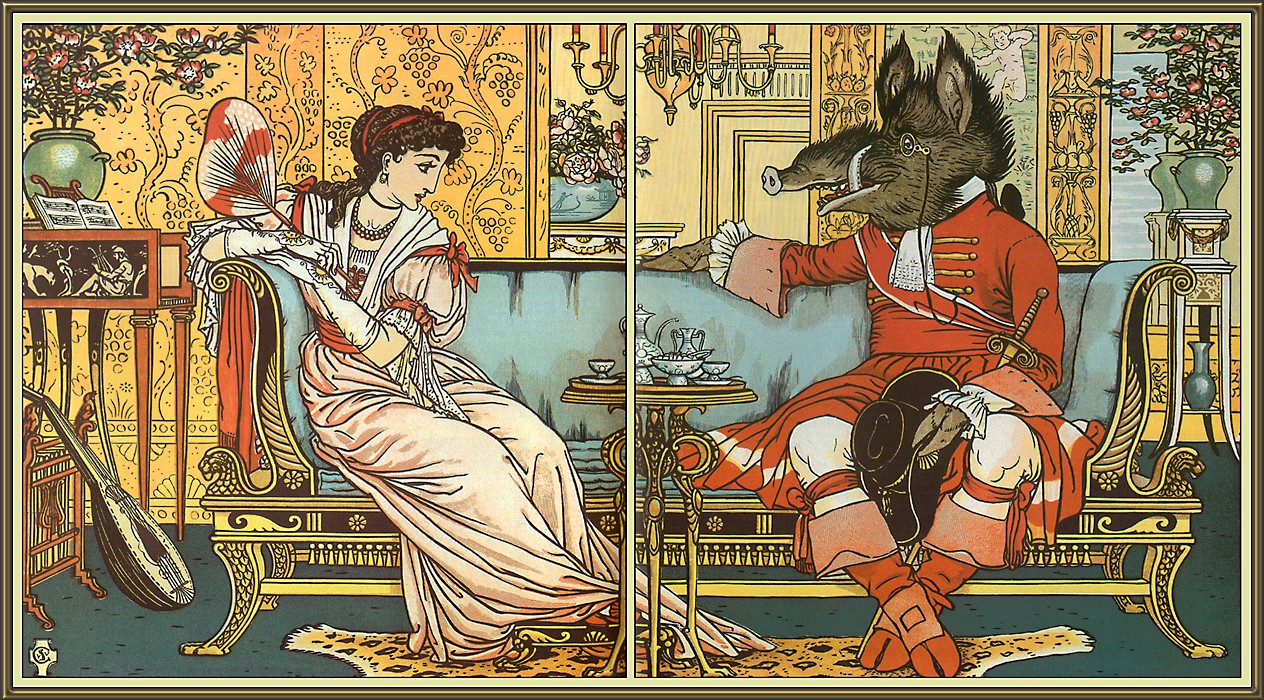
| By Walter Crane |
The Power of Friction
Besides subject matter, how do these dualities make for compelling story telling? By playing with expectations, misleading, and deceiving. Building on or creating audience expectations allows the story-teller to establish rapport, build comfort, and then question or shock them. They are an important element of surprise. Dualities are great also great for ambiguity, which creates mystery and builds tension. In these ways, they make for great drama. From a structural side, this should not be surprising, since narrative theory tends to reveal story's structures as opposing sets of conflicting parties, problem and solution, rising and falling tension, etc.
I leave much untouched here, of course. This story is a great way to explore gender anxieties, and if Jung is right, then it is an expression of and magnet for women's animus issues and men's anima issues. (See the illustration of Jung's view of the Self from below. For more on the transgendered region of our unconscious, see here and here.)
I'll leave you with an image from my childhood*: the moment that Beauty finds the Beast collapsed. It has received many touching renditions, for more, start in the Beauty and the Beast illustration gallery at SurLaLune.
![]() |
| by Warwick Goble |
Subscribe to:
Posts (Atom)