

 |
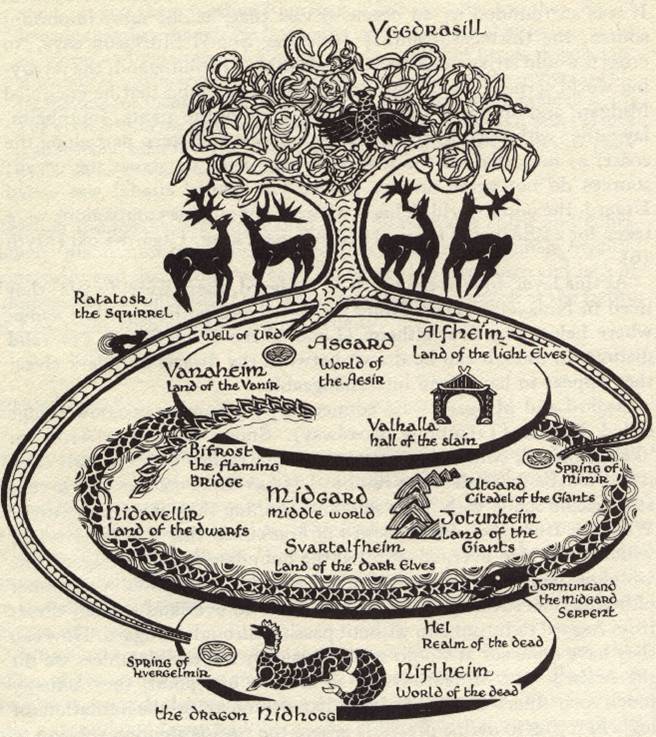
| Link: A Collection of Attempts to Diagram the Norse Cosmology |
There is uncertainty about the origin and meaning of the name of the Norse world tree. The dominant hypothesis at the moment seems to be that it means "Ygg's horse"; Ygg being another name for Odin meaning "terror" or "terrible one". The name may be intended to be a colorful term for gallows. The tree seems to be either an ash or a yew. This gives rise to a particularly grim thought: If the name of the world tree is Terror's Gallows, it seems that the nine worlds were hung there to die. This fits nicely with the conception that all these worlds are temporary, to be destroyed on the day of Ragnarok in the final battle.
Here's a quick review of the Nine Worlds, by Norse name, as I have begun to organize them.
- Ásgarð – Home of one group of gods, the Aesir, and their hall for heroes
- Vanaheim – Home of another group of gods, the Vanir.
- Álfheim – Home of the elves
- Miðgarð – Plane of humanity and mundane beings
- Jötunheim – Home of the giants
- Svartálfaheim (or Niðavellir) – Home of the dwarves and lower faeriedom
- Hel – Home of the Dead
- Niflheim – Plane of Water
- Muspellsheim – Plane of Fire
Let's start with the three upper worlds. I like the idea that the elves are other-worldly, and that they are an alien presence in the middle world of men. Drawing from the old D&D books, I will take the idea of alignment, and particularly of a conflict between Law and Chaos (thank you, Michael Moorcock!) I like the pulpy feel that this can give a setting. This has the advantage here of fitting with two different groupings of gods in Norse cosmology, the Aesir and the Vanir, the latter who had been largely displaced by the time of our sources, who at one time warred. A lot of folks identify elves with Chaos, so that would leave gods of Law and gods of Neutrality or Balance. I would go in another direction, however, and identify the Elves as the beings of Neutrality/Balance in a struggle between the Law-beings, centered on a renamed Asgard (Loggard? Ullgard or Ullurgard?) and the Chaos-beings, centered on Freehome (or a requisitioned and similarly renamed Vanaheim). The Law-beings have obviously succeeded in appealing to humans, promising their heroic allies a place of reward in an afterlife hall of the brave. I also want to resist the equation of Law with Good and Chaos with Evil, and keep morality and righteousness as potential separate issues from this struggle.
Middle world is dominated by humans, but also the crux in the struggle between the two opposing alignments of higher beings. This decision is good for adventuring. Initial research suggests that "gard" means "farm." Is farming a part of what distinguishes Midworld from the surrounding realms? On the edge of Midworld is Giantdom. Are the mountains the home of the giants? The barrier against giants or humans? Or do the mountains just get progressively higher and more inhabited by bigger giants?
The sixth realm is starting to look like a problem to me. Let's just call it Faerie. Clearly, it's related to Elfhome in the Overworld. Let's take the old idea that elves can't be resurrected, but that they can be reincarnated. Is it a cycle? Is there a progression, like in Hinduism? Are elves the top of the fae reincarnation ladder? This seems likely to me. Maybe some elves have abandoned the cause of Balance or maybe that is something they have to evolve towards, and that when they finally attain it, they becomes elves. Does this lower Faerie fit as part of the Underworld? Or should it become part of the Middleworld? If it is a part of the former, then that gives a reason for elves to be visitors to Middleworld: to help guide their less evolved kin toward Elfhome. I think I like this idea, plus the symmetry of three levels and three realms in each is nice. Up to this point, I have not dealt with where halflings would fit in this setting. As it is developing, I wonder if it wouldn't be better to drop some of the Tolkienesque associations and make them a fae race. Otherwise, they are farmers and more like little humans. It is possible, of course to have a mundane, miniature human race. One could look to pygmy peoples and the mythological portrayals of them for further inspiration.
I have already given the Underworld the most extensive treatment, so let's step back and see how things look at this point, and let's start by strengthening the three tiers and drop the divisions of worlds between them:
The Overworld: The Dominion of Law, the Fields of Freedom, Elfhome.
The (Middle) World: The Cultivated Lands of Man, The Uncultivated Lands of Faerie, The Giant March. As I describe it so, I begin to think that the giants and the Chaos-beings are in league: on the side of Chaos to minimize access of Law, on the giants' side to have an opportunity to enslave the smaller races.
The Underworld: In this setting, the Underworld is largely of primordial elements, the main exception being the realm of the dead. An important question to address next would be, to what extent does the struggle between Law and Chaos extend to the Underworld, and how do the three realms below fit in it? Are the dead unaligned? Are the other two realms internally divided into camps of Law and Chaos? Fire giants and hellhounds (L) versus Efreet, Salamanders, and Red Dragons (C), for example?
Ygg's Tree
As I look back over the experimental structure delineated so far, I wonder if more could be made of the image of the tree. In what way could we now go back and view the Overworld in terms of the canopy, Middle World as the trunk, and the Underworld as the roots? By a continual process of zooming in and dealing with very concrete details and zooming out to see how things are coming together in the big picture, I keep returning to what is accounted for, and what is left to be accounted for. In this way, questions multiple. Are clerics both of Law and of Chaos? In this setting, should they turn different kind of outsiders based on their alignment? Where does magic come from? Is it a feature of the Tree itself? Should treants (=ents) and dryads be given special treatment in this setting? Maybe the fae races were the original races of this world before some outer power chose it as a prison for these warring factions of Law and Chaos. Is this outer power Ygg? Or is Ygg the original of the fae races? I like the pulpy feel of the name, Ygg. Maybe this universe should be called Ygg's Tree. Maybe when one looks up from Middle World at night, instead of seeing the Milky Way, one see a nebula that looks like the foliage of a celestial tree, giving the tree identification a visual focus. In the threefold world of Ygg, an intelligent race of tusked, magical caprids discuss philosophy, while in the mountains, clerics call yetis to protect their shrines against the ravages of marauding giants...
 |
| See Collection Linked Above |


