Showing posts with label Jung. Show all posts
Monday, December 19, 2011
What is Victoria's Secret?
My most popular post of all time has been, for some time, Z is for Zoomorphic Angels. I suspect that there is more than one reason for this, but around the time of the Victoria's Secret TV special a few weeks back and forward, some of the most popular searches that find my blog are various searches for Victoria's Secret angels. So, here I go being all opportunistic, by posting late on this Mythopoeic Monday on the Secret.* Now, the appeal of heavenly bodies, such as Lily Donaldson's pictured above is no secret at all, is it? Isn't everything rather on display? Where's the secret?
I do not think that the intuition or instinct reflected in the name of what surely must be the most successful lingerie company in the world is off, at all. The opposite sex has always represented some irreducible mystery, whichever gender one is. Mona Lisa's smile has become a symbol of the mystery that women represent to men. Jung theorized that men and women both have a transgendered aspect in their psyches (the anima in men and the animus in women) that correspond to the opposite sex -- an aspect buried in their individual unconscious.
Few things garner interest like a secret. Children who were lucky enough to read E.L. Konigburg's From the Mixed-up Files of Mrs. Basil Frankweiler were treated to an extended exploration of the value of a secret. It is something that we are driven to uncover, and yet, may also be driven to hide from others. The feeling that we share a secret binds us to another and heightens our own sense of interiority. In the second chapter of the Apocalypse (Revelation), Christ promises to give those who are faithful from Pergamum a white stone with their secret name written on it. Value is based on rarity, and what is rarer than a secret? If knowledge is power, then knowledge of a secret is power of a greater degree.
Mystery novels and shows do not seem to have lost their popularity over the years. In recent times, conspiracy theories have exploded in popularity. The element of secrecy is sure to increase interest and dramatic tension in any story or game. But I think that there is an element of depth, of mystery, that must be present in the best secrets. The idea I am trying to get across here goes back to my use of the Victoria's Secret angel. We looked at her and I dared to say, isn't it all on display? No. The mode of revelation covers even as it uncovers. Disclosures are always partial. We are shown enough to know something, to feel the pull of something, to identify a presence, but the presence is also an absence. There is a hint of something more. If a secret is so shallow that it may be revealed in a single proposition or a single glance, then the secret is consumed in its entirety. Not so the deeper things, which is what our plots should strive for. Knowing how to include human mystery -- or even mystery that is somehow deeper than humanity -- in a plot's secret is the way to hold interest with a richness that draws but is never fully exhausted or realized. Perhaps that is part of Victoria's Secret. By giving the models the wings of celestial beings, their transcendence is symbolized, so that suggesting that they are not women emphasizes their womenhood: that there is an attracting secret of the feminine that can never be fully known or possessed, even in the knowing and possessing. The display tantalizes with its revelation, and by revealing, reminds us of what is covered, and of the fact that howsoever much one may discover, there will always be something more.
* I'm behind because the last week of the semester was as one would expect.
Monday, August 1, 2011
The Ouroboros
The image of a serpent (snake or dragon) with its tail in its mouth is ancient, pervasive, and arresting. Frankly, it's also one of my favorites. The serpent itself is popular in symbolism in its own right, but something about the ouroboros makes it stand out. While obviously the circle itself is suggestive and useful, I propose moreover that it is because the ouroboros introduces an irreducible ambiguity that creates tension and narrative.
The Rub: what is the serpent doing? The Greek name of the symbol tells us literally that "he eats the tail."
But is the serpent eating his own tail?
Why would the serpent be eating itself? Is it an expression of the death wish? The greed or gluttony which consumes itself? Total Self-Sufficiency (or the futility of the notion)?
Certainly, the alchemists were attracted to this symbol (as were Hermeticists and Gnostics) from time of the second century Chrysopoeia ("Gold Making") of Cleopatra, and so it was reproduced throughout the Middle Ages. In the version in the Chrysopoeia, it is accompanied by the Greek inscription, "One is All." Yet, the failure of the attempt to transmute base metals into gold by discovering the quintessence, the philosopher's stone, can't help but cast such proclamations in a futile light. For the quest to have value, once must spiritualize alchemy as Jung and his followers have.
In contemporary tales of alchemy (see the Full Metal Alchemist and FMA: Brotherhood franchise of manga and anime), the symbol might implicitly indicate the tendency of the state to consume the people it uses as weapons and the fundamental ambivalence of power, in contrast to a principle of equivalent exchange. If the state destroys all its members in the perpetuation of itself, where then is the state?
One final note: if a snake does mistake it's own tail for a meal, the results are disastrous for it apart from human intervention. If human beings had come across such a snake in an ancient context, the primitive mind would have likely latched on to such a prodigy as a potent omen. There is at least one more good candidate in nature for the inspiration behind the ouroboros.
Or is he curling up and holding on?
There is a species of lizard in Africa that has adapted a peculiar antipredator behavior:
So the serpent might be protecting itself, rather than engaging in autosarcophagy. Inscribing something inside the serpent might, however suggests that serpent is protecting something else. Or is it? One of the most common instances of the encircling serpent is the Midgard serpent of Norse lore. Jörmungandr is usually understood as threatening the world with an encirclement of doom. Are we trapped? Will we be crushed? But beside a native hostility to the snake, the encirclement might be an embrace rather than assault. Perhaps he girds us to guard us.
Or is he shedding his skin?
The snake's shedding of his skin seems to have fired the human imagination early on. Does he go on shedding his skin, renewing his youth, ever-growing and ever-living? Oh for the power that we might do so! So it seems that some have latched onto the ouroboros as a symbol of reincarnation, eternal life, or related concepts. I don't know that any snake actually engages in biting the tail to assist itself in moulting, but the ancients may well have thought as much. It fits with the circle as a symbol of infinity or eternity.
Ultimate Ambivalence
Finally, the ambivalence of the ouroboros symbol calls to mind another serpent symbol. There is a serpent encircling a tree. How do know it is the serpent tempting you to disobedience, forbidden knowledge, and death? What if your knee-jerk identification of the serpent as Satan mislead you from the appearance of Christ on his cross (Nehushtan*)? Is this the wise serpent that poisons or that saves?
Until the next time our rambles cross, I wish you a merry Mythopoeic Monday!
*Numbers 21:4-9; John 3:14-15. Cf. the rod of the healer Aesculapius.
The Rub: what is the serpent doing? The Greek name of the symbol tells us literally that "he eats the tail."
But is the serpent eating his own tail?
Why would the serpent be eating itself? Is it an expression of the death wish? The greed or gluttony which consumes itself? Total Self-Sufficiency (or the futility of the notion)?
Certainly, the alchemists were attracted to this symbol (as were Hermeticists and Gnostics) from time of the second century Chrysopoeia ("Gold Making") of Cleopatra, and so it was reproduced throughout the Middle Ages. In the version in the Chrysopoeia, it is accompanied by the Greek inscription, "One is All." Yet, the failure of the attempt to transmute base metals into gold by discovering the quintessence, the philosopher's stone, can't help but cast such proclamations in a futile light. For the quest to have value, once must spiritualize alchemy as Jung and his followers have.
In contemporary tales of alchemy (see the Full Metal Alchemist and FMA: Brotherhood franchise of manga and anime), the symbol might implicitly indicate the tendency of the state to consume the people it uses as weapons and the fundamental ambivalence of power, in contrast to a principle of equivalent exchange. If the state destroys all its members in the perpetuation of itself, where then is the state?
One final note: if a snake does mistake it's own tail for a meal, the results are disastrous for it apart from human intervention. If human beings had come across such a snake in an ancient context, the primitive mind would have likely latched on to such a prodigy as a potent omen. There is at least one more good candidate in nature for the inspiration behind the ouroboros.
Or is he curling up and holding on?
There is a species of lizard in Africa that has adapted a peculiar antipredator behavior:
![]() |
| Armadillo Lizard (Cordylus cataphractus). Photo by Cindy Shuttleworth |
Or is he shedding his skin?
The snake's shedding of his skin seems to have fired the human imagination early on. Does he go on shedding his skin, renewing his youth, ever-growing and ever-living? Oh for the power that we might do so! So it seems that some have latched onto the ouroboros as a symbol of reincarnation, eternal life, or related concepts. I don't know that any snake actually engages in biting the tail to assist itself in moulting, but the ancients may well have thought as much. It fits with the circle as a symbol of infinity or eternity.
Ultimate Ambivalence
Finally, the ambivalence of the ouroboros symbol calls to mind another serpent symbol. There is a serpent encircling a tree. How do know it is the serpent tempting you to disobedience, forbidden knowledge, and death? What if your knee-jerk identification of the serpent as Satan mislead you from the appearance of Christ on his cross (Nehushtan*)? Is this the wise serpent that poisons or that saves?
![]() |
| Sébastien Bourdon, Moses and the Brazen Serpent, 1653. The Prado, Madrid. |
Until the next time our rambles cross, I wish you a merry Mythopoeic Monday!
*Numbers 21:4-9; John 3:14-15. Cf. the rod of the healer Aesculapius.
Wednesday, April 20, 2011
Q is for Queenly Quest
No, I'm not just being cute, nor showing off that I can think of more than one Q word, nor kicking up my consonantal alliterating heels, nor suffering from the inability to choose a subject. I actually have something in mind here: multiple relationships between queens and quests, two classic mythopoeic elements, and if one puts any stock in Jungian theories, two archetypes in and of themselves. What are these combinations?
The Quest to find a Queen
Every king needs a queen, so goes the traditional assumption. It seems to be generally desirable that a king be of a providential temper, and so that he exercise forethought to have a queen-to-be at the ready before his ascension to the throne. Thus all the stories in history, legend, and literature about the prince finding a princess against the day that he takes on the crown and all that pertains thereunto. According to the global media reporting enthusiastically on upcoming nuptials between a certain William Mountbatten-Windsor and his fiancée Kate Middleton, I am lead to believe that such fairy-tale countries as the United Kingdom still observe this nicety. If Jane Austen had written fairy-tales, we might have had this: "It is a truth universally acknowledged, that a single prince in possession of a good kingdom must be in want of a princess." So Hans Christian Anderson gives us "The Princess and the Pea." The concern in this story is the test to identify a real princess. Is she the genuine article? Does she have the potential to become the queen? Perhaps princes are poor judges of such an important matter. Using the principle "it takes one to know one," the queen mother is the one who can discern the young lady who's got the right stuff, and the critical test of the pea underneath a score of mattresses neatly sorts the gentle lady from the look-a-likes. Whatever form the quest to find her takes, the queen is a figure highly desired, and finding her is something quest-worthy.
The Quest to become Queen
Your mind might first go to the all the historical stories of the strong women who set out to rule, but I have more in mind the young lady who sets out on her quest not knowing that it will end with a queenly crown. Maybe it's the extent I've been influenced by fairy-tale thinking, maybe it is just a personal preference or something about my own worldview. Often fairy-tale retellings end with the heart-shaped close-up of the happy couple and a Happily Ever After caption. This seems to me a practical necessity at best, and a damn shame at worst. Even if this the moment she becomes or is revealed to be a princess, this is just one initiation before the ultimate one. The heroine has yet to graduate to queen! I would like to explore the trials that the noble young woman overcomes to achieve her queenship.
The Quest on behalf of the Queen
I'd be willing to bet that this what comes to most people's minds first. My memory is dominated by scenes of favors and jousting, of Sir Lancelot du Lac riding to Guinevere's defense in trial by combat, and of Ivanhoe serving the same for Rebecca the Jewess. But even when queens don't need saving, they are first and foremost a medieval Lady and therefore have a Knight who goes forth at her bidding (see the code of courtly love). I'm tempted to speculate about how women could improve their life and the life of their husbands based on exalting the Honey Do list, but I think I shall steer back towards safer waters. One cool thing about the latest Alice in Wonderland film was seeing Alice appear as the White Queen's Champion.
The Queen going on a Quest
This would seem to be the rarest of all. I'd love to hear of examples people may have of the queen going questing, but all I can think of is Amidala in Star Wars Episode I. First, a queen has to change into a more practical questing outfit, obviously.
As Jungian Archetypes
If the Jungian take is correct, the Queen represents the fully individuated, fully realized female self. She is the embodiment of the ideals and virtues of female wisdom and power, of female maturity and achievement. In other words, she is the goal of the ultimate, lifelong quest for a woman. (Individuation or self-actualization is the quest itself.) That she is worthy of the quest, whether to find her or become her, that she is worthy to command quests in which she takes various parts, is obvious upon accepting this view of her. Perhaps the strong tradition of female domesticity counteracts having lots of stories of the queen going questing herself, but I expect that this will change, if it hasn't already. I mean, who's going to stop her?
- The Quest to find a Queen.
- The Quest to become Queen.
- The Quest on behalf of the Queen.
- The Queen going on a Quest.
![]() |
| Illustration by Edmund Dulac |
The Quest to find a Queen
Every king needs a queen, so goes the traditional assumption. It seems to be generally desirable that a king be of a providential temper, and so that he exercise forethought to have a queen-to-be at the ready before his ascension to the throne. Thus all the stories in history, legend, and literature about the prince finding a princess against the day that he takes on the crown and all that pertains thereunto. According to the global media reporting enthusiastically on upcoming nuptials between a certain William Mountbatten-Windsor and his fiancée Kate Middleton, I am lead to believe that such fairy-tale countries as the United Kingdom still observe this nicety. If Jane Austen had written fairy-tales, we might have had this: "It is a truth universally acknowledged, that a single prince in possession of a good kingdom must be in want of a princess." So Hans Christian Anderson gives us "The Princess and the Pea." The concern in this story is the test to identify a real princess. Is she the genuine article? Does she have the potential to become the queen? Perhaps princes are poor judges of such an important matter. Using the principle "it takes one to know one," the queen mother is the one who can discern the young lady who's got the right stuff, and the critical test of the pea underneath a score of mattresses neatly sorts the gentle lady from the look-a-likes. Whatever form the quest to find her takes, the queen is a figure highly desired, and finding her is something quest-worthy.
![]() |
Victoria, Queen of Great Britain and Ireland in the Robes of State by Franz Xavier Winterhalter, 1859 |
Your mind might first go to the all the historical stories of the strong women who set out to rule, but I have more in mind the young lady who sets out on her quest not knowing that it will end with a queenly crown. Maybe it's the extent I've been influenced by fairy-tale thinking, maybe it is just a personal preference or something about my own worldview. Often fairy-tale retellings end with the heart-shaped close-up of the happy couple and a Happily Ever After caption. This seems to me a practical necessity at best, and a damn shame at worst. Even if this the moment she becomes or is revealed to be a princess, this is just one initiation before the ultimate one. The heroine has yet to graduate to queen! I would like to explore the trials that the noble young woman overcomes to achieve her queenship.
![]() |
| Miniature of George Clifford, 3rd Earl of Cumberland, the Queen's Champion, by Hilliard, c. 1590. |
I'd be willing to bet that this what comes to most people's minds first. My memory is dominated by scenes of favors and jousting, of Sir Lancelot du Lac riding to Guinevere's defense in trial by combat, and of Ivanhoe serving the same for Rebecca the Jewess. But even when queens don't need saving, they are first and foremost a medieval Lady and therefore have a Knight who goes forth at her bidding (see the code of courtly love). I'm tempted to speculate about how women could improve their life and the life of their husbands based on exalting the Honey Do list, but I think I shall steer back towards safer waters. One cool thing about the latest Alice in Wonderland film was seeing Alice appear as the White Queen's Champion.
![]() |
| Queen Amidala of Naboo, property of Lucasfilm Ltd. |
This would seem to be the rarest of all. I'd love to hear of examples people may have of the queen going questing, but all I can think of is Amidala in Star Wars Episode I. First, a queen has to change into a more practical questing outfit, obviously.
As Jungian Archetypes
If the Jungian take is correct, the Queen represents the fully individuated, fully realized female self. She is the embodiment of the ideals and virtues of female wisdom and power, of female maturity and achievement. In other words, she is the goal of the ultimate, lifelong quest for a woman. (Individuation or self-actualization is the quest itself.) That she is worthy of the quest, whether to find her or become her, that she is worthy to command quests in which she takes various parts, is obvious upon accepting this view of her. Perhaps the strong tradition of female domesticity counteracts having lots of stories of the queen going questing herself, but I expect that this will change, if it hasn't already. I mean, who's going to stop her?
Saturday, April 2, 2011
B is for Beauty and the Beast
![]() |
| by Allen Douglas |
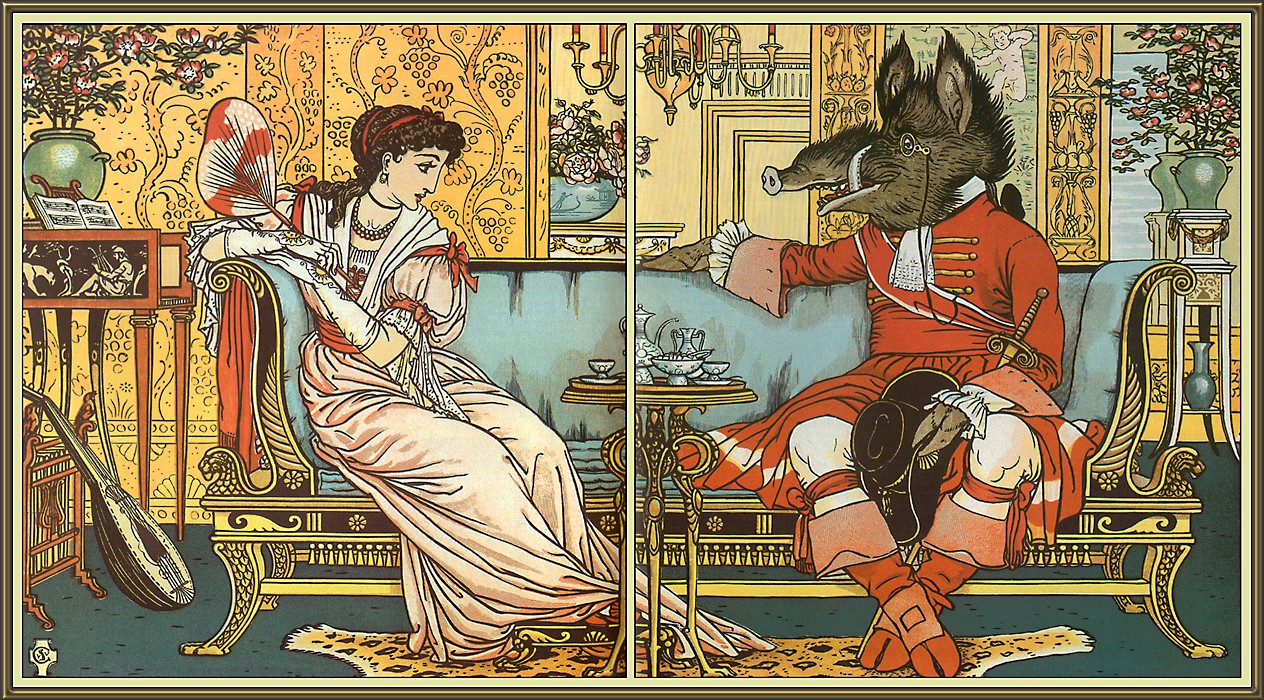
The fairy tale Beauty and the Beast (or La Belle et la Bête) is one of the traditional fairy tales that everyone knows. It has had the mixed blessing of being made into a film by the Walt Disney Co., so while it would be difficult now to find anyone unfamiliar with the story, their imaginations will be dominated by one version of it and by Disney-style animation to the almost exclusion of the rich tellings and imaginings that proceeded it.
The power of the tale lies in its treating themes of duality, a subject already raised in this blog. But what makes Beauty and the Beast stand out is that it layers duality on top of duality:
- Beauty vs. Ugliness
- Humanity vs. Beastliness
- External Appearance vs. Interior Reality
- Female vs. Male
- Revulsion vs. Love
- Safety vs. Danger
Mad, Bad, and Dangerous to Know?
Beauty and the Beast is one of those fairy tales that raises feminist concerns. I know of no way to satisfactorily quantify this, but I bet we all know far more women who have tried to tame the beast to their sorrow than we know men who can say the curse was lifted from them by the love of a good woman. First, I would want to urge a truth that is often lost in these kinds of discussions: something that is powerfully destructive is, first of all, powerful. As long as something is not inherently evil, its power to work harm could just as well be turned to work weal. Throwing away something that is powerful just because it is powerful is reactionary and short-sighted. While anything powerful is dangerous, it is equally beneficent, given the right use. Retrievals and reinterpretations are the way to go. Further, taking a lesson from the tale itself, layering and opposing these multiple versions are more entertaining and enjoyable, as well as the means to harness its power for good and ameliorate harmful effects.
![]() |
| By Walter Crane |
The Power of Friction
Besides subject matter, how do these dualities make for compelling story telling? By playing with expectations, misleading, and deceiving. Building on or creating audience expectations allows the story-teller to establish rapport, build comfort, and then question or shock them. They are an important element of surprise. Dualities are great also great for ambiguity, which creates mystery and builds tension. In these ways, they make for great drama. From a structural side, this should not be surprising, since narrative theory tends to reveal story's structures as opposing sets of conflicting parties, problem and solution, rising and falling tension, etc.
I leave much untouched here, of course. This story is a great way to explore gender anxieties, and if Jung is right, then it is an expression of and magnet for women's animus issues and men's anima issues. (See the illustration of Jung's view of the Self from below. For more on the transgendered region of our unconscious, see here and here.)
I'll leave you with an image from my childhood*: the moment that Beauty finds the Beast collapsed. It has received many touching renditions, for more, start in the Beauty and the Beast illustration gallery at SurLaLune.
![]() |
| by Warwick Goble |
Friday, April 1, 2011
A is for the Archetypes, April Fool, and Apollo
Welcome to the first installment of the 26 alphabetic entries of April! Today's post will deal with two different archetypal figures, Apollo and the April Fool.
A Note on Archetypes
The concept of archetype is older than its Jungian developments. Even if you don't buy-in to much of Jung, there is a strength, a primal-ness, and ubiquity of certain images, and this what I am looking to trade on. I won't be worrying so much about the Jungian category that these images fit in (which archetype or blending of archetypes they are) as much as reflecting and playing with the images themselves. I think tropes (in the sense of the addictive TVTropes, click on link below at your own peril) are a good sign that we are likely dealing with the expression of something archetypal, with something that has some serious symbolic heft.
Apollo
The Greek solar god suggests the Self as it blazes in power and the will, but this is desire civilized and cultivated, guided by the light of the intellect and giving light and warmth to all those so blessed to be in its orbit. The Intellect is in the driver's seat of this chariot, carrying a cargo of knowledge, truth, oracular prophecy, medicine and health, music, poetry, and the arts, herding and colonial settlement, youth and athleticism. Many are the gifts of this bright god, but they generally burn beneficently and not out of control. (Negative scenes are not unknown, but there is a strong tendency to shift such things away from Apollo and towards Dionysios, the god of ecstasy, drunkenness, and madness: the desires let loose. This is certainly evident in Nietzsche and Jung. Cf. my post below on duality) Apollo thus is the expression of many ideals of classical Greece and was later adopted at the dawn of France's obsessive classicism by Louis XIV, the sun king. Even when not named, the anthropomorphized sun is a popular and persistent image. In this part of the United States, its popularity in Hispanic contexts is especially evident.
April Fools
I'm struck by the solar imagery in the popular Rider-Waite Tarot card of The Fool. This fair-haired youth, resplendently arrayed, is walking the path of doom, oblivious to danger and warning. While not all those who wander are lost, the Fool obviously is. But what of the solar imagery? The golden youth, decked with laurels, his head in the clouds we see above clearly has solar elements of his own. Is this a comment on the follies possible for the extreme Apollonian? That one could dwell in one's head, in the realm of ideals, so much that one loses touch with earthly realities?
If that is one kind of fool, I don't see the connection with April Fools Day. We are faced with a problem right away: Who is the April Fool? Is she the person oblivious to the schemes of the merry prankster or is he the obnoxious prankster himself, who observes the day by trying to trick people all day long with outrageous and even humiliating pranks? It might be an interesting normative dilemma, but I'm going to resolve it by distinguishing between the Fool who Pranks as the Trickster and the Fool who is Pranked, calling the latter the April Fool. Dwelling in himself, the April Fool is insensitive to external realities that are unimportant to him. He knows the date, but that the trickster is operative on this date is not duly weighed. He doesn't see the trickster coming, and he is oblivious to the setup of the prank. Someone has cut down the rope bridge at the mountainous chasm, but the Fool doesn't look. Is he contemplating the reflective glory of Apollo in the vault of the mind or the vault of the sky? Again, I don't think, most April Fools are so Apollonian. They are focused actually on practical matters at hand like the yawning chasm in front of them. Season aside, April Fools are apt to look more like this:
The April Fool thinks the dog, if there is one, is barking a warning -- a warning it doesn't need to pay attention to because he's already hard at work on the case of the chasm. He doesn't realize the barking is to lull him into forgetting about the dog as an important factor. This will allow the dog to time its move perfectly, whether leaping at his back when AF is precariously balanced, or doing a run under the feet and tripping AF. Hilarious! barks the dog. I never saw it coming until it was too late, bemoans the April Fool.
What I've been groping towards is a distinction between the April Fool and the Apollonian Fool. The distinction comes down to this: while the Apollonian Fool doesn't need a Trickster to fall off the mountain, the April Fool isn't a fool until the Trickster makes her into a fool. The April Fool's is made a fool by someone else. This is different from a kind of Apollonian autism or absent-minded professorship.
Apollo is a big help, but not a big help when it comes to dealing with the Trickster. Baby Hermes shakes him up one side and down the other. Come to think of it, Apollo himself is more of an April Fool than an Apollonian Fool. The difficulty is not being distracted, but of dealing with a master manipulator. Apollo is fine as long as people are honest and is only in trouble when the smooth Trickster shows up and sets to work. This is all starting to sound like cautionary tale for April and Apollonian Fools, so lest we forget, these fools are normally very happy folks...until they fall off the mountain in the case of the Apollonian Fool or are pushed off of the mountain in the case of the April Fool.
Whatever way you go, I wish you all joy of your archetypes, a happy April, and happy Abecedaries!
A Note on Archetypes
The concept of archetype is older than its Jungian developments. Even if you don't buy-in to much of Jung, there is a strength, a primal-ness, and ubiquity of certain images, and this what I am looking to trade on. I won't be worrying so much about the Jungian category that these images fit in (which archetype or blending of archetypes they are) as much as reflecting and playing with the images themselves. I think tropes (in the sense of the addictive TVTropes, click on link below at your own peril) are a good sign that we are likely dealing with the expression of something archetypal, with something that has some serious symbolic heft.
![]() |
| Image by Willem den Hertog |
Apollo
The Greek solar god suggests the Self as it blazes in power and the will, but this is desire civilized and cultivated, guided by the light of the intellect and giving light and warmth to all those so blessed to be in its orbit. The Intellect is in the driver's seat of this chariot, carrying a cargo of knowledge, truth, oracular prophecy, medicine and health, music, poetry, and the arts, herding and colonial settlement, youth and athleticism. Many are the gifts of this bright god, but they generally burn beneficently and not out of control. (Negative scenes are not unknown, but there is a strong tendency to shift such things away from Apollo and towards Dionysios, the god of ecstasy, drunkenness, and madness: the desires let loose. This is certainly evident in Nietzsche and Jung. Cf. my post below on duality) Apollo thus is the expression of many ideals of classical Greece and was later adopted at the dawn of France's obsessive classicism by Louis XIV, the sun king. Even when not named, the anthropomorphized sun is a popular and persistent image. In this part of the United States, its popularity in Hispanic contexts is especially evident.
April Fools
I'm struck by the solar imagery in the popular Rider-Waite Tarot card of The Fool. This fair-haired youth, resplendently arrayed, is walking the path of doom, oblivious to danger and warning. While not all those who wander are lost, the Fool obviously is. But what of the solar imagery? The golden youth, decked with laurels, his head in the clouds we see above clearly has solar elements of his own. Is this a comment on the follies possible for the extreme Apollonian? That one could dwell in one's head, in the realm of ideals, so much that one loses touch with earthly realities?
If that is one kind of fool, I don't see the connection with April Fools Day. We are faced with a problem right away: Who is the April Fool? Is she the person oblivious to the schemes of the merry prankster or is he the obnoxious prankster himself, who observes the day by trying to trick people all day long with outrageous and even humiliating pranks? It might be an interesting normative dilemma, but I'm going to resolve it by distinguishing between the Fool who Pranks as the Trickster and the Fool who is Pranked, calling the latter the April Fool. Dwelling in himself, the April Fool is insensitive to external realities that are unimportant to him. He knows the date, but that the trickster is operative on this date is not duly weighed. He doesn't see the trickster coming, and he is oblivious to the setup of the prank. Someone has cut down the rope bridge at the mountainous chasm, but the Fool doesn't look. Is he contemplating the reflective glory of Apollo in the vault of the mind or the vault of the sky? Again, I don't think, most April Fools are so Apollonian. They are focused actually on practical matters at hand like the yawning chasm in front of them. Season aside, April Fools are apt to look more like this:
![]() |
| Image by Charles M. Schulz |
What I've been groping towards is a distinction between the April Fool and the Apollonian Fool. The distinction comes down to this: while the Apollonian Fool doesn't need a Trickster to fall off the mountain, the April Fool isn't a fool until the Trickster makes her into a fool. The April Fool's is made a fool by someone else. This is different from a kind of Apollonian autism or absent-minded professorship.
Apollo is a big help, but not a big help when it comes to dealing with the Trickster. Baby Hermes shakes him up one side and down the other. Come to think of it, Apollo himself is more of an April Fool than an Apollonian Fool. The difficulty is not being distracted, but of dealing with a master manipulator. Apollo is fine as long as people are honest and is only in trouble when the smooth Trickster shows up and sets to work. This is all starting to sound like cautionary tale for April and Apollonian Fools, so lest we forget, these fools are normally very happy folks...until they fall off the mountain in the case of the Apollonian Fool or are pushed off of the mountain in the case of the April Fool.
Whatever way you go, I wish you all joy of your archetypes, a happy April, and happy Abecedaries!
Thursday, March 31, 2011
April is the Cruelest Month for Lazy Bloggers
...and perhaps for overtaxed readers.
I have accepted the A to Z Blogging Challenge for April 2011 (see badge in the right side panel). This means I will be blogging on subjects, and often a confluence of subjects, according to the alphabet and my mythopoeic interests each day of April, Sundays excluded. I've had a loose plan in place for almost a month (it's tighter in some places), but I might consider reader requests if I get them with enough lead time and they strike my fancy.
What is he rambling on about?
Maybe this is a good time to say what I consider the (rather rambling, of course) territory of my blog: anything that touches on mythic themes or features. Art, music, literature, religion, philosophy, psychology, popular culture -- I don't consider anything out of bounds if I think I can find grist there for my blogging mill. They might be right out there in the open or hiding in the nooks and crannies, but if I see them and I can use them to pull a reflection together, you can hear my thoughts on them. While I write them on one level for the joy of my own exploration and talk, I offer them here to contribute to your own cognizing or cloud-castle construction. I'm certainly interested in hearing readers thoughts on either my reflections or the objects, occasions, or excuses for my reflections, so feel free to comment. Over time, it will become clearer who my influences are, but let me name several biggies: Carl Jung, J. R. R. Tolkien, C. S. Lewis, G. K. Chesterton. Maybe Origen, Philo, and the Alexandrian tradition deserve a shout-out, too. I'll let you judge when it comes to T. S. Eliot. Does it depend on how obscure I truly am or whether you like Eliot? As a member of the guild of religious studies, I actually did my work in a more philosophical field, for those who are curious.
Mythopoeic?
Yeah, you know academic types. We love words. Especially special words. Words we make up are especially special (sorry though, most folks need a license to do this, unless you're Shakespeare or something). Mythopoeic means "having to do with myth-making," and thus applies to both the analysis and the creation of "lies breathed through silver tissue." Compelling lies that are sometimes also knowing and complex, of interest for the sake of the truths they may hide as well as the fun and satisfaction that they offer, are my aim. Maybe they offer fun and satisfaction because they're the truest lies of all.
Extra
Many years ago, when Jung was terra incognita to me, I watched Joseph Campbell's Mythos on PBS with a friend who had been in Jungian analysis for years. She drew me this handy little guide which I will now share with you. Maybe it will be of use to readers who are unfamiliar with Jung's view of the Self (the circular diagram in the middle of the page). I'll eventually see about getting a graphically savvy person to put it into a clearer format.
TOMORROW: April Fools and Apollo
I have accepted the A to Z Blogging Challenge for April 2011 (see badge in the right side panel). This means I will be blogging on subjects, and often a confluence of subjects, according to the alphabet and my mythopoeic interests each day of April, Sundays excluded. I've had a loose plan in place for almost a month (it's tighter in some places), but I might consider reader requests if I get them with enough lead time and they strike my fancy.
What is he rambling on about?
Maybe this is a good time to say what I consider the (rather rambling, of course) territory of my blog: anything that touches on mythic themes or features. Art, music, literature, religion, philosophy, psychology, popular culture -- I don't consider anything out of bounds if I think I can find grist there for my blogging mill. They might be right out there in the open or hiding in the nooks and crannies, but if I see them and I can use them to pull a reflection together, you can hear my thoughts on them. While I write them on one level for the joy of my own exploration and talk, I offer them here to contribute to your own cognizing or cloud-castle construction. I'm certainly interested in hearing readers thoughts on either my reflections or the objects, occasions, or excuses for my reflections, so feel free to comment. Over time, it will become clearer who my influences are, but let me name several biggies: Carl Jung, J. R. R. Tolkien, C. S. Lewis, G. K. Chesterton. Maybe Origen, Philo, and the Alexandrian tradition deserve a shout-out, too. I'll let you judge when it comes to T. S. Eliot. Does it depend on how obscure I truly am or whether you like Eliot? As a member of the guild of religious studies, I actually did my work in a more philosophical field, for those who are curious.
Mythopoeic?
Yeah, you know academic types. We love words. Especially special words. Words we make up are especially special (sorry though, most folks need a license to do this, unless you're Shakespeare or something). Mythopoeic means "having to do with myth-making," and thus applies to both the analysis and the creation of "lies breathed through silver tissue." Compelling lies that are sometimes also knowing and complex, of interest for the sake of the truths they may hide as well as the fun and satisfaction that they offer, are my aim. Maybe they offer fun and satisfaction because they're the truest lies of all.
Extra
Many years ago, when Jung was terra incognita to me, I watched Joseph Campbell's Mythos on PBS with a friend who had been in Jungian analysis for years. She drew me this handy little guide which I will now share with you. Maybe it will be of use to readers who are unfamiliar with Jung's view of the Self (the circular diagram in the middle of the page). I'll eventually see about getting a graphically savvy person to put it into a clearer format.
TOMORROW: April Fools and Apollo
Thursday, March 24, 2011
Archetypes of Duality: Janus, Haga, & Co.
"Two heads are better than one." An English proverb, in print by 1546.
two-faced
The Strict Janus Face vs. Other Two-Faces
The image above is a reproduction I own of a herm. Most herms appear to have been of Hermes, as the name would lead you to expect, and were blocks used as markers topped by a head scultpure (of Hermes or another figure) and were ithyphallic. The one I have is less usual, appearing at first to be an image of Janus. In fact, it is two different faces, however, rather than two identical Janus faces. Seemingly, this herm is Hermes on one side and Dionysios on the other.
What is the meaning of the Janus face? Most basically, it is a figure of duality. Moreover it is a doubling, an intensification. Janus, the Roman god of gates/doors, gives us the name for our gateway month: January. Thus he faces both sides of the gate. It is natural that Hermes would attract characteristics of Janus since he's the liminal god the Greeks, presiding over roads and travel, even travel between the world and the underworld. He shared the crossroads with Hecate.
Familiarity with the caduceus, or herald's staff (shown above) with the entwined snakes may call to mind a similarity with the Janus face, but these are two faces of two different snakes* facing one another: the role that a herald plays. Still, the intermediary character is present in both, if not the same degree of duality-in-unity.
But whereas the simple Janus-type gives Janus both the view one direction and the view the other, this herm gives Hermes the view one direction and Dionysos the other. Hermes plays an import role in the story of Dionysos, so perhaps this is the reason for the pairing. (If we knew the location of the original, this might shed further light.) Hermes, as psychopomp or Soul Guide, may be leading us from our world into the celebration of the Dionysian Mysteries. We still know little of these rites, and are left with later evidence and much speculation. But as Dionysos stood as savior figure to his devotees, it make sense that his own savior, who, among other things was the messenger of the gods and the guide of souls, would guide initiates into the ecstasies of the divine union.
What about "hypocritical, double-dealing, deceitful"? Why do we make this association rather than "two heads are better than one" in the case of Janus? One clue might be the fore noted fact that for Janus, they are the same face. But note the further character of Hermes: he's the god of thieves, and took up cattle-rustling almost immediately on birth, in his steps to becoming a full-blown wheeler-dealer. He's a classic example of the Trickster archetype. Dionysos, on the other hand, is the god of wine, which is well-known for its own deceitful effects, likely linked to his being the inspirer of divine madness.
The two-faced figure also makes an important appearance in another combination with Hermes: his son Hermaphroditos, which is half Hermes his father, half Aphrodite his mother (different versions of the story exist), the origin of our own term hermaphrodite. Representations of this figure, especially in alchemy, fascinated Jung as they fit his theory of a transgendered archetype in each personal unconscious, men's anima and women's animus. Here again, what's important is the difference, the compounding.
The Haga or Double-Headed Imperial Eagle
My fondness for this figure is seen in the Hittite blog entry (02-19-2011) and the heraldic shield by my name. The earliest known uses are Hittite, and they in the same region as the later center of the Roman Empire, Christianized and re-centered on Constantinople. Here the Romans pick up the image and make it their own, and it is from here that it spreads to the Holy Roman Empire in the West and its descendants, Imperial Russia (which called itself the third Rome), and the Seljuk Empire. It is given a single crown, emphasizing one Emperor and one Empire, though it faces both east and west. This was both geographical (the east-west axis was the longest and most important one for the Empire) and political (difficulty in holding together both halves of the Empire was not just a worry: eventually it produced two cultural-linguistic spheres and split the Imperial Church as well.
Now, Jung did know a version of the image that emphasizes compounding or hybrid, as opposed to duality-in-unity in its bi-directionality. Instead of one crown there were two and, unlike some representations with two identical crowns, there was a papal tiara on one head and the crown of the emperor on the other. Thus instead of representing East and West, it represented the spiritual and temporal powers of a (theoretically) united Christendom.
A Jungian Meditation
The figure of duality, with two identical faces or heads, faces two directions. It is one, and therefore a good candidate for an archetype of the Self. Having identified a Self that faces two directions, we now look for the identity of the two directions. The past and the future are good candidates, this would yield a figure of Wisdom that has learned the lessons of the past yet looks forward with foresight. But for a specifically Jungian meaning, the most obvious reference, in the absence of gender difference, is the Conscious and the Unconscious. A more awakened Self has larger vision than the Conscious Self, which faces out only into life through the Ego. The realization of Janus looks also back into the Unconscious, so that the Conscious Self is not dominated by unseen psychic forces. This is a particularly Jungian version of Wisdom, larger even than the temporal self. It is well represented by this kingly image:
This figure does not have the connotations of Dr. Jekyll and Mr. Hyde, the Wolfman, Two-Face, or the Norse goddess Hela -- the shadow, Jung might say, of the two-faced Self or the unintegrated hybrid or compound of two disparate selves or natures.
The divided figure: the negative usage or conception of the person with two faces is more prominent, so I will not dwell on it as long. Whenever we call someone "two-faced," we are not complementing them on their complexity. We have seen one face that we trust, and then learned to our sorrow that another personality just as real, if not more so, lurked out of sight which harmed us once we let down our guard.
How do we know the difference between the two kinds of figures on mere sight? Can one always tell the god from the monster? The healthy whole person from the pathologically divided person? Not all will always agree in concrete instances. For example, later history judges the Rome of the double-headed Eagle to be not the Roman Empire with its positive value of the two heads, but the Byzantine Empire, another beast all together, a grotesque and degenerate hybrid. So Edward Gibbon would have us believe, and therefore we find a derivative, negative usage of the adjective, byzantine:
4. often not capitalized a : of, relating to, or characterized by a devious and usually surreptitious manner of operation {a Byzantine power struggle} b : intricately involved : labyrinthine {rules of Byzantine complexity}
Merriam-Webster Dictionary, 2011.
While I may have picked up on some clues that will help in our visual discernment, more practical kinds of discernment will only improve with continued reflection and practice. The images that make a more obvious distinction for us may, however, give us points of reference for us to build on.
So What?
The potential of this powerful image, or images of its kind, for art, play**, and greater self-knowledge are rich. First, ask yourself, what kind of duality am I exploring? Is there a basic unity that seems most important? Or is the difference the most important? This will lead one to search for different types of images to contemplate and experiment with. Then, if you have a clear answer, you are ready to settle on images that fit the feature, idea, or value you are exploring, whether it is the threshold between two realms, two features of a single society, or a flaw or division in a character that has both creative and destructive potential, depending on how it is integrated into the conscious Self...or not. Exploring such characters, situations, representations, and themes will make ourselves and our creations deeper, more meaningful, and more likely to change for the better. After all, pairings are as important in action as they are in dining or color schemes.
*Although, perhaps two mating snakes.
** For attempts to use the Haga in a gaming context, see David Posener's concept of the Haga and Chris Mortika's attempt to stat it in Paizo's RPG Superstar 2010 contest.
two-faced
adj.
The American Heritage® Dictionary of the English Language, Fourth Edition copyright ©2000 by Houghton Mifflin Company. Updated in 2009. Published by Houghton Mifflin Company. All rights reserved.1. Having two faces or surfaces.
2. Hypocritical or double-dealing; deceitful.
The Strict Janus Face vs. Other Two-Faces
The image above is a reproduction I own of a herm. Most herms appear to have been of Hermes, as the name would lead you to expect, and were blocks used as markers topped by a head scultpure (of Hermes or another figure) and were ithyphallic. The one I have is less usual, appearing at first to be an image of Janus. In fact, it is two different faces, however, rather than two identical Janus faces. Seemingly, this herm is Hermes on one side and Dionysios on the other.
What is the meaning of the Janus face? Most basically, it is a figure of duality. Moreover it is a doubling, an intensification. Janus, the Roman god of gates/doors, gives us the name for our gateway month: January. Thus he faces both sides of the gate. It is natural that Hermes would attract characteristics of Janus since he's the liminal god the Greeks, presiding over roads and travel, even travel between the world and the underworld. He shared the crossroads with Hecate.
Familiarity with the caduceus, or herald's staff (shown above) with the entwined snakes may call to mind a similarity with the Janus face, but these are two faces of two different snakes* facing one another: the role that a herald plays. Still, the intermediary character is present in both, if not the same degree of duality-in-unity.
But whereas the simple Janus-type gives Janus both the view one direction and the view the other, this herm gives Hermes the view one direction and Dionysos the other. Hermes plays an import role in the story of Dionysos, so perhaps this is the reason for the pairing. (If we knew the location of the original, this might shed further light.) Hermes, as psychopomp or Soul Guide, may be leading us from our world into the celebration of the Dionysian Mysteries. We still know little of these rites, and are left with later evidence and much speculation. But as Dionysos stood as savior figure to his devotees, it make sense that his own savior, who, among other things was the messenger of the gods and the guide of souls, would guide initiates into the ecstasies of the divine union.
What about "hypocritical, double-dealing, deceitful"? Why do we make this association rather than "two heads are better than one" in the case of Janus? One clue might be the fore noted fact that for Janus, they are the same face. But note the further character of Hermes: he's the god of thieves, and took up cattle-rustling almost immediately on birth, in his steps to becoming a full-blown wheeler-dealer. He's a classic example of the Trickster archetype. Dionysos, on the other hand, is the god of wine, which is well-known for its own deceitful effects, likely linked to his being the inspirer of divine madness.
The two-faced figure also makes an important appearance in another combination with Hermes: his son Hermaphroditos, which is half Hermes his father, half Aphrodite his mother (different versions of the story exist), the origin of our own term hermaphrodite. Representations of this figure, especially in alchemy, fascinated Jung as they fit his theory of a transgendered archetype in each personal unconscious, men's anima and women's animus. Here again, what's important is the difference, the compounding.
The Haga or Double-Headed Imperial Eagle
My fondness for this figure is seen in the Hittite blog entry (02-19-2011) and the heraldic shield by my name. The earliest known uses are Hittite, and they in the same region as the later center of the Roman Empire, Christianized and re-centered on Constantinople. Here the Romans pick up the image and make it their own, and it is from here that it spreads to the Holy Roman Empire in the West and its descendants, Imperial Russia (which called itself the third Rome), and the Seljuk Empire. It is given a single crown, emphasizing one Emperor and one Empire, though it faces both east and west. This was both geographical (the east-west axis was the longest and most important one for the Empire) and political (difficulty in holding together both halves of the Empire was not just a worry: eventually it produced two cultural-linguistic spheres and split the Imperial Church as well.
Now, Jung did know a version of the image that emphasizes compounding or hybrid, as opposed to duality-in-unity in its bi-directionality. Instead of one crown there were two and, unlike some representations with two identical crowns, there was a papal tiara on one head and the crown of the emperor on the other. Thus instead of representing East and West, it represented the spiritual and temporal powers of a (theoretically) united Christendom.
A Jungian Meditation
The figure of duality, with two identical faces or heads, faces two directions. It is one, and therefore a good candidate for an archetype of the Self. Having identified a Self that faces two directions, we now look for the identity of the two directions. The past and the future are good candidates, this would yield a figure of Wisdom that has learned the lessons of the past yet looks forward with foresight. But for a specifically Jungian meaning, the most obvious reference, in the absence of gender difference, is the Conscious and the Unconscious. A more awakened Self has larger vision than the Conscious Self, which faces out only into life through the Ego. The realization of Janus looks also back into the Unconscious, so that the Conscious Self is not dominated by unseen psychic forces. This is a particularly Jungian version of Wisdom, larger even than the temporal self. It is well represented by this kingly image:
This figure does not have the connotations of Dr. Jekyll and Mr. Hyde, the Wolfman, Two-Face, or the Norse goddess Hela -- the shadow, Jung might say, of the two-faced Self or the unintegrated hybrid or compound of two disparate selves or natures.
The divided figure: the negative usage or conception of the person with two faces is more prominent, so I will not dwell on it as long. Whenever we call someone "two-faced," we are not complementing them on their complexity. We have seen one face that we trust, and then learned to our sorrow that another personality just as real, if not more so, lurked out of sight which harmed us once we let down our guard.
How do we know the difference between the two kinds of figures on mere sight? Can one always tell the god from the monster? The healthy whole person from the pathologically divided person? Not all will always agree in concrete instances. For example, later history judges the Rome of the double-headed Eagle to be not the Roman Empire with its positive value of the two heads, but the Byzantine Empire, another beast all together, a grotesque and degenerate hybrid. So Edward Gibbon would have us believe, and therefore we find a derivative, negative usage of the adjective, byzantine:
4. often not capitalized a : of, relating to, or characterized by a devious and usually surreptitious manner of operation {a Byzantine power struggle} b : intricately involved : labyrinthine {rules of Byzantine complexity}
Merriam-Webster Dictionary, 2011.
While I may have picked up on some clues that will help in our visual discernment, more practical kinds of discernment will only improve with continued reflection and practice. The images that make a more obvious distinction for us may, however, give us points of reference for us to build on.
So What?
The potential of this powerful image, or images of its kind, for art, play**, and greater self-knowledge are rich. First, ask yourself, what kind of duality am I exploring? Is there a basic unity that seems most important? Or is the difference the most important? This will lead one to search for different types of images to contemplate and experiment with. Then, if you have a clear answer, you are ready to settle on images that fit the feature, idea, or value you are exploring, whether it is the threshold between two realms, two features of a single society, or a flaw or division in a character that has both creative and destructive potential, depending on how it is integrated into the conscious Self...or not. Exploring such characters, situations, representations, and themes will make ourselves and our creations deeper, more meaningful, and more likely to change for the better. After all, pairings are as important in action as they are in dining or color schemes.
*Although, perhaps two mating snakes.
** For attempts to use the Haga in a gaming context, see David Posener's concept of the Haga and Chris Mortika's attempt to stat it in Paizo's RPG Superstar 2010 contest.
Friday, February 4, 2011
Texans, Gods, and Monsters
Carl Jung believed that certain symbols had archetypal power, and that they were a part of the mind's imaginative and primal way of communicating. As for the God question, he usually would dodge the ultimate metaphysical question by asserting that he was treating the scientific question of God as the ultimate archetype of the mind itself, and of the collective unconscious beneath all individual, conscious minds.
Jung also believed that things repressed were relegated to the pressure cooker of the unconscious, eventually erupting forth in dramatic ways, forcing us to deal with whatever we were hiding from, whether as individuals or as a society. So if there were psychological issues being repressed by the individual, or larger issues being repressed by society, these would return in the symbolic language of the archetypes: notably in the individual in dreams. For society, these might manifest themselves in storytelling (myth and folklore in the ancient world, books, t.v., and films for us) or visual art.
I raise these two points to suggest that gods and monsters, relegated as they are to certain genres that are generally pushed out of the mainstream--even ridiculed!--represent the dynamic of repression on a societal level. (The ambiguity of the place of religion in contemporary life is another way in which these archetypes are very difficult for us, if not outright suppressed.) If Jung is right, their power will not be denied. Recent notices in mainstream media, linked below, prompted this reflection on gods and monsters in American culture.
Mythopoets such as Robert E. Howard (a recent publication prompting an article in the Wall Street Journal) may be odd balls, misfits, or madmen (1), but their commerce with gods and monsters find new distribution methods when forced underground. Consider, for example, Paul Devlin's recent article on Slate about the film True Grit [spoiler alert]. Following Jung's prediction, the archetypes being suppressed in their more obvious mythological guise are finding ways of being expressed in less obvious ways that will reach individuals who shy away from silly things like gods and monsters. "Don't like fantasy novels or films? More comfortable making fun of D&D nerds? (2) "Sure" says the collective unconscious, "Go watch your safe, comfortable Western. Pay no attention to the archetype hiding behind the eye patch."
One final fancy: As a Texan, I can't help but notice that the three instances of mythopoets I've run across in the news recently all connect with Texas: Howard the Texan, requisite Texas-related plot elements in a Western like True Grit, and...how does it connect to Guillermo del Toro, you ask? Well, just asking that question shows how much you know of the ties between Texas and Old Mexico. Perhaps out on the western frontier, where things are wilder and freer, suppression weakens.
Home, home on the range, where the gods and the monsters play...
(1) See the portrayal of "Two-Gun Bob" in The Whole Wide World.
(2) Perhaps this episode of NBC's Community is also a sign of the pressure for removing such societal suppression.
Subscribe to:
Posts (Atom)