Showing posts with label Cartography. Show all posts

Saturday, May 7, 2016

Deciphering Dyson

I can't imagine there are any readers of my blog who are unfamiliar with Dyson's Dodecahedron. It's a must-read RPG blog -- and his lovely maps have gone isomorphic, which I simply adore as the most helpful kind of dungeon maps.

Recently as I was looking over one of Dyson's maps, I found a spot I couldn't rightly interpret, nor helpfully explain to Dyson my perception in the comments to get clarity. So I made some pictures to hopefully get across my problem to enable him to fix my understanding.

The map is found at the top of this post: Return to Durahn's Tomb. At the top of the stairs to the overlook above the elevated niche to the entry room is where my interpretation problem begins.

In the detail shot below, as I look at the right angle niche above the half-square dais or platform, the stairs appear to lead to an undifferentiated space. I can imagine that the red lines I've added below would differentiate the space, but they'd represent a sheer drop from the stairs which I doubt Dyson intended.


In the detail shot below, I have added a landing for the stairs in green lines that turn into a gallery above a lower overlook, but getting those two spaces to make sense together is also not exactly obvious.


Funny enough, if I flip the entire image (below) the problem with that intermediary space disappears entirely and the area becomes an octagon, and the only things that then would need fixing are the sarcophagi and the main entrance.


So, I look forward to Dyson's explanation, and I appreciate the time he spends sharing his labors with us foremost, but also in helping me get clarity.

If you have never supported Dyson's work before, now is as good a time as any. If you're looking for a one-time purchase, I've enjoyed his Dyson's Delves II, but you could also contribute to his Patreon account to keep these works coming and released into the wild.

Monday, June 18, 2012

Free RPG Day Haul


Oh free RPG day, how I love thee.
This Mythopoeic Monday will be spent in thine afterglow.
Soon I think thy map shall go up in splendor, over my desk.
 
Was it just me, or was this one of the better years?

Tuesday, April 24, 2012

U is for URBAN SETTING

"Why, Sir, you find no man, at all intellectual, who is willing to leave London. No, Sir, when a man is tired of London, he is tired of life; for there is in London all that life can afford."

"A great city is, to be sure, the school for studying life."
— Samuel Johnson

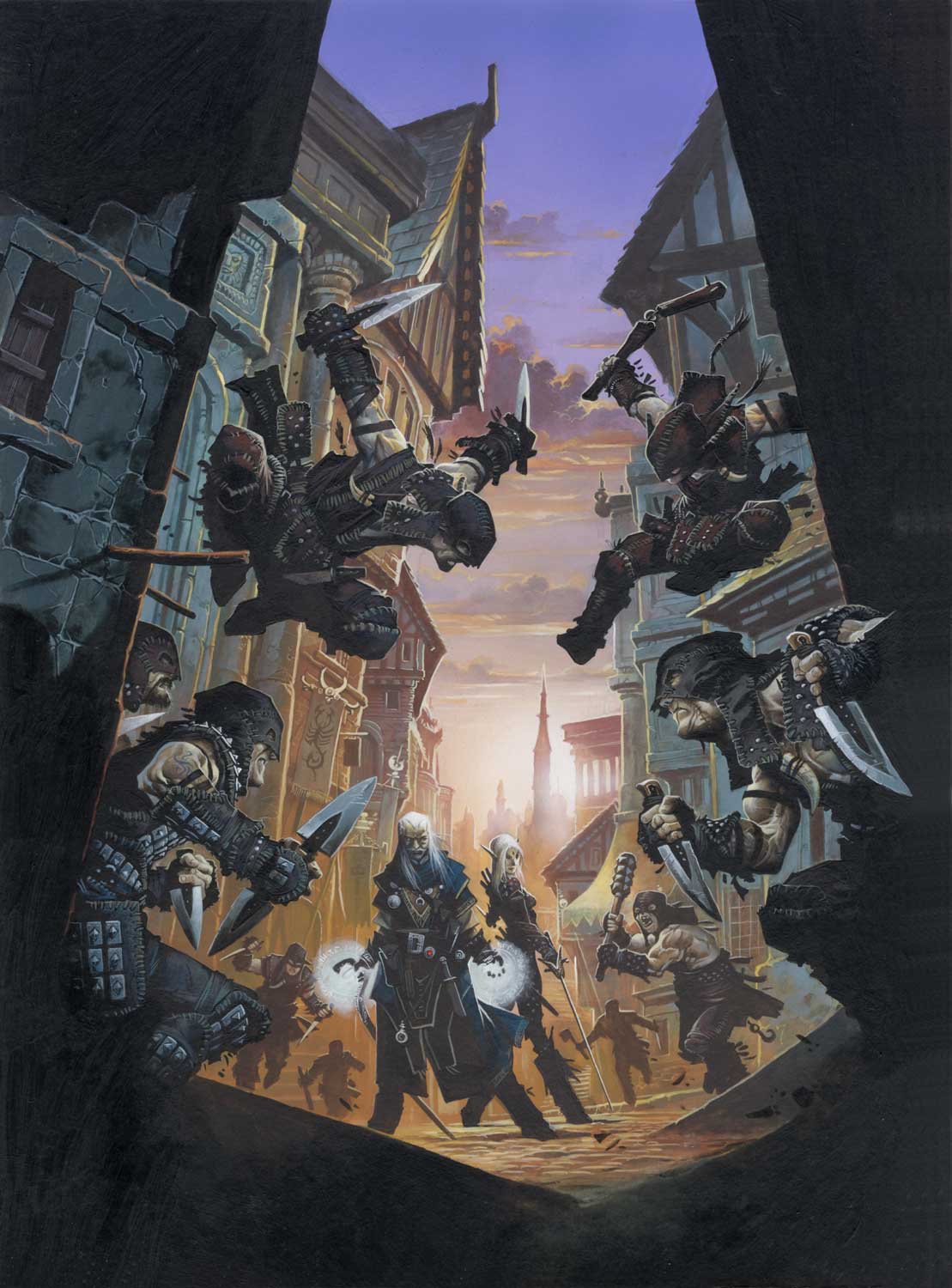
The city.  Urbs.  Civitas.  Polis.  There is something powerful about the packing of places and teeming of characters that make it rich for the imagination to inhabit.  Thus it is one of the settings that I love, even for fantasy adventure.  It's not because I eschew variety: the hamlet, the wilderness, and -- especially the Underworld -- all have their charms.  But a well-drawn city matches the well-done Underworld in my book.  Dickens' London (to choose one London), lives for me and it is one of the Londons that I love; Rutherford's is another.    McCullough's late Republican/early Imperial Rome likewise seems a real place with its own distinctive character.  I'd like to find fiction set in Venice and Florence that do the same for those cities in the Renaissance.  It's been a long time since I read much Ann Rice, but I think I'd probably say her New Orleans, and perhaps to a lesser extent her Paris, read well.  The Thieves World novels made Sanctuary breathe and roar and spit.  In game settings, the Free City of Greyhawk, Waterdeep, and Golarion's Absalom (for sale here) are intriguing cities that promise strong sense of place. 


What cities do you love?  What materials from fiction or gaming deliver a city in its stones and in its soul to your imagination?  What are the touches that make the city seem a unique, living place?  Are there equivalences of the double decker bus, the little black cab, the red phone box, and the red royal post box?  How do you go about city building in your secondary creations?  I would love to hear your thoughts, examples, and recommendations!

Saturday, April 7, 2012

G is for GOLARION

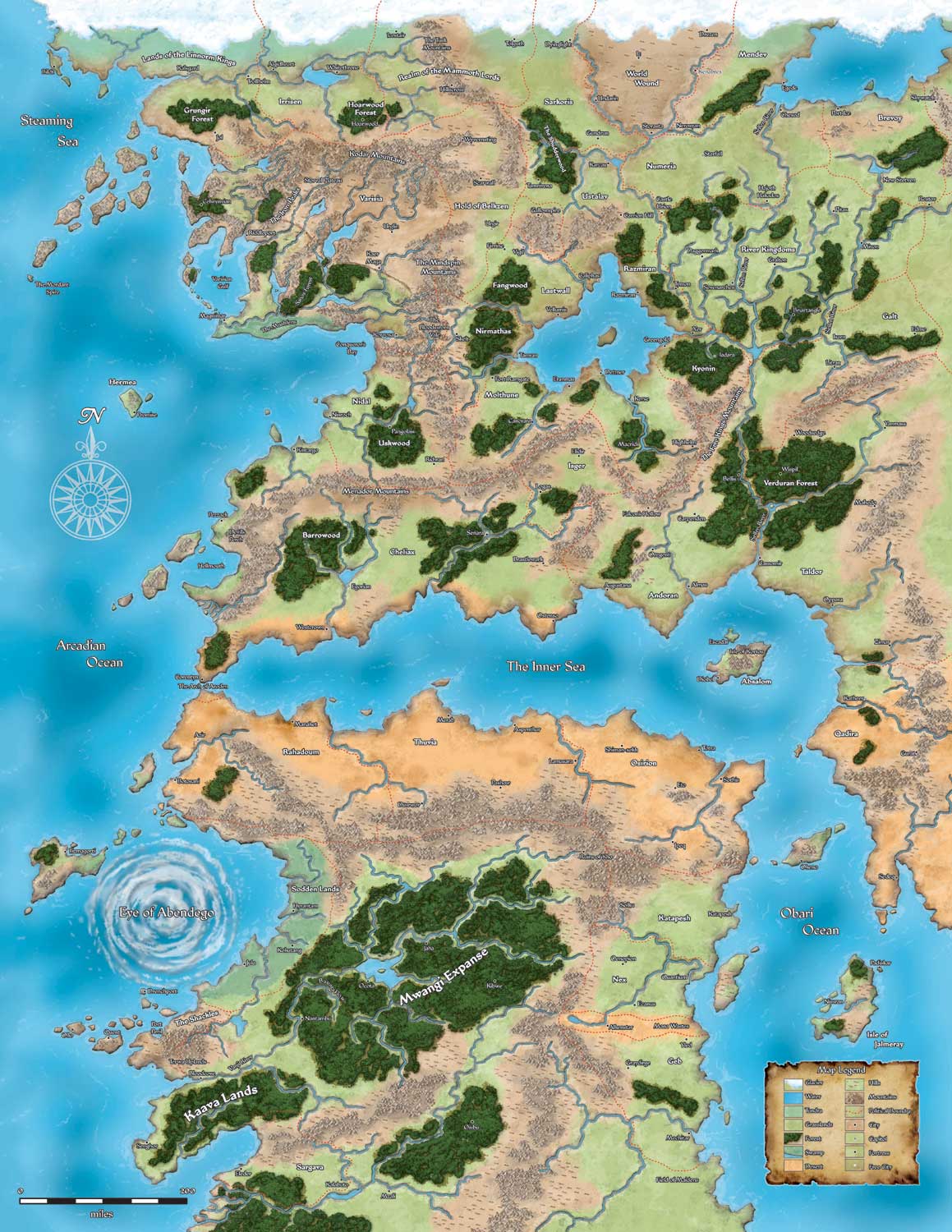
My favorite published gaming world these days is Paizo's Golarion.  While I enjoy building a world from scratch, from my own starting points and with carefully chosen elements (with input from players, of course), I also enjoy the richness of a well-designed world made by the cooperative labor of many imaginations.  Golarion is a high magic, polytheistic, kitchen-sink world that is the work of many designers and authors.  You can play in it, run it, or just read about -- moreover, you can read stories set in it by good authors.


If you are unfamiliar with Golarion, Tracy has written a series of introductory posts on it at Troll in the Corner.  The PathfinderWiki has over 6,000 articles detailing the world that are freely available.  And the mountain of material from Paizo continues to grow.  If you want a descriptive dip of the toe into Golarion, grab the Inner Sea Primer.  If you're a fan of fantasy fiction, then check out the Pathfinder Tales line.  You can start with the Web Fiction for free, but I don't think you get the full experience until you try a novel.  Any of them are good, and you can check out the blurbs and reviews for indications of what is up your alley, but my recommendation for a first would still be one of the two authored by Dave Gross.  And not just because he writes about my favorite character, Count Varian Jeggare. Okay, maybe partly...

Also, if you are a fan of the Lovecraft mythos, you will enjoy Golarion as a game world as it includes lots of nods towards Innsmouth.  Lovecraftitis has not, as yet, infected the fiction.  It will be interesting to see how long that state of affairs will continue.

Thursday, October 20, 2011

A Cold Wind Blows from the East this October

A Michael Tumey map from the module Frozen Wind
I have blogged before about Michael Tumey's Kaidan setting for the PFRPG.  As a special Halloween treat, Rite Publishing is giving away an adventure for fifth-level characters to face the frozen fury of a vengeful spirit: Frozen Wind.  Grab the free pdf at the Paizo store for a look at what Kaidan has to offer.  One way this adventure will facilitate that is it provides pregenerated characters so you can play it as a one-shot.  If you are not familiar with the Japanese tradition of ghost stories and you have Netflix, you might want to watch this.  There is also likely a copy of a small hardback titled Kaidan on the clearance shelves at your local Barnes & Noble, but I can't find a link on their online store.

Since I bought the original The Gift, Michael has been kind enough to send me a copy of the new version by Rite Publishing, and I will be offering a review of it in the future.  (But not before I pay my dues to you, Mike Welham!)  Thanks, Michael!

Monday, June 6, 2011

World-Building by Analogy

No one starts from scratch.  But to even make a world look new, alien, original, and otherworldly, is tough.  I'm sure that Frank Herbert had both oil and drugs on Earth in mind as he built Arrakis, but those are not the first things one thinks of when one hears "the spice melange," one of the highly original elements of the internal verisimilitude that is Dune.  Instead my minds travels from the desert to the worms to the Fremen to the spice trade to the navigators to folding space to the empire and on and on.  No matter what route the development of the Dune universe takes, it may reflect its light back on Earth, but it never grounds me there.

Sadly, I am not Frank Herbert (who, in my book, may be the equal of Tolkien when it comes to world-building).  But on the other hand, I don't want to be as bald as Gygax in his Mythus and have Aerth, Aegypt, Aeropa, etc., even when I am coming close to this kind of alternative Earth as I am in Ygg.  So while I start from real world analogues, I'm looking for a trajectory that starts with the analogy and then develops it in original ways.  If you've been keeping up, you've already seen me start with real world mythemes like Yggdrasil or Atlantis, or real cultures like the Norse and classical Greek, and drop them in as major elements and references points.  Even when I haven't done anything with them, these elements that I lift give me and the players a ballpark idea of what would fit in certain areas of the world or where the creative process is at least going to start, even (or maybe, especially) if the end product is largely unrecognizable from the point-of-view of its inspiration.

Another example for me are the Persians: a distinctive culture and empire from ancient times, they were later one of the great Islamic empires, and culturally continued into Mughal India.  As a fan of The Thousand and One Nights (a great deal of which is actually Persian rather than Arabian in background) who is dying to read The Shahnameh, I felt that this rich mine had not been adequately tapped in fantasy settings, least of all by me.  Thinking about what I already knew, I knew that Zoroastrianism had a tradition of dualism and fire worship to tap into, but I didn't want to simply reproduce a fantasy version of it.  I had always liked the idea of the lion (especially the maned head of a male lion) being identified with the sun.  I started looking at Persian symbols and words and found khorshid for the sun and sher or shir for lion.  Thus was born one of the two main deities, Khorshir, personal patron of the Emperor.  I saw Vata as a name of a wind deity, which reminded me of the Vaati or Dukes of the Wind.  I had my second, opposing deity.  What to call this immortal empire of the East?  Aryanastan seemed an obvious choice.

This is how I proceed when I know enough to be dangerous.  When I know somewhat more, I take language more seriously:  Take the long unnamed "Peoples of the City-States of the Middle Sea," inspired by the Greeks.  I always liked the name of the great city, Thessaloniki.  The Greek ideal of Kalos kagathos or kalokagathia -- "Beauty & Goodness" -- inspired me to call them after Kalokaniki  or "Beauty & Victory," a compound that looked like it could have been misheard and vulgarized to create the words classic and classical. This yields the plural, Kalokanikai (kah loh kah NEE keh).

As the lands multiply, the question arises: Now, what to do if one, like me, has no creativity in his hands to speak of?  Instead of drawing an ugly (and largely unintelligible) map, I started with a diagram I could easily make on the computer as an abstract stand-in.  I could later use it to make a map in Hexographer. Due to its abstractness, I don't mind players getting some minor spoilers from the map. Some entries may be temporary.


How do you use analogy in your world-building?  I'd be interested to hear your thoughts in the comments.  As the week progresses, I'll add notes about these updates about these lands and cultures in the respective game tabs.

Friday, April 29, 2011

Y is for Yggdrasil

Originally, I envisioned dedicating today's entry to two mythic creatures: the yale and the yeti.  For you see, this is one of my secret wacky plans!  I will open a chain of pubs.  A chain with exactly two locations.  In New Haven, Connecticut, I will open the Yeti & Yale pub with a Himalayan theme.  Meanwhile, in some Himalayan country (not Tibet, sadly.  Damn Commies!), I will open a Yale-themed pub called the Yale & Yeti.  Wouldn't you like to see a stuffed yeti dressed in Yale blue at the door?  Maybe be waited on by Yale students doing their semester in Asia?  But I wasn't able to get original art lined up for the blog in time, and I already had gotten into this setting-building trend here towards the end of our A-Z project, so maybe I should do more with that.  Thus we have Y is for Yggdrasil, but if I find a way to work yales and yetis into the world-building...well, I make no promises.

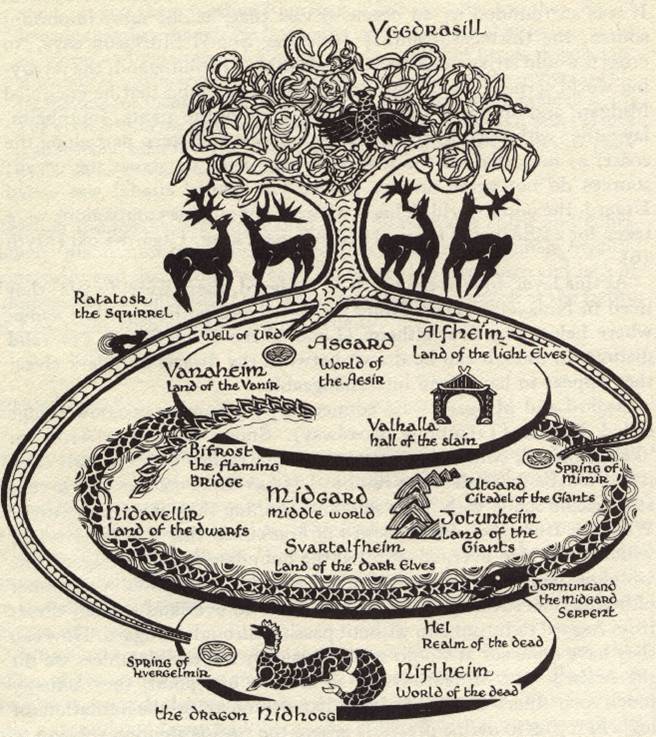
Link: A Collection of Attempts to Diagram the Norse Cosmology

There is uncertainty about the origin and meaning of the name of the Norse world tree.  The dominant hypothesis at the moment seems to be that it means "Ygg's horse"; Ygg being another name for Odin meaning "terror" or "terrible one".  The name may be intended to be a colorful term for gallows.  The tree seems to be either an ash or a yew.  This gives rise to a particularly grim thought: If the name of the world tree is Terror's Gallows, it seems that the nine worlds were hung there to die.  This fits nicely with the conception that all these worlds are temporary, to be destroyed on the day of Ragnarok in the final battle.

Here's a quick review of the Nine Worlds, by Norse name, as I have begun to organize them.
  1. Ásgarð – Home of one group of gods, the Aesir, and their hall for heroes
  2. Vanaheim – Home of another group of gods, the Vanir.
  3. Álfheim – Home of the elves
  4. Miðgarð – Plane of humanity and mundane beings
  5. Jötunheim – Home of the giants
  6. Svartálfaheim (or Niðavellir) – Home of the dwarves and lower faeriedom
  7. Hel – Home of the Dead
  8. Niflheim – Plane of Water
  9. Muspellsheim – Plane of Fire
1-3 Are the upper planes, 4-5 are the middle planes, and 7-9 are the underworlds.  Six could be a problem, let's come back to it.  In keeping with my work so far, I am beginning with Norse inspiration and then taking them in whatever direction they need to go.  There will probably be a tendency to go next to Judeo-Christian sources next, but I will also be drawing heavily from the D&D pastiche, whose sources are listed in suggested reading lists or appendices.

Let's start with the three upper worlds.  I like the idea that the elves are other-worldly, and that they are an alien presence in the middle world of men.  Drawing from the old D&D books, I will take the idea of alignment, and particularly of a conflict between Law and Chaos (thank you, Michael Moorcock!)  I like the pulpy feel that this can give a setting.  This has the advantage here of fitting with two different groupings of gods in Norse cosmology, the Aesir and the Vanir, the latter who had been largely displaced by the time of our sources, who at one time warred.  A lot of folks identify elves with Chaos, so that would leave gods of Law and gods of Neutrality or Balance.  I would go in another direction, however, and identify the Elves as the beings of Neutrality/Balance in a struggle between the Law-beings, centered on a renamed Asgard (Loggard?  Ullgard or Ullurgard?) and the Chaos-beings, centered on Freehome (or a requisitioned and similarly renamed Vanaheim).  The Law-beings have obviously succeeded in appealing to humans, promising their heroic allies a place of reward in an afterlife hall of the brave.  I also want to resist the equation of Law with Good and Chaos with Evil, and keep morality and righteousness as potential separate issues from this struggle.

Middle world is dominated by humans, but also the crux in the struggle between the two opposing alignments of higher beings.  This decision is good for adventuring.  Initial research suggests that "gard" means "farm."  Is farming a part of what distinguishes Midworld from the surrounding realms?  On the edge of Midworld is Giantdom.  Are the mountains the home of the giants?  The barrier against giants or humans?  Or do the mountains just get progressively higher and more inhabited by bigger giants?

The sixth realm is starting to look like a problem to me.  Let's just call it Faerie.  Clearly, it's related to Elfhome in the Overworld.  Let's take the old idea that elves can't be resurrected, but that they can be reincarnated.  Is it a cycle?  Is there a progression, like in Hinduism?  Are elves the top of the fae reincarnation ladder?  This seems likely to me.  Maybe some elves have abandoned the cause of Balance or maybe that is something they have to evolve towards, and that when they finally attain it, they becomes elves.  Does this lower Faerie fit as part of the Underworld?  Or should it become part of the Middleworld?  If it is a part of the former, then that gives a reason for elves to be visitors to Middleworld: to help guide their less evolved kin toward Elfhome.  I think I like this idea, plus the symmetry of three levels and three realms in each is nice.  Up to this point, I have not dealt with where halflings would fit in this setting.  As it is developing, I wonder if it wouldn't be better to drop some of the Tolkienesque associations and make them a fae race.  Otherwise, they are farmers and more like little humans.  It is possible, of course to have a mundane, miniature human race. One could look to pygmy peoples and the mythological portrayals of them for further inspiration.

I have already given the Underworld the most extensive treatment, so let's step back and see how things look at this point, and let's start by strengthening the three tiers and drop the divisions of worlds between them:

The Overworld:  The Dominion of Law, the Fields of Freedom, Elfhome.

The (Middle) World: The Cultivated Lands of Man, The Uncultivated Lands of Faerie, The Giant March.  As I describe it so, I begin to think that the giants and the Chaos-beings are in league: on the side of Chaos to minimize access of Law, on the giants' side to have an opportunity to enslave the smaller races.

The Underworld: In this setting, the Underworld is largely of primordial elements, the main exception being the realm of the dead.  An important question to address next would be, to what extent does the struggle between Law and Chaos extend to the Underworld, and how do the three realms below fit in it?  Are the dead unaligned?  Are the other two realms internally divided into camps of Law and Chaos?  Fire giants and hellhounds (L) versus Efreet, Salamanders, and Red Dragons (C), for example?

Ygg's Tree
As I look back over the experimental structure delineated so far, I wonder if more could be made of the image of the tree.  In what way could we now go back and view the Overworld in terms of the canopy, Middle World  as the trunk, and the Underworld as the roots?  By a continual process of zooming in and dealing with very concrete details and zooming out to see how things are coming together in the big picture, I keep returning to what is accounted for, and what is left to be accounted for.  In this way, questions multiple.  Are clerics both of Law and of Chaos?  In this setting, should they turn different kind of outsiders based on their alignment?  Where does magic come from?  Is it a feature of the Tree itself?  Should treants (=ents) and dryads be given special treatment in this setting?  Maybe the fae races were the original races of this world before some outer power chose it as a prison for these warring factions of Law and Chaos.  Is this outer power Ygg?  Or is Ygg the original of the fae races?  I like the pulpy feel of the name, Ygg.  Maybe this universe should be called Ygg's Tree.  Maybe when one looks up from Middle World at night, instead of seeing the Milky Way, one see a nebula that looks like the foliage of a celestial tree, giving the tree identification a visual focus.  In the threefold world of Ygg, an intelligent race of tusked, magical caprids discuss philosophy, while in the mountains, clerics call yetis to protect their shrines against the ravages of marauding giants...

See Collection Linked Above
EDIT: Broken picture fixed.  Seems like this has been happening recently.

Thursday, April 28, 2011

X Marks the Spot!

Original Art by Katy Salvo
Upon first hearing, I immediately identified with the boy, being one myself at the time.  He worked for his family in their little seaside inn.  All that it took to change his life forever was the arrival of an old, shifty guest soaked with sea-salt, rum, and paranoia.  The traveler dies in mysterious and violent circumstances and a search of his belongings turns up a map.


Maps!  
There's nothing to spice up your adventure like a map, as old gamers know.  (Can I get an "Arrr-men"!?)  Maps are enormously helpful in getting imaginary landscapes into one's mind.  But they should not be underestimated as artefacts and plot elements in and of themselves, either.  We live in a world where maps are common to the point of being cheap and even free.  We expect maps to be available, up-to-date, and accurate. In this way as in so many others, it is our contemporary world that is utterly exceptional.  Before the 18th century, maps were rare and expensive, and the more recent and accurate they were the rarer and more expensive they were.  Finding a map is practically finding a treasure already, not to mention introducing a major plot element.

Maps can (1d12 Table!)
  1. Be the object of the quest itself
  2. Show the way there
  3. Show the way home
  4. Show the adventure location
  5. Mislead due to accident
  6. Lie purposefully!
  7. Be at the center of a dispute between two kingdoms
  8. Be stolen property
  9. Bear a curse
  10. Allow one to use a well between worlds
  11. Be the product of the adventure
  12. Lead to buried treasure
Fantasy Cartographers
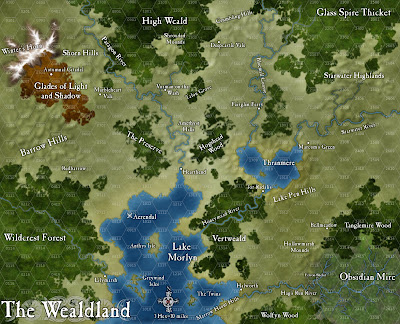
The two pictures below link to my two current favorite fantasy cartographers for your browsing pleasure.  Also, if you draw like me (read: like a spaz), then you might also enjoy playing around with Hexographer's map-making software.  It produces clear and usable, detailed hex maps.

Atlas of the Flanaess Project by Anna B. Meyer
The Wealdland by Allen Taliesin

Oh, and before you respond to me by quoting Indiana Jones, remember that line is a purposeful set-up for this scene below.  Hey, a lightly marked Roman numeral ten is still an X.


EDIT: Link added from below for convenient navigation.  http://towerofthearchmage.blogspot.com/2011/04/x-is-for-x-marks-spot.html