Showing posts with label World of Ygg. Show all posts

Monday, January 16, 2012

Execution by Element

wirenoose.JPG  By: taliesin


I had another one of those thoughts, recently.  (Hopefully, I'm not among the last folk to have it, and just don't know it.)  A steady diet of period pieces and fantasy sometimes prompts these things at odd moments.  My thought is this: it seems to me that before the modern period, it may be that all forms of execution may be grouped by substance of the cause or means of execution.  How?  Elementally, my dear readers.

Recall the four classical elements, then think about how premodern convicts were executed and the element involved.  Those who are stoned or buried alive: Earth.  Those who are drowned: Water.  Those who are burned: Fire.  The only element that may not obviously be associated with a historically popular means of execution is Air.  Perhaps hanging or being tossed from high places corresponds with Air.  Perhaps strangulation also belongs with Air.  What other means of execution are left?  Beheading?  Arguably, execution by metal would also be an Earth execution.

In a fantasy setting, I would like this elemental um, element, to come to the fore.  Going by the old adage, let the punishment fit the crime, certain executions, if not all corporal punishments, would be by the element according the category of the crime.  Crimes against people gaining their livelihood by the Earth would be met by an Earth execution.  Criminals who violated lèse-majesté would be hung.  Criminals sentenced to death for acts of pollution would be burnt with Fire or immersed in Water.  Perhaps offenders of the most heinous sort would be sentenced to multiple executions.  "Guilty of high crimes against the gods, his liege, the people, and all creatures, the Doomed one is sentenced to be stoned, removed before death and hung, removed before death and burned, and finally his ashes scattered in the Sea of Woe."  Or strangled while being held underwater, roasted, and then drawn and quartered (to the four quarters of the earth).  Given what he know about judges and human nature, creativity would come into play.  I've had another spurt of inspiration for the World of Ygg (the setting for my in-stasis S&W game) the last couple of days, and as I develop it, I will bear in mind the place of the elements in certain areas and how that would play into their system of justice as much as, say, their religions (these come up in the Greek and Persian analogues -- Kalokanikai and Aryanistan -- particularly.

Ashes to ashes, dust to dust.  Even if it is a tad morbid, this is how I wish you happy mythopoeicizing this MP Monday.

Monday, October 17, 2011

More Ancient Persian Inspiriation for Aryanistan

Faravahar-Gold by Shaahin

I picked up some books on ancient Persia and Zoroastrianism in the library further research into one of the important lands of Ygg.  (So far, I have been working with Mary Boyce's Zoroastrians: Their Religious Beliefs and Practices.)  Though Norse mythology was my initial inspiration, and the Northern realm is where I planned on starting out with PCs, Aryanistan, drawing inspiration from central Asia and Iran, is the largest empire in Ygg.  Below is a C/C table on the two great religions of Aryanistan, the first which has the broadest popularity and the second which is the royal patronage and popular with ambitious nobles.  Some of the ideas are firmer than others, but I liked the direction that it taking as weave game elements and historical elements into this proud, though conflict, imperial behemoth. 


May the winds of inspiration blow upon you, this Mythopoeic Monday!

Saturday, October 8, 2011

Quick Questions for Ygg: 1-11

 Recently, I have seen Jeff Rients' 20 Quick Questions getting picked up again by fellow bloggers (like Richard and Carter Soles). Questions 1-11 were pretty easily answered, but from 12-20 I found a greater number of questions that would demand pondering from me as I look over my sketch of a map and scattered Ygg notes.  Yeah, I was jumping on the bandwagon as it made another tour, but I also post on Ygg from time-to-time in hopes that it will reactivate the PbP.


  1. What is the deal with my cleric's religion?  It all depends first on alignment.  In Ygg, I am going with the three classic alignments of Lawful, Chaotic, and Neutral as warring cosmic principles, and leaving the question of good and evil, not out of role-playing and character, but out of alignment and game mechanics.  I'm offering god options for each alignment, depending on the cleric's culture.  The Northland, Kalokanikai, and Aryan (pronounce: ahr-yahn; think, Persian) are the main human cultures that I have developed to any degree, though I also have given some thought to Elves.  (Dwarves and Halflings I will admit have not gotten the same consideration at this point.  My default assumption for dwarves is admittedly not particularly original, but I tend to go for something Vulcanian.)   For more details on these, see the Players' Guide to Ygg tab above, or, if you are not one of the people who had been talking to me about getting in the Ygg game, both it and the Dungeon of Game Mastery tab.
  2. Where can we go to buy standard equipment?  Standard equipment?  Either finding the craftsmen who provide the equipment in question or going to a local market day.  If by standard equipment you are including adventuring equipment or arms that would not have a common use but would be more adventurer-specific, then one might have to go to a larger town to be sure one would find it.  But adventurers are going to tend to gather in larger towns to start with anyway, seeking employment, information, goods, comrades, hirelings, and -- let's face it -- adventure!  If characters are not burghers themselves, they are going to be people trying to leave the farm (or its equivalent).
  3. Where can we go to get platemail custom fitted for this monster I just befriended?  That better be some strong friendship magic, pardner, cuz monsters are, well, MONSTERS.  Unless they are a rare, only-apparently-a-monster (Not Evil, Just Misunderstood), they are going to turn on you faster than you can get them plate armor with little hearts engraved on it.
  4. Who is the mightiest wizard in the land?  If in the North and asking about a human wizard, somebody in Farlangenforum [Farlangengora?] -- the furthest point at colonization from the Southern civilization reached, where cultures of the North and South meet.  But the most powerful wizard in the world is probably in the great city of Magushabad -- city of mages and thieves on the edge of the Aryanistan cultural sphere, built by an extinct ancient culture.  On the other hand (don't count), I bet those merpeople -- if they truly exist out where sages say a western continent once existed -- would have to have some great wizards.
  5. Who is the greatest warrior in the land?  Definitely some skull-crushing Northman who patterns himself on Thunnar.
  6. Who is the richest person in the land? The head of the richest Kalokanikan merchant family in the middle sea, the Magocrat Magushabad, or the Immortal Emperor of Aryanastan.  Actually, it would be the last fellow, who's crazy-rich, from milking a vast empire.
  7. Where can we go to get some magical healing?  No cleric in your party?  You must have Jeff Rients for your DM, or you're playing with a group of people that are either soft-headed or love rolling up new characters!  In a world where healing potions existed, the market would demand production and distribution of such an item far beyond any other magic item.  Local temples of healing would likely have a cleric that was a healer and capable also of brewing healing potions.  The locals will know where to go, unless you are in some gods-forsaken part of the world.  Don't worry, you'll know if you are from the dearth of humanoid populations.  Better stock up on healing one way or another before you go there.
  8. Where can we go to get cures for the following conditions: poison, disease, curse, level drain, lycanthropy, polymorph, alignment change, death, undeath?  See above.  The higher level of magic required, the more likely you will be forced to seek what you need in higher population centers.
  9. Is there a magic guild my MU belongs to or that I can join in order to get more spells?  Quite possibly: let's make one up!  You either belong to some kind of magical organization or you had a master you apprenticed under.  Hopefully you stayed on his or her good side if you don't belong to such a group.  Of course, many magic-users kill other magic-users or steal their spell books.  Or they sucker groups into going with them to dangerous places where old spell books might be.
  10. Where can I find an alchemist, sage, or other expert NPC?  It depends on whether finding said expert is going to be a fun part of the adventure, in which case it will be an ordeal just answering that question, or an incident on the way to the real fun.  While the answer will always be explained in setting terms, when it comes to where they are and the time and money it takes to find and hire them, game time and energy will depend on the fun involved.  
  11. Where can I hire mercenaries?  Easily in any large town, but possibly in small towns.  Rarely outside of towns.  Inquire at local tavern or hire a crier, if they operate in the vicinity.


Monday, October 3, 2011

Inspiration: Necropolis of Pahlavan-Mahmud, Uzbekistan


I recently stumbled across this real life location in my rambles through the internet: a necropolis built around the tomb of a Muslim saint in what was the Khanate of Khiva, in present-day Uzbekistan.  Check out the map above.  I wish I could find a clear, detailed map of the old, inner city: Itchan Kala (also see here).  It looks like it would be a wonderful source to base a game map on.  The old town is a walled fortification, but it seems to be dominated by mausoleums and mosques.  Getting lots of information about it off the internet in English is posing a bit of challenge, but it seems that my initial impression that I was looking at a single vast necropolis was mistaken.  Pahlavan-Mahmud's is one of many mausoleums in Itchan Kala.  However, I like my initial misapprehension: a fortified town, dominated by a sprawling necropolis and enough temples to keep the whole thing semi-contained.  It sounds like the makings of a great location in Aryanastan: The Empire of the Immortal Sun in my Ygg setting.  A Google image search or a search in Flickr for some of the key words in this post, and you will see more reasons why I find the place inspiring.

Here are a few more views of Itchan Kala (other spellings out there include Ichan Qala).

Google Maps

Arun Narayan Sabnis' photograph of another city map.  It's not downloadable, but it is hi-res and zoomable.

Monday, September 5, 2011

Halflings of Another Color

The word halfling is an old Scots English word for "one not fully grown; a stripling" according to the OED.  Tolkien eventually picked it up as the Common Speech word for a hobbit on this basis: to indicate one who is roughly half the size of adult humans.    But the word has other uses in Terry Brooks' Sword of Shannara and Jack Vance's Lyonesse novels (and perhaps other fantasy literature as well), and could name creatures who were half one thing and half something else just as well as it does creatures who are are half-sized.  Today's Mythopoeic Rambling will be dedicated to exploring alternative ideas for developing a halfling race.

Beyond Classical Halflings
Let me start by saying I love Tolkien's hobbits.  While I don't encourage their derivative use in  fiction unless it is fan-fiction, I definitely understand the desire to play one of them in a fantasy game with a Tolkienesque setting -- in which case they shouldn't be, say, the strike force of the Thieves' Guild, wielding repeating crossbows whose bolts are coated with deadly poison  (I wish I was making this up just as a random example). To put the same point differently, Tolkien's hobbits don't work in every setting, so I have been thinking about ways to keep the halfling game race across settings.  I have two ideas.  The first continues to center on the idea of size (pygmies) and the second picks up the idea that they are the bearers of a dual heritage (human descendants of fae).


Pygmies
Real world pygmies are indigenous peoples in  various areas of the world -- most famously Central Africa* but also in other regions of Oceania, Southeast Asia, and South America.  Both the real world tribes themselves and the  ways they entered into the folklore of other peoples are rich sources of inspiration for a developing a distinctive halfling race that will fit fantasy worlds that are different from Middle Earth.  For myself, I will undertake a reading of anthropological literatureand supplement it with material from Greco-Roman mythology and African folklore to produce a race that is proudly African and heroic in flavor.  For example, the war with the cranes (or better, one of D&D's crane-like monsters) could be central to pygmy culture and history.  This is the direction I was planning initially for the halflings in the World of Ygg setting.  Now to turn away from size and toward the biracial.


Fey Halflings
Fairy tales and folklore are full of dalliances between humans and the denizens of faerie.  Classic forms of D&D have a number of fey creatures in addition to elves as a PC race.  And if you are playing a game with only the four classic races (and not the races added by Advanced D&D and its descendants), halflings provide a slot that will take the place of races added later and have flavor that works well for half-humans with fey blood.  Halflings' ability to disappear in wooded areas reflect well the flavor of a fey heritage, and the diminutive size of many of these creatures in their natural state would explain halfling size.  
While I imagine the appearance of this fey-blooded race to vary greatly, they may vary in size, too -- I suggest two physical types for halflings, to represent the variety of potential fey parentage: small halflings for those in whom the heritage of small and beautiful faeries predominate and medium (up to larger than the average man) for those who derive the majority of their heritage from big or ugly faeries. In essence, this would allow halflings to take the place of the roles of half-elves and half-orcs, that proved so popular in later editions of D&D.   In mechanical terms, what would decide whether one had generated a large or a small halfling would be, above all, strength size (the idea of a standard halfling getting a strength bonus has always stretched believability for me, certainly any modifier over +1).  Higher strength scores would indicate a larger halfling, descended from the more brutish creatures of faerie.  The idea behind this is that the interaction of fey blood with human in the case of the beautiful races has the quirk of producing smaller half-humans, while the larger or uglier fey blood produces a hybrid vigor that gives a game equivalent to half-orcs.  All this while sticking with the core four racial choices.

Elves, Pixies, Sprites, Nixies, Dryads (Gnomes possibly)
Halflings as they are already represented in the standard versions of the rules fit well the flavor of humanoids with fey blood: small, hard-to-catch humanoids who "are difficult to spot, having the ability to seemingly vanish into woods or underbrush" and are also good as hiding in subterranean surroundings (B10).  In games that follow the structure of four PC races, this would

Goblinoids, Trolls (Hags, if they have them in your game)
This is where I begin to question keeping the mechanics of the halfling for larger creatures.  The GM may want to come up with flavorful replacements for the dodging, hiding, and missile accuracy mechanics for the larger halflings, although, with a little thought, there could be reasons why they get the same bonuses other than size (they exude a slippery skin oil, have some subtle, protean ability that doesn't utterly change their appearance but distorts their physical form enough to allow escape, their skin color lends them natural camouflage in certain environments, etc.)  This version of the race could be used to satisfy the desires of players who like the appearance options that half-orcs or even tieflings offer in the  the Advanced form of the game (and its descendant) and.  One thing I can tell right away: using my idea of a racial primary attribute (and accompanying bonus) that I briefly introduced in my card generation method, I would switch the primary attribute for this line of fey halfling from Dexterity to Strength.

Reproduction
The simple solution is to have halflings breed true: they seek out others of mixed heritage, perhaps as a result of feeling rejection or difference from the community of their mother, and settle with like outside of a human or fey community.  Over time, the commerce between humanity and faerie would result in a significant enough population that they would come to be, in practical terms, a virtual race.  Location vis-à-vis populations of different kinds of fey creatures would determine whether a halfling community was predominantly small halflings, larger halflings, or composed of both sizes.

Happy world-building until the next Mythopoeic Monday!


*For one way to help the plight of one pygmy people, the Batwa of Uganda, I recommend the Kellermann Foundation.


Monday, July 25, 2011

Merfolk Flash Vikings!


The 1973 collection of Sword & Sorcery novelettes pictured above was a real find that I devoured so quickly there was no updating my book trophy section at the bottom of the page.  I skipped the Leiber story, since I've read the last two books of his Fafhrd and the Gray Mouser series in the past year.  The other three are quite enjoyable.  In particular I learned two lessons.  First, there is not now nor has there ever been enough Jack Vance in my life.  (The Lyonesse books are good, but I need those Dying Earth books!)  Second, I am not the first person to have thought about the mythopoeic match-up of vikings and merfolk.  (Which reminds me, when am I ever going to find out what they did with mermaids in On Stranger Tides?  Don't tell me!)

Leave it to Poul Anderson, a trailblazer in many ways, to have put merfolk and vikings together when I was a toddler, long before I was dreaming up the World of Ygg in "The Merman's Children."  Anderson is fascinated in the transition of the Norse from pagan to Christian, and he sets the story in a time where the characters are struggling with categories in terms of the old gods (devils) and the Christian God.

The old bishop in the story tells his archdeacon that "They lack souls, yes, like other beasts, but they do not imperil salvation as might the denizens of an elf-hill."  The archdeacon goes on to share the reports he has of them.  "This is not a hideous race with fish tails, my lord.  Save that they have broad, webbed feet and big, slanting eyes, and the men among them are beardless, and some have green or blue hair -- on the whole, they look like beautiful humans."  No men of Innsmouth, these.  They are not even like classic mermaids, but are closer to human form, in spite of their lack of a soul (an assertion that, as you might guess, turns out to be more problematic than the initial confident assertion would lead one to believe).

The root of the trouble is this: the birth of children part-human and part-merfolk have given rise to an unusual degree of commerce between merfolk and the sea-faring rustics of his coastal diocese.  The former are part of the mystery of the sea and a disappearing, if not anti-Christian, world.  The description works well for the merfolk of Ygg, but the sense of their antiquity I plan to have coming from their connection to the Atlantis and classical world analogues, which is both a whispered past and a glorious, begrudged present.  I still haven't found a copy of FS!#2, but I did just find a copy of #4, which has another merfolk story in it.  Huzzah!  More inspiration may yet break forth from Poul Anderson.

Folks with an interest in Ygg will have noticed that my posting of material for it has slowed as the hopes of a S&W play-by-post set there have been delayed.  I'm not giving up on it, but the production will continue at a slow pace until circumstances change.  Tangentially, I admit that I was a little surprised that the solid popularity of my bonnacon post did not rub off on the rumor table that I created for it.  (Scroll down to Rumor Table A.)  What, I used the d30 and everything!

As always, thanks for dropping in for Mythopoeic Monday!

Monday, July 11, 2011

We tried, my Lord, but it ass-flamed us!

The Bonnacon (Bonacon, Bonasus, or Vilde Kow)

Only the Anglo-Saxon word can do this creature semantic justice in English.  It sprays fiery shit from its nethers.  The medieval bestiaries are clear on this matter:


Even to us today, the humor and disgust are evident.  I presume that the bonnacon is the inspiration for the stench kine (singular, kow), the cattle that roam D&D's nine hells.  But the medieval Europeans inherited this foul bovine from their beloved Pliny, who passes this on: "There are reports of a wild animal in Paionia called the bonasus, which has the mane of a horse, but in all other respects resembles a bull; its horns are curved back in such a manner as to be of no use for fighting, and it is said that because of this it saves itself by running away, meanwhile emitting a trail of dung that sometimes covers a distance of as much as three furlongs [604 m], contact with which scorches pursuers like a sort of fire" (Naturalis Historia, Book 8, 6)  That's more than 1200 feet away.  Four playing fields between you and a bonnacon and you'd still be in danger, depending on whether you're thinking American or Association Football.  Take a look at The Medieval Bestiary and The Aberdeen Bestiary Project.  The text of the latter seems to agree with Pliny that it is contact that causes combustion, but with the "fumes" rather than the dung itself.

It is clear that a creature this awesomely awful deserves an honorary place in mythopoesis.  You can decide if they were they fall on the continuum from mere rumor to straightforward magical creature within your imaginary world.  I can't help but relate them to another mythic bovine, the cattle of the Sun (appearing most famously in Homer's Odyssey xii.127–137), although one could also relate them to the medieval (bovine) gorgon, the biblical golden calf, or the Hindu taboo regarding cows.  I have added a Rumor Table to the Dungeon of Game-Mastery.  GMs can decide which parts of the rumors are true and which are false for themselves, just as I will for Ygg.  (While I've tailored the rumors to my world of Ygg, those few details can be changed as needed for other worlds by GMs who want to adapt them.)  Later this week I will add stats for a S&W version of the bonnacon that I have been working on, perhaps with further Ygg-specific text, in the same section.

Here's wishing you a merry Mythopoeic Monday!

NB.  I have tried to name each file for its origin.  There are a couple that I cannot trace, but if anyone informs me about these, I will correct the names.

EDIT: Here is a link to a creature (the charnel cow) for Pathfinder RPG that was put together by two pals of mine, Mike W. and Sarah C., inspired by the stench kow mentioned above.   Thanks for your faithful support of M.R. and of consumers of fine (er, disgusting) monsters everywhere!

Monday, July 4, 2011

It's Snowing Villains!

Happy July 4th to my fellow Americans!  Maybe the heat of the Texas summer is just getting to me, but I've had wintry villains on my mind lately.  Not just cold climate monsters, mind you, but individual characters with frosty outsides and frosty morality.  The first one I remember encountering comes courtesy of Rankin-Bass'  Santa Claus is Coming to Town:

The Winter Warlock
Shortly thereafter, my class took a field trip to see Hans Christian Andersen's Snow Queen on the stage.

Of course the Christmas specials kept up the barrage:

From Year without a Santa Claus' Loveable Snow Miser
to Frosty the Snowman's jerkish Jack Frost.

These days, I'm more likely to think of Narnia's usurping, dem fine woman, or the hilarious, suspiciously winter-warlock-like Ice King of Adventure Time.


How does this guy enjoy life so much when happiness constantly eludes him?
What can we say in general?  There is a figure popular in various manifestations, perhaps a personification, that attracts monarchy and magic, winter and wickedness.  The mash-up plays on archetypal themes of the shadow and opposing gender image (anima/animus) and turns them into a figure of power that is associated with the chaotic, difficult, and destructive potential of winter, sometimes grudgingly retaining the beauty of winter.  It's a compelling mix for a villain.  For my own setting of Ygg, I'll be combining the two into a composite of Loki and the Finnish Louhi, taking advantage also Loki's penchant for changing forms -- who's to say that s/he has one true form instead of a range of forms?  That's it for this Mythopoeic Monday.  I'd love to hear your thoughts on these cold characters, and let me know of any that I have missed!

Monday, June 13, 2011

Beastly World Building

Sometimes, world-building needs to go by the book, beast by beast.  Below are two books I recently finished in which I found ideas about the beasts of a setting that intrigued me and stood out as worthy of reflection, and perhaps out-right stealing.*  Though some revelations are inevitable, I will try to minimalize any significant spoilers.


Hunt the Space Witch!
Reading Notes:  Quite enjoyed these stories, more than the fantasy doorstop setting that he later wrote (admittedly, I just sampled his famous series, reading one or two novellas rather than the full novels.)  Energetic and pulpy!


Beastly Business:  In the titular story of the book, we run across a character who keeps and exhibits a menagerie of exotic creatures.  I am tempted to simply relocate this character to Ygg, changing some minor character features so that s/he fits the fantasy setting better than his outer space origin.  Silverberg's beasties are colorful and threatening.  In the traveling zoo, we find (leaving out Earth creatures):
  • Dreamstones (The gems are apparently non-living treasures he exhibits, but I include them because of the flavor)
  • Gems from the barren wastes of Duu
  • Talking trees of Thanamon
  • Dwarf squids of Qi with red gimlet eyes
  • Poison-tongued raintoads of Mivaghik
  • Violet legless salamanders from the blazing sunside of UpjiLaz
  • Smiling protopods of Viron (blinding agility, flesh eaters)
Bringing the Exhibitor, and the beasts and their keeper(s), into Ygg raises the issue of the problems of a traveling circus/museum such as his/hers.  In a non-sci-fi setting, this would require a large company, unless the Exhibitor wielded great magic.  What if the entry or the exterior of the exhibition traveled and the menagerie itself staid in some hidden location?  Now the Exhibitor is the master of a dungeon.  I'm getting kind of an evil Howl's Moving Castle feel from this change, and I like it.  Maybe most people who pay and visit don't have the dungeon experience.  That would be reserved for special guests.  I think I will also read Ray Bradbury's original short story that inspired Something Wicked This Way Comes for more development ideas.  A dungeon based on such a model doesn't have to concern itself with figuring out a natural ecology, since it is also a zoo.  In addition to holding almost any beast in the bestiary, such a dungeon is a great place to introduce strange new creatures.

I may expand on this idea in a future update to the Dungeon of Game-Mastery.


The Kingdom Beyond the Waves
Reading Notes:  Enjoyable, lots of twists.  I didn't enjoy it as much as the first book for some reason, perhaps partially because I was disappointed the two main characters were almost excluded from the second book.  The first book had an ancient dungeon ruled by elder gods in it.  The second has a dungeon that is the degenerated remnant of the sewer system beneath an ancient city. 

Beastly Business:  The lost civilization at the heart of the story was the pinnacle of super-science and the bio-engineered denizens of the sewer system had mutated into monsters.  The sewer creatures had been created to maintain, clean, and reprocess all the wastes of the great city, and to share a hive consciousness so that they worked together like an efficient system of machines.  From these docile servants, they mutate into monsters.  My preference in gaming generally excludes ancient super-science and technology, but for the Expedition to the Barrier Peaks fans among you, this is a great way to approach beasts and the dungeons they populate.  A look at the Swords & Wizardry Core bestiary yields a number of potential mutants of the degenerated techno-sewer: fire beetles, giant rats, yellow mold, gelatinous cubes, grey ooze, ochre jelly, will-o-the-wisps, black pudding, and giant slugs would need little justification or alteration to fit perfectly.


I hope you've enjoyed this Mythopoeic Monday's peek into one aspect of world-building in two authors, and how they can be adapted for gaming purposes.  Either one of the options could be developed, with thought, from a small dungeon to even a sprawling megadungeon with the features of a mythic underworld.  They provide an environment for imprisonment, exploration, and threat that give a particular character to the setting, whether they are central or tangential to the plot. **


* Gaming, like teaching, is one of the areas of life where one can and should steal from the best, unlike writing and scholarship.  So even while reading a steampunk novel and a collection of space romances, I am alive to picking up some gems to share at the gaming table.
** While the issue of plot is more complex in the case of gaming than it is in the case of the composition of fiction, I maintain that it is an essential part of role-playing, and that the better the plot that arises in gaming, the better the game for most players.

Monday, June 6, 2011

World-Building by Analogy

No one starts from scratch.  But to even make a world look new, alien, original, and otherworldly, is tough.  I'm sure that Frank Herbert had both oil and drugs on Earth in mind as he built Arrakis, but those are not the first things one thinks of when one hears "the spice melange," one of the highly original elements of the internal verisimilitude that is Dune.  Instead my minds travels from the desert to the worms to the Fremen to the spice trade to the navigators to folding space to the empire and on and on.  No matter what route the development of the Dune universe takes, it may reflect its light back on Earth, but it never grounds me there.

Sadly, I am not Frank Herbert (who, in my book, may be the equal of Tolkien when it comes to world-building).  But on the other hand, I don't want to be as bald as Gygax in his Mythus and have Aerth, Aegypt, Aeropa, etc., even when I am coming close to this kind of alternative Earth as I am in Ygg.  So while I start from real world analogues, I'm looking for a trajectory that starts with the analogy and then develops it in original ways.  If you've been keeping up, you've already seen me start with real world mythemes like Yggdrasil or Atlantis, or real cultures like the Norse and classical Greek, and drop them in as major elements and references points.  Even when I haven't done anything with them, these elements that I lift give me and the players a ballpark idea of what would fit in certain areas of the world or where the creative process is at least going to start, even (or maybe, especially) if the end product is largely unrecognizable from the point-of-view of its inspiration.

Another example for me are the Persians: a distinctive culture and empire from ancient times, they were later one of the great Islamic empires, and culturally continued into Mughal India.  As a fan of The Thousand and One Nights (a great deal of which is actually Persian rather than Arabian in background) who is dying to read The Shahnameh, I felt that this rich mine had not been adequately tapped in fantasy settings, least of all by me.  Thinking about what I already knew, I knew that Zoroastrianism had a tradition of dualism and fire worship to tap into, but I didn't want to simply reproduce a fantasy version of it.  I had always liked the idea of the lion (especially the maned head of a male lion) being identified with the sun.  I started looking at Persian symbols and words and found khorshid for the sun and sher or shir for lion.  Thus was born one of the two main deities, Khorshir, personal patron of the Emperor.  I saw Vata as a name of a wind deity, which reminded me of the Vaati or Dukes of the Wind.  I had my second, opposing deity.  What to call this immortal empire of the East?  Aryanastan seemed an obvious choice.

This is how I proceed when I know enough to be dangerous.  When I know somewhat more, I take language more seriously:  Take the long unnamed "Peoples of the City-States of the Middle Sea," inspired by the Greeks.  I always liked the name of the great city, Thessaloniki.  The Greek ideal of Kalos kagathos or kalokagathia -- "Beauty & Goodness" -- inspired me to call them after Kalokaniki  or "Beauty & Victory," a compound that looked like it could have been misheard and vulgarized to create the words classic and classical. This yields the plural, Kalokanikai (kah loh kah NEE keh).

As the lands multiply, the question arises: Now, what to do if one, like me, has no creativity in his hands to speak of?  Instead of drawing an ugly (and largely unintelligible) map, I started with a diagram I could easily make on the computer as an abstract stand-in.  I could later use it to make a map in Hexographer. Due to its abstractness, I don't mind players getting some minor spoilers from the map. Some entries may be temporary.


How do you use analogy in your world-building?  I'd be interested to hear your thoughts in the comments.  As the week progresses, I'll add notes about these updates about these lands and cultures in the respective game tabs.

Thursday, June 2, 2011

Ygg Updates: Elemental Races

Charles Santore's illustrated version of The Little Mermaid


Both the Game Masters' and Player's sections (tabs above) have been updated with more information about mermen, giants, and other elemental races.  (Updates marked with dates)  All by taking the Swords & Wizardry bestiary as given, but personalizing the flavor to fit the setting.  I also like seeing Fr Dave's post which fits pretty well with where I have been going with the fae or elfkin and is suggestive for where I am going with kobolds.  For those just joining the conversation, these develop ideas that I put forward here.

Tuesday, May 31, 2011

Return to Mermaid Island


To my fellow Americans, especially veterans and servicemen and -women: I hope you had a great Memorial Day weekend.  But between my recovery and the return of Mrs. Obscure for the holiday weekend, the Mythopoeic Monday blog had to be postponed.  In the future, I hope to have planned better so that the MM feature is truly regular, come hell or high water, but this week, I'm playing catch-up. 

Last Monday, I raised the topic of mermen and mermaids, as they have been placed on my mind by the recent Pirates of the Caribbean movie (which I still have yet to see) and by the classic bestiaries of D&D.  Indeed, the disparity between these two is the source of creative tension.  The iconic image of the mermaid -- half fish, half woman, with nary a merman* in sight -- as pictured above is not only classic, but seems to continue to have the strongest appeal.  We have not only the witness of On Stranger Tides in this matter, but that of a highly successful company whose espresso machines sing their sirens' songs, luring us in to spend more than ever before on coffee.  (For more on Starbuck's mermaid logo, see this excellent blog.)  Further, in the past week I have discovered two blogs entirely devoted to the mermaid: Melusina Mermaid and I am a Mermaid.  This frankly makes me want to dump mermen and go all classic, all maiden, all the time, but I'll save that for another setting.  For Ygg, I'll retain the sexual dimorphism.  Also, I am going to set aside the option of mermen as monster, another large part of their traditional role.  This latter decision stems largely from the considerations below.


Broadly, to even consider mermen as a race raises the question, what kind of race?  Again, when we turn to traditional lore, there is a strong tendency to make them a fey race, as for example, in the stories of merrows and selkies.  This would work very well in some settings, but I feel like I largely have faerie carved out for Ygg, and with its largely Nordic feel for the faerie, there is less call for the mermen there.  Indeed, the bestiary already includes nixies for fey water creatures.  Instead, there are two other elements on Ygg that pull the race of merfolk towards them: the classical civilization of the South (an imagined version of what the civilization of Greek city-states might have been like if they had survived and gone the route of independent colonies instead of empire) and the elemental races.  It is in relation to these two elements that I will develop the mermen further on the pages devoted to Ygg (see tabs above).  So it was the connection with classical mythology and the greater need for elemental races that finally decided the matter in favor of race.**  Appealing to classical mythology inevitably raises before our imaginary senses the sunken continent of Atlantis, and I will pick up with this in my Ygg updates.

In addition to looking to classical sources for inspiration, I'm interested in literary sources as well.  In Leigh Brackett's Skaith (John Eric Stark) trilogy, there are the mutated Children of the Sea.  Similarly, there are the Seaborne in Robert Silverberg's "Spawn of the Deadly Sea" (see link for Hunt the Space Witch! below).  From these I take the idea that mermen were originally human, but mutated -- in this case, by a god and not by pre-cataclysmic genetic engineering.  However, the idea of a casually related cataclysm is attractive and echoes the Atlantis myth.  These ideas will be developed accordingly in the respective Ygg sections tabbed above.

Finally, for further visual inspiration, I recommend the Flickr photo group Triton or merman, where I found the image below.

Rothenburg ob der Tauber. Triton als Brunnenaufsatz vor St.Johannis, photographed by Renzo Dionigi


* I recommend cartoons 1 and 3 here.  Note that the humor in these cartoons relies on prior shared knowledge about mermaids and the absense of mermen.  It is interesting to note that, based on the images in the Flickr group linked above, it would seem that our medieval forebears were much more familiar with mermen than we are, thanks to their immersion in the classics.
** The categories of "race" and "monster" in the D&D bestiarium are nowhere near as clear and consistent as I have been using them.  This is a tension that D&D frankly inherits.  In Tolkien, for example, orcs and trolls are generally treated as monsters, but there are scenes that almost shock us with their conversation and give us hints of some sort of society and technology belonging to them.  These raise some troubling questions for the mythopoet, especially as we reflect back on these categories of race versus monster.  The world builder has the option of deciding with some clarity upon these matters ahead of time, or leaving them open to allow clarity on the question to be created through story-telling, or, if it is not crucial to the story, leaving the answers vague.   I will admit to being in the camp that prefers to be clear on what is a monster and what is a race -- not for the characters, necessarily, but for myself.  This is a moral issue for me: it is not genocide to wipe out a nest of dangerous pests, it is genocide if they are a race.  As far as I can tell, it comes down to monsters being inherently evil and races having a potential for good through an inherently good creation.

Edit: Just ran across the work of Juan Cabana. Wonderfully horrific stuff, with an emphasis on the horrific.

Thursday, May 19, 2011

Elves of Ygg Updates

Artist Daniel Reeve's Interpretation of Some of Tolkien's Creations

The entries for the elves in the Player's Guide and Dungeon of Game-Mastery have both been updated.  There are further mechanical elements to support the world-building soon to come.  While the elves are a part of this Norse-inspired structure, and have Tolkienian and Christian elements, the most influential tradition on my poesis has been Hinduism.

The starting point for my inspiration was the old D&D convention that elves do not have souls and hence cannot be resurrected,  They may, however, be reincarnated.  I took this rather confused notion and simply interpreted it to mean that elves have a different kind of soul from human and other non-fae creatures, and that unlike humans, these souls go through a process of metempsychosis or reincarnation.  Hindu thought is thus a natural starting point for inspiration to develop the elves in the Ygg setting.  I took Tolkien's Iluvatar or Eru and identified it (for lack of a better pronoun) with (Nirguna) Brahman, and that opened the way up for a Trimurti or Trinity of Saguna Brahman. That, is, Deity in the ultimate, transcendent divine nature, and deity as known and interacting with lesser beings.

There is a nice parallel here with Sanskrit as well: my players can happily make use of any knowledge they have of Quenya to put in the mouths of the Brahmin-like priests who head elven, caste-organized society.  Making magic, or to be specific, enchantment, the elven birthright, mean the lowest members of elven society are those who have not yet passed through the cycle of rebirth, and are thus non-enchanted.  This makes nice work of the multi-class options for the characters and puts them into a social structure with mythic significance.

Thursday, May 5, 2011

Development in Ygg

I've finally figured out that I can turn comments on for my Dungeon of Game-Mastery page (tab above), where I am developing the Ygg setting that was favored with some interest.  I've also added a "World of Ygg" label for blog posts, so that I between the two clicks, interested parties can go between the two and get the latest on what's happening with the setting.

It looks like there's enough interest that I'll run an online play-by-post set in Ygg sometime this summer.  I'll post a link to where that will be when the time comes for interested readers.  Also, I've decided to use the Core Rules of Swords & Wizardry for the game, so I will leave you with this badge of mystical membership.


I like that creepy magic-user.  He looks like someone who would understand this guy:
You may want to skip ahead to about 9:30 to set up for the relevant dream sequence.  Unfortunately, the video is a mirror-image.  :-(

Friday, April 29, 2011

Y is for Yggdrasil

Originally, I envisioned dedicating today's entry to two mythic creatures: the yale and the yeti.  For you see, this is one of my secret wacky plans!  I will open a chain of pubs.  A chain with exactly two locations.  In New Haven, Connecticut, I will open the Yeti & Yale pub with a Himalayan theme.  Meanwhile, in some Himalayan country (not Tibet, sadly.  Damn Commies!), I will open a Yale-themed pub called the Yale & Yeti.  Wouldn't you like to see a stuffed yeti dressed in Yale blue at the door?  Maybe be waited on by Yale students doing their semester in Asia?  But I wasn't able to get original art lined up for the blog in time, and I already had gotten into this setting-building trend here towards the end of our A-Z project, so maybe I should do more with that.  Thus we have Y is for Yggdrasil, but if I find a way to work yales and yetis into the world-building...well, I make no promises.

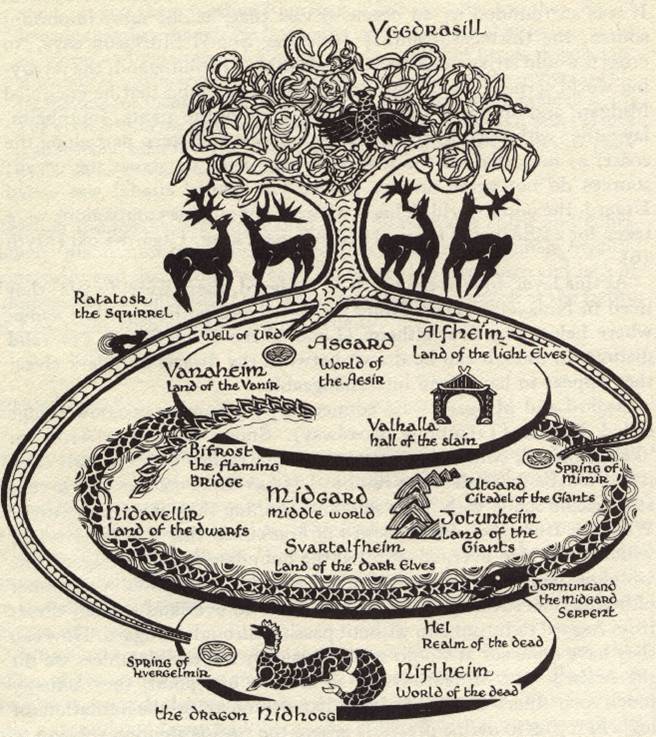
Link: A Collection of Attempts to Diagram the Norse Cosmology

There is uncertainty about the origin and meaning of the name of the Norse world tree.  The dominant hypothesis at the moment seems to be that it means "Ygg's horse"; Ygg being another name for Odin meaning "terror" or "terrible one".  The name may be intended to be a colorful term for gallows.  The tree seems to be either an ash or a yew.  This gives rise to a particularly grim thought: If the name of the world tree is Terror's Gallows, it seems that the nine worlds were hung there to die.  This fits nicely with the conception that all these worlds are temporary, to be destroyed on the day of Ragnarok in the final battle.

Here's a quick review of the Nine Worlds, by Norse name, as I have begun to organize them.
  1. Ásgarð – Home of one group of gods, the Aesir, and their hall for heroes
  2. Vanaheim – Home of another group of gods, the Vanir.
  3. Álfheim – Home of the elves
  4. Miðgarð – Plane of humanity and mundane beings
  5. Jötunheim – Home of the giants
  6. Svartálfaheim (or Niðavellir) – Home of the dwarves and lower faeriedom
  7. Hel – Home of the Dead
  8. Niflheim – Plane of Water
  9. Muspellsheim – Plane of Fire
1-3 Are the upper planes, 4-5 are the middle planes, and 7-9 are the underworlds.  Six could be a problem, let's come back to it.  In keeping with my work so far, I am beginning with Norse inspiration and then taking them in whatever direction they need to go.  There will probably be a tendency to go next to Judeo-Christian sources next, but I will also be drawing heavily from the D&D pastiche, whose sources are listed in suggested reading lists or appendices.

Let's start with the three upper worlds.  I like the idea that the elves are other-worldly, and that they are an alien presence in the middle world of men.  Drawing from the old D&D books, I will take the idea of alignment, and particularly of a conflict between Law and Chaos (thank you, Michael Moorcock!)  I like the pulpy feel that this can give a setting.  This has the advantage here of fitting with two different groupings of gods in Norse cosmology, the Aesir and the Vanir, the latter who had been largely displaced by the time of our sources, who at one time warred.  A lot of folks identify elves with Chaos, so that would leave gods of Law and gods of Neutrality or Balance.  I would go in another direction, however, and identify the Elves as the beings of Neutrality/Balance in a struggle between the Law-beings, centered on a renamed Asgard (Loggard?  Ullgard or Ullurgard?) and the Chaos-beings, centered on Freehome (or a requisitioned and similarly renamed Vanaheim).  The Law-beings have obviously succeeded in appealing to humans, promising their heroic allies a place of reward in an afterlife hall of the brave.  I also want to resist the equation of Law with Good and Chaos with Evil, and keep morality and righteousness as potential separate issues from this struggle.

Middle world is dominated by humans, but also the crux in the struggle between the two opposing alignments of higher beings.  This decision is good for adventuring.  Initial research suggests that "gard" means "farm."  Is farming a part of what distinguishes Midworld from the surrounding realms?  On the edge of Midworld is Giantdom.  Are the mountains the home of the giants?  The barrier against giants or humans?  Or do the mountains just get progressively higher and more inhabited by bigger giants?

The sixth realm is starting to look like a problem to me.  Let's just call it Faerie.  Clearly, it's related to Elfhome in the Overworld.  Let's take the old idea that elves can't be resurrected, but that they can be reincarnated.  Is it a cycle?  Is there a progression, like in Hinduism?  Are elves the top of the fae reincarnation ladder?  This seems likely to me.  Maybe some elves have abandoned the cause of Balance or maybe that is something they have to evolve towards, and that when they finally attain it, they becomes elves.  Does this lower Faerie fit as part of the Underworld?  Or should it become part of the Middleworld?  If it is a part of the former, then that gives a reason for elves to be visitors to Middleworld: to help guide their less evolved kin toward Elfhome.  I think I like this idea, plus the symmetry of three levels and three realms in each is nice.  Up to this point, I have not dealt with where halflings would fit in this setting.  As it is developing, I wonder if it wouldn't be better to drop some of the Tolkienesque associations and make them a fae race.  Otherwise, they are farmers and more like little humans.  It is possible, of course to have a mundane, miniature human race. One could look to pygmy peoples and the mythological portrayals of them for further inspiration.

I have already given the Underworld the most extensive treatment, so let's step back and see how things look at this point, and let's start by strengthening the three tiers and drop the divisions of worlds between them:

The Overworld:  The Dominion of Law, the Fields of Freedom, Elfhome.

The (Middle) World: The Cultivated Lands of Man, The Uncultivated Lands of Faerie, The Giant March.  As I describe it so, I begin to think that the giants and the Chaos-beings are in league: on the side of Chaos to minimize access of Law, on the giants' side to have an opportunity to enslave the smaller races.

The Underworld: In this setting, the Underworld is largely of primordial elements, the main exception being the realm of the dead.  An important question to address next would be, to what extent does the struggle between Law and Chaos extend to the Underworld, and how do the three realms below fit in it?  Are the dead unaligned?  Are the other two realms internally divided into camps of Law and Chaos?  Fire giants and hellhounds (L) versus Efreet, Salamanders, and Red Dragons (C), for example?

Ygg's Tree
As I look back over the experimental structure delineated so far, I wonder if more could be made of the image of the tree.  In what way could we now go back and view the Overworld in terms of the canopy, Middle World  as the trunk, and the Underworld as the roots?  By a continual process of zooming in and dealing with very concrete details and zooming out to see how things are coming together in the big picture, I keep returning to what is accounted for, and what is left to be accounted for.  In this way, questions multiple.  Are clerics both of Law and of Chaos?  In this setting, should they turn different kind of outsiders based on their alignment?  Where does magic come from?  Is it a feature of the Tree itself?  Should treants (=ents) and dryads be given special treatment in this setting?  Maybe the fae races were the original races of this world before some outer power chose it as a prison for these warring factions of Law and Chaos.  Is this outer power Ygg?  Or is Ygg the original of the fae races?  I like the pulpy feel of the name, Ygg.  Maybe this universe should be called Ygg's Tree.  Maybe when one looks up from Middle World at night, instead of seeing the Milky Way, one see a nebula that looks like the foliage of a celestial tree, giving the tree identification a visual focus.  In the threefold world of Ygg, an intelligent race of tusked, magical caprids discuss philosophy, while in the mountains, clerics call yetis to protect their shrines against the ravages of marauding giants...

See Collection Linked Above
EDIT: Broken picture fixed.  Seems like this has been happening recently.

Wednesday, April 27, 2011

W is for Wells

Norns at the Wyrd Well by L. B. Hansen
Wells, springs, fountains, sources -- places where water comes bubbling up from the depths into the upper world to support human life have been identified as holy places from time immemorial.*  This is true of the Norse sources we have been drawing as well.  In the Marvel diagram of the Nine Worlds I linked a few days back, three wells are shown: Urðarbrunnr, Mímisbrunnr, and Hvergelmir.  These wells or springs have suggestive, even mysterious places in Norse mythology that we only have a very partial knowledge of today.  But they provide a powerful mythic image -- conveniently appropriate to the letter of the day! -- for us to continue our exercise in world-building.  Keeping the original names is probably a little much for my preferences, so I would bring them over something like this:

Wyrd's Well (Urðarbrunnr) Running between the Home of Heroes and the Home of the Dead, attended by the three Norns, though named for some reason after only one of them, Wyrd.  This well is connected to the fate of all who are born and die in the Nine Worlds.  I'd hate to think what a sip from or a dip in this well might do...but it might be a likely preparation for a descent to the dead.  This raises the questions of who the three norns are, and the relation of other fey water women (nymphs, nixies, swanmays) to this trio, Bygone, Necessity, and Wyrd.

Mimir's Well (Mímisbrunnr) At the farthest roots of the World Tree, reaching down to depths no one knows (into the chaos of the void?).  This well demands a significant sacrifice for access to its wisdom.  This sounds like the perfect magnet for a magic-user who wants to lay it all on the line for access to a secret or great power.  If you keep the association with Mimir's head, wouldn't you like to see the well bubbling forth from his mouth?  Further inspirational images would be of the great stone heads in Angkor Wat and Mesoamerica that are entwined in tree roots, as Mimir's head would be in the roots of Yggdrasil.

Mimir by Trishkell

Boiling Springs (Hvergelmir) Between the Plane of Fire and the Plane of Water, it is the source of the clouds and mists over the Plane of Water.  Doesn't sound inviting, does it?  Perhaps it is simply the passage between the two planes and the armies of fire and water elementals flinging themselves into combat and dying create the boiling spring.

Such mythic locations as these wells could be the object of a quest, the gate to a quest, guarded by terrible guardians or a dungeon, or a location in a megadungeon; in any of these, a nexus between the elements of the setting and the characters' plot-lines promising an unforgettable gaming experience if utilized to their potential.

The Norns by J. L. Lund


*For Jungians, these are symbols of the Unconscious itself, welling up into Consciousness.

Monday, April 25, 2011

U is for Underworld II

Part II: Denizens of the Underworld


Looking at the Norse Nine Worlds,* four seem to clearly fall into the realm of the Underworld:
  1. Svartalfheim: Home of the Black Elves
  2. Hel: Home of the Dead
  3. Niflheim: Home of the Mists
  4. Muspelheim: Home of Fire
Turning to the creatures listed in the Moldvay and Cook books, I've sorted those that seem to obviously fit into these four, though a few may call for further comment.

Svartalfheim is identified with the dwarves explicitly in Norse mythology.  We might also stick the gnomes here, as relatives of the dwarves.  But all the other creatures that traditionally have a connection with the elves, that fit in an Underworld setting better than a higher concept of Elfland, arguably belong here: bugbears, goblins, hobgoblins, kobolds, and orcs.  These traditional enemies of dwarves and gnomes suggest an underground realm that is full of conflict and warfare.

Hel is the realm of the dead who are not great heroes.  It is also where one would expect the undead to originate and generally dwell.

Niflheim is wet and cold, a realm of mists.  Here the white dragon, water elemental, and frost salamander would best dwell.  Though there is a an over-world location for giants, the frost giants would also fit well here.

Muspelheim, the realm of flame, is the natural home for fire giants, efreet, fire elementals, red dragons, hell hounds, and fire salamanders.

What does an Underworld divided into such regions suggest?  For one, the further down one goes in the Underworld, the worse things get.  Svartalfheim, one might be tempted to call it the Underdark, the Feydark, or Underfaerie is a realm that is dominated by evil humanoids, but still has dwarves and gnomes in it (although, the dwarves are more morally ambiguous or even evil in Norse literature than they are in traditional high fantasy).  Hel is the realm of the mass of the dead, but also of the evil undead.  To avoid later associations with Hell, one might rename it the Kingdom of Death or the Deadlands or the Hollow or the Valley of the Shadow of Death or some such.  It could be ruled over by a Queen like Hela or Persephone.  Niflheim sounds like an elemental plane of water, but the best that one can hope for in sea with lands and mountains of ice, covered by mists, is moral neutrality: the giants and dragons are evil.  Muspelheim is the elemental plane of fire, where again the neutral elementals seem outnumbered by very evil races.  Passages between these domains would perhaps be by means of wells, which were significant in Norse mythology, or by means of the roots of Yggdrasil, itself.

A megadungeon complex might well cross through multiple of these Underworld domains, which hardy adventurers  would brave as they trace surface evils to their sources or seek treasures of the Underworld, but Angela's comment on part I brings to mind another possibility that has often been overlooked -- very strangely given its prominence in the myths.  In games that have allowed the resurrection of characters, this has often been the availability and affordability of the spell for the raising of player characters of major NPCs.  But what if the spell was just one component that was necessary?  What if the party had to make a trip into the realm of Death to reunite body and soul with the spell?  Keep in mind that the god Pluto and Plutus, or the god of wealth, were often identified as the same god.  This would keep resurrection from being too common in game and also work character death and resurrection into story in a more direct way.

An initial identification of four regions of the Underworld in this way marks the beginning of the (sub)creation of a distinctive campaign setting, suggestive of further elements, such as the purpose of quests and the way that certain magic works.

*There is no universal system of imagining the arrangement of these worlds in Norse literature.  This one makes sense to me.  There might be an argument for locating the realm of the giants (Jotunheim) as a whole in the Underworld, but it does not make sense to me to put giants of hill, stone, cloud, and storm there (not to mention ogres and trolls), as much as to put the home of the frost giants in Niflheim, just as the fire giants are in Muspelheim.