Showing posts with label Hero. Show all posts

Tuesday, October 15, 2013

Campbell's Mythopoeic Soup, you say?


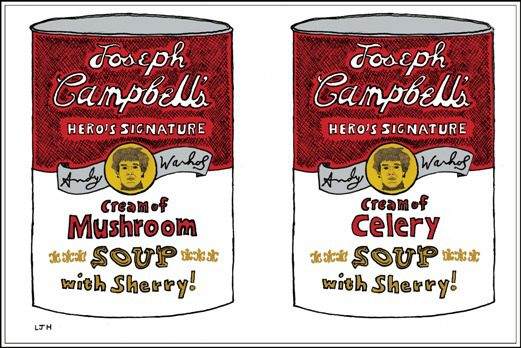
Bound to be overly processed and loaded with sodium, says I.  But don't take my word for it.  Head on over to Black Gate for this interesting reflection.

Oh, and to the commenter who noted that Campbell gets things wrong when he talks about areas he knows well, that's exactly how I feel when Campbell talks about the Judeo-Christian tradition.

Wednesday, April 18, 2012

P is for PALADIN, Part 2

This post is my second meditation on the paladin.  For last year's, see here.


"Don't deny your rowdy nature, paladin.  And don't take advice from old people."

from season 1 episode 25, "His Hero."


Pendleton Ward had included plenty of hints in previous episodes of Adventure Time.  Finn had previously referred to his alignment and his inability to act against it.  In episode 23, he refuses to kill a Neutral creature, as he will only kill evil ones.  In episode 24, he tells Bubblegum he can't beat up the Ice King for no reason.  "It's against my alignment!"  The kind of character that worries this much about not transgressing against his alignment is, of course, a paladin, so RP gamers watching had known that Finn was a paladin before the old lady calls him one in episode 25, and before Ward explicitly acknowledged the fact in an interview on Wizards' Dungeons and Dragons website.


The name derives from a Roman term for a palace official, and thence came to be applied to Charlemagne's Twelve Peers, and later to all chivalrous heroes.  Gary Gygax (Supplement I: Greyhawk 1976 -- spelled out further two years later in the PHB) took the term for such a paragon of knighthood and added to it the sanctity of the ideal crusader -- a crucial development that goes beyond even the importance of the Christian identity of the Twelve Peers contrasted against the background of their Saracean foes.  This development gave games from D&D and its descendents, including WoW, the name for their holy warrior classes, when the obvious term in the West would have most likely been crusader.  Perhaps the denigration of that name mitigated against its effectiveness as a choice.  It is interesting that the original uses of the name would have better suited it as the name of a member of a royal order of knights bound to a king -- such as Finn and Jake play in season 2, episode 3, "Loyalty to the King" of Arthur's Knights of the Round Table.  But perhaps the later, especially those devoted to the Quest of the Holy Grail, will help us to bind the two concepts together, with paladins being Lawful in so far as they are bound to a king or other divinely ordained ruler of law and Good in so far at they are devoted to their deity.*  This could provide a fun source of tension as well for the character, when there is the potential for loyalty and holiness to come into conflict.

As Adventure Time so bluntly points out, the paladin uses violence for ends that are both lawful and good: in particular, the protection of the weak.  For more on the chivalric code, see here and here.  Crafting a bipartite code for a paladin that spells out in one part his duties to his leige lord (or lady) and in another, his duties to his heavenly Lord (or Lady), would go a long way towards world and character building, whether for fiction or gaming.

In addition to Mallory's Morte d' Arthur, I'd rewatch  Ridley Scott's Kingdom of Heaven, although I did not like the director's cut which seemed to step away from the fine line of showing the good and bad on both sides and towards being obviously anti-Christian.  Therein are examples of the holy warrior struggling to be bound to both God on one hand and to his King and kingdom on the other.


* Let's not pass up the opportunity to link this Lawful Good entry.

Monday, April 9, 2012

H is for HERO


Stories catch heroes like honey catches flies.  With all the varieties of stories, we have evolved simultaneously many different types of heroes and heroines.  In the most general sense, a hero is a protagonist, that is the (or a) main character with whom the audience identifies and who is in conflict with the antagonist (or villain).  In its original Greek usage, a classical hero was semi-divine human (in other words, a demi-god), such as Heracles, Theseus, or Perseus.  Even the Greeks weren't satisfied with the classical hero alone and quickly followed him up with the tragic hero.  If you think adding anti-hero to the list and calling it a day covers the field, you haven't sunk nearly enough time into thinking about the field of heroism.  Start in the shallow end with the introductory articles in Wikipedia and in TVTropes, and then get ready to lose hours of the day and maybe even some of your comfortable hours of sleep for starters, for you've skipped over many kinds of heroes, only to land in anti-hero land which also has a diverse population of types, and have a lot of catching up to do.

Once you have of populated a goodly list of hero types, then you can ask questions about the necessary structures and elements that have been proposed by modern theorists from Carlyle to Raglan to Propp to Campbell.  So much for simple courageous self-sacrifice for the good of others in the struggle against evil!  As long as human nature and our understandings of good and evil remain complex and placed in diverse contexts, we are likely to continue to tell complicated stories of heroes that develop the options for heroism in ever more baroque patterns.

Wednesday, August 24, 2011

Female as Fantasy Goal


Fantastical fiction is, felicitously, no longer the forbidden fiefdom of phallus-kind.  In spite of the success of female authors and the growth of female fandom, the ongoing strength of male, and specifically heterosexual male, perspective is undeniable.  For good or ill, fantasy was and still is highly popular with male readers.  The extent to which fantastical fiction is subject to this perspective and to which it incorporates the quest motif, is the extent to which the male quest for a woman, or women, or The Woman, exerts itself in fantastical fiction.  This came to mind as I thought back over three novels that I have read in the past year in which main male characters' quests for female companionship end in ways that suggest certain patterns.  For what it is worth, I am assuming that there is nothing particularly significant about the fact that these three novels are all game-related.

SPOILERS FOLLOW FOR
Saga of the Old City (1985) by Gary Gygax,  
Man of Gold (1984) by M. A. R. Barker, 
and Prince of Wolves (2010) and Master of Devils (2011) by Dave Gross.  
If you haven't read the latter three books, I highly recommend that you bookmark this post and come back later.  I will at least try to soften the spoilers for Gross' novels, so as not to undermine my ongoing campaign to convince everyone to read them.  No seriously, go read Gross' two NOW, then come back.  I'll keep the post up.


In Gygax's first novel, the young thief Gord strives to rise from his humble beginnings and make his way in the world (of Greyhawk).  A part of his rise is finding a woman.  The first two are false prizes, but all indications are that he finally has found The Woman in Evaleigh.  (PS She's a princess.)  Only she turns out to be The One Who Got Away.  Thus Gord is free to continue his Oerthly wanderings.

In Barker's first novel, the young scholar-priest Harsan leaves his life of quiet study in the temple and is set upon a path of adventure and advancement in the world of Tekumel.  First he meets the bad girl.  Then he meets the good girl.  Finally {MAJOR SPOILER} he ends up getting both the sexy bad girl (who is high caste) and the sweet good girl (low caste and with a curse), because -- hey! -- who doesn't want to have the wish fulfilled of having the best of both?  (It is natural to suppose that Barker's conversion to Islam makes polygamy a live option for his character.)  My expectation from the double domesticity of the hero at the denouement is that Harsan's career as an adventurer is at an end.

Dave Gross' excellent novels, set in Pathfinder's Golarion, follow the exploits of Pathfinder and nobleman Varian Jeggare and his bodyguard of partially demonic heritage, Radovan.  In the first, we glimpse a noblewoman of Count Jeggare's past: a youthful flame who gives every indication of having been a female mentor and a bad girl.  Radovan, however, meets both the sexy bad girl (a real bitch!  No, I'm not being a male pig, honest!)  and the sweet good girl (with a curse).  Radovan leaves them both behind when he must leave the scene of adventure for home, though he certainly continues to think of them (am I wrong to think the former carnally and the latter as something more than merely carnal?) afterwards.  In the second novel, the ladies are off-limits to Radovan, because he gets stuck in a state of demonic, uh, enhancement.  So it's Jeggare's turn to have a love interest: yep, she's a princess and has the potential to be The One.  However it doesn't work out, and there's some indication that she may instead turn out to be The One Who Got Away. 

From this selection of three authors and four novels, common characteristics recur in regard to the female love interests of the male main characters.  In the stories of Gygax and Gross, the females who are the characters' goals elude them.  The character (particularly in the case of Jeggare) is deepened by loss and is kept free for further unattached adventuring.  Further, male readers who have suffered the loss of a beloved woman are given the opportunity to strengthen their identification with the heroes.  In Barker's story, the struggle of the book is doubly rewarded, and the male reader enjoys the fantasy of not having to choose between two desirable women -- who, incidentally, resonate with different archetypes.  Hmm, now I'm tempted to go back and analyze all these female love interests in terms of four feminine archetypes.  Maybe I will save that for a future post.

Friday, April 22, 2011

S is for Sacrifice III: Gaming

Part III: Sacrifice in Role-Playing

In this installment of "S is for sacrifice," I explore two ways in which sacrifice can contribute to your gaming: sacrifice proper and the sacrifice of characters by your players. 

Religious Sacrifice
Before the loss of the Jewish temple and the substitution of the bloodless sacrifice tied to the blood of Christ, religion everywhere was dominated by the immolation of victims as an offering to the numen or numina.  I'm sure this happens in your games, but I bet when it does, it is usually something like this:

Frank Frazetta, Sacrifice, 1980 - Cover for a Conan book
Now, there's nothing wrong with this as far as it goes.  Villains that are unholy are especially villainous, and saving beautiful innocents from their clutches is hitting about eleven fantasy buttons at once instead of just one.  But beyond its cliche, and potentially chauvinistic, use, it ignores the fact that sacrifice is and has been a dominant practice in religions that are not summoning devils or waking Cthulhu.  To give the religions in your game setting some substance, look into adding sacrifice, whether as background world-building, plot elements, or even mechanics.  But the characters sending their sweet-smelling sacrifice of some quality barbeque heavenwards is nothing compared to them offering themselves.

Heroic Self-Sacrifice
Above all, I am thinking of the players sacrificing their characters, and the characters sacrificing themselves in-game.  Note I'm not talking about taking a risk that the player-characters recognize could result in character death: they do that all the time in the game, and they generally do it for character gain.  I mean making a decision for the good of others, which the player-characters enact in the knowledge that death is likely or even certain in the attempt to bring about the altruistic outcome.  Being saviors, rather than simply the greatest achievers, is the height of heroism.

Why would anyone want to do this in a game?  To achieve the pinnacle of heroism is obviously a motive on the player side of he equation, more than the character side.  It could be the denouement of the player's character development.  It could be the attainment of some great goal that they have long been gaming towards.  Experienced gamers know nothing is as dramatic as death, so this will make your game dramatic like nothing else will.  I should say, death that is not stupid--experienced gamers have also seen some pretty lame deaths in their days, as well.  But just imagine the possibilities when the players have been empowered to achieve meaningful deaths for their characters.  In all the creative and exciting things I have done in my (cough, 30) years of  gaming, I've never done this intentionally, and I owe the idea to my college DM, who discussed the idea with me on the phone recently.  (Commendations to you, K.A.)

I hope I don't need to argue that suicide for escape, dramatic effect, or for religious reward is not heroic self-sacrifice, but selfish acts that at best on masquerade as heroic self-sacrifice.  If done well, I'll wager players will never forget their heroes' deaths, and it can then be folded into the world-building so that it is an ongoing part of their new characters' experience.  Just don't make the mistake of role-playing Valhalla.

ST2: The Wrath of Khan.  "The needs of the many..."

Monday, April 18, 2011

P is for Paladin

Emperor Charles the Great by Albrecht Dürer
Roland, the most famous of Charlemagne's Paladins.
And you thought I was done after blogging about Knight Arthur and his Knights of the Round Table!  Not when Charlemagne had his Twelve Peers, who were also known as Paladins (literally, "of the Palace").  But the term paladin has come to have special freight in our day.  It started with this guy, seen below.


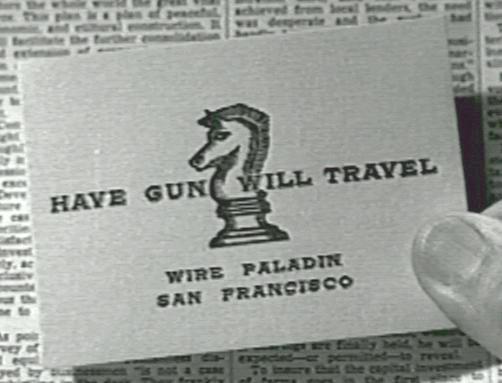
The titular character of Have Gun--Will Travel was simply known as "Paladin."  The connection between the Western hero (or cowboy) and the Knight (chevalier or cavalier) is made explicit with his calling card.  Not convinced?  Give the ballad a listen.


It's no surprise that the hero on the white horse moved from Medieval Western Europe to the 19th C. Western United States.  The translation will also be made back and forth with the Samurai in Japanese movies, particularly those of the great Akira Kurosawa. Then along came the Dungeons & Dragons phenomena in the 70s and 80s.  Little boys who'd never heard of Charlemagne were suddenly pretending to be warriors who were not only noble, but even holy and righteous.  It was Lawful Good or bust!

A Paladin in Hell by David Sutherland
This iconic hero thus spread throughout everything touched by D&D, including the MMORPG behemoth World of Warcraft, and children's cartoons.  Behold today's paladin, adventuring weekly on Cartoon Network!  (If you've been following me previously, you know he's one of my current favorites.)

"I'm a righteous boy!  I can't do that, it's against my alignment!"
The way we picture the righteous, noble warrior may change, but this iconic hero is here to stay.  Let's close with Paizo Publishing's take on the paladin.  Though clearly within the tradition, in this case it's no stretch to say...

Illustration by Alex Aparin.

You've come a long way, baby.


EDIT: Just found this site.  Hopefully it will be expanded.

O is for Orphan

AAARGH!

I shouldn't have prided myself on being relatively unique in my choices for the Mythopoeic Abecediary of April, knowing that I was setting myself up for a Fall of the Ninja Kind.  Blast you, Archmage!  Well, the train is too far down the track to call it back now, so I'm sticking to it like gruel to a spoon.  His post, after all, takes the subject both coming from and heading in a rather different direction.  He also focuses on the orphan in role-play gaming, while my reflection only starts with role-playing.

"Please, sir, I want some more." Illustration by George Cruikshank


There was a period of time where I was getting to do a lot of one-on-one gaming with my daughter, and our gaming circle couldn't keep up with our schedule in group play.  The result was that she made many characters during this time, and got to explore lots of class, racial, and gender options in mechanical terms, as well as in story potential.  All this character generation can be rather time consuming, especially when you want to get down to the actual play, so I fell into a habit when she was working on back story.  "You're an orphan," I apparently said one too many times, from the heights of Mount Game Master Dad.  She finally complained.  "Da-a-ad...all my characters are orphans, except one.  And she was a foster child who didn't know her parents."  "Oh," I responded, I am sure unconvincingly.  While likely there was then a part of me that was a little nervous about family-of-origin issues coming into our games, the main reason beside getting things going were these: 1.  orphans aren't tied down and can haul off and go adventuring whenever they want, 2.  it introduced unknown elements that we could uncover later in gaming, without creating more on the spot, and 3. the orphan is a sympathetic character.  Obviously this habit had become a crutch and a cliche by that point, and my daughter wanted to address this in her share of the world and character building.  Bless her heart, she wanted "some more."

Still, used with discretion and temperance, I find a lot to be said for the figure of the orphan, in terms of freedom and sympathy.  Her unknown parents provide a blank slate upon which creativity may sketch, and whose surface may hide a mystery.  If she takes up a quest, we say to ourselves that orphans don't have a place in the world and so must go out and find or make it for themselves.  And seriously, who is going to root against an orphan?  They're the ultimate underdogs, economically and emotionally.  And any ties they have are made all the more precious, like Chestertonian treasure saved from Crusoe's ship.  Frodo Baggins, after all, was an orphan, and the anxiety that the Pevensies will end up that way are in the background of the first few Narnia novels.

What is the defining issue or issues at the heart of the orphan?  Abandonment, bereavement, want, identity, belonging.  These are powerful human issues; perennial, yes, but I think that belonging and identity may be among the biggest concerns of our time, even in parts of the world where abandonment and want are less pervasive.  Choosing the orphan allows the story to explore this cluster of issues, so we shouldn't be surprised if the choice is timely.


It looks like there are at least eight TV tropes associated with orphan at the eponymous website, so I am not the only one who has overused this character feature.  Being encouraged by the new visitors, comments, and followers of the blog, I would love to hear your thoughts on this.*  What do you think?  Is the orphan overused in certain genres?  Do you have a story about a cliche that you got stuck on in your writing, playing, or other creative outlets that you'd like to share?  Do you have other reflections on orphan characters?  I'd love to hear from you!


*Or indeed, any of the matters on which I have blogged.

Wednesday, April 13, 2011

K is for the King and his Knights

N. C. Wyeth's Frontispiece to The Boy's King Arthur
The image of the king, and especially the ideal king, is as powerful as it is widespread.  One testimony to its power is the popular appeal of this image within modern democracies that are fundamentally anti-monarchic.  Without even turning to Walt Disney, Cartoon Network's Adventure Time provides us with an example.  While there is an abundance of princesses in the setting of the cartoon, the main king that we have seen is the Ice King, one of the major villains of the series who is a serial abductor of princesses and sworn enemy of Finn and Jake, the heroes.

{Spoiler Alert!}

In the episode, "Loyalty to the King," the Ice King shaves his beard after his latest "romance" with a princess has come to an end with her escape from the Ice Kingdom.  Without his major identifying feature, and looking presumably much younger, princesses are suddenly fawning all over him instead of fleeing his sight.  Through his quick-witted capitalization on a misunderstanding, he comes to be known as the Nice King.  Upon hearing of the arrival of a Nice King, the heroes immediately go to offer to enter his service.

{End of Spoiler}

I am sure that my gentle readers can multiple many examples of the ideal King, but in English-speaking contexts today, as well as for much of European history, the example par excellence is the legendary, perhaps semi-historical, Arthur.  He exemplified the virtues of wisdom, learnedness, justice, piety, and courage, skill at arms, and leadership.  Chosen by divine providence, and perhaps other numinous indicators, he had the gift of charisma,* like the Israelite leaders of old did.  The ideal king is worth being loyal too, and so other men of nobility and gifts are attracted to his court and his rule.  Enter the knights.

Is it because even heroes need a hero?  Is it that a bunch of gifted and testosterone-heavy, if not violent, men need an alpha male for social purposes?  Or is it a common human yearning to make a virtue of necessity: if we must have a leader, we yearn for one of nobility, of destiny, one who is worth-ship-ful?  Or is there simply a high degree of success that tended to accrue to past societies who gave immediate and radical obedience to the leader who inevitably has to make difficult and dirty-handed decisions? (A kind of social Darwinian advantage to the theory of the divine right of kings, if you will.  Cue Socrates with the Founding Lie.)  I've been reading James Branch Cabell lately, and he makes a good deal of fun of the human need for the Redeemer figure.  The ideal king can simply be a more secularized version of the Messiah: Jesus had his Twelve Apostles, Arthur had his Knights of the Round Table.  Meanwhile, mythopoets in the Lewis-Tolkien school (continuing a tradition from Christian apologists in the late Roman world) might see this as the way that all mythology reflects the truth at the heart of our world, and Jungians would search for the way that it reflects the archetypes of the Self.  But whatever the reason, his heart or his shoes, Arthur sat there on Whitsun eve with knights in his mews.**  Even Cabell's King Manuel has a Fellowship of the Silver Stallion.

Clearly we expect for knights to be champions of a virtuous king, gathering around him and then dispersing in benevolent errantry throughout the land or being sent on specific quests.  Among them there is a fellowship of loyalty, mutual interest, righteous heroism, and dangerous competition for training purposes and for renown -- tournaments.  That we still yearn for something that the King and his Knights represent, is evident in that fact that they refuse to disappear from our cinemas and television screens, video games, and comics.  To some extent, the Walt Disney empire rests on the foundations of Camelot, as seen by the presence of the storybook castle as the center of his theme parks.  But in recent decades, the multiplication of Societies for Creative Anachronism, for training in medieval martial arts, Renaissance festivals, Shakespeare companies, and even restaurants where you root as opposing factions over a faux, live medieval tournament while dining on hearty fare without knives and forks show that our need or our desire for the King and his Knights may be stronger than ever, even in the land that did away with kings and nobility.  (So, who's planning on watching William and Kate's wedding?)

Medieval Illumination of the Knights at Arthur's Round Table

Whether you build on the assumption that a group of noble, renowned, loyal warriors gather to the banner of the ideal monarch or you choose to question or even subvert it, you are trading on the expectations accrued to this well-known and well-received premise.  With the richness of the institution politically, religiously, historically, and mythically, it has a lot to offer in terms of commenting on these dimensions, building setting, developing characters, and it comes with traditional plot elements built in to it.  But trade on the desire to develop oneself in heroic directions and to belong to an ideal community are powerful, so caution should be used when taking it in non-traditional directions.


* Note that the common usage of the word (1) is actually derivative from the earlier, more technical usage (2).  We have Max Weber to thank for the reintroduction of the term in scholarly discourse outside of theology (further down in the article).

** Eat your heart out, Theodor Geisel.

Tuesday, April 12, 2011

J is for Journey

A classic journey story that dominated my young imagination. 20th C Fox, 1959.

The Journey is a powerful motif, everywhere you look.  We conceive of life itself as a journey from our mother's womb to the womb of the earth...and perhaps, for those who believe in a final eucatastrophe, beyond that.  Dante journeys from Earth to Paradise, via Hell and Purgatory.  Bilbo journeys from the Shire to the Lonely Mountain and back again.  Frodo journeys from the Shire across Middle Earth to Mount Doom and returns to the Shire, only to discover he must journey out of Middle Earth forever, to the Undying Lands in the West.  The Aeneid tells Aeneas' journey from Troy to Rome.  The Bible tells of humanity's journey from the Garden into exile in the dying lands back into a recreated Garden.  Even in the prosaic literature of America, Huck and Jim journey down the Mississippi River.

As much as we talk now of the hero's journey (there's just no getting away from that Campbell fellow these days), we each strive to be the hero of our own story.  It's an excellent question to ponder when other questions fail.  In the story, where are the characters going?  In a game, where are the player characters going?  And of course in life, where are you going? 

Wherever you find yourselves on your journeys: Bon voyage, my fellow ramblers.  If we learn anything from our furry-footed friends, it's a good idea to make the trip with true friends.  On the other hand, a model poet may not be a bad choice for a guide, either.

"In the middle of the journey of our life, I came to myself within a dark wood where the straight way was lost."*

* Dante Alighieri, Inferno I.1-3Illustration by Gustav Doré. Things start looking up once he finds Vergil.

Monday, April 11, 2011

I is for Initiation

An Epiphany of Dionysios, who is called Dithyrambos
The epitaph of one of the central Mystery figures seems to connect him with "two doors," and is applied not only to the hymns dedicated to him, but to the god himself as well.  If this is correct, it is not surprising: Dionysios was born twice: once from his mother, and once from his father, Zeus.  (By some accounts, he was even thrice-born!)  His devotees are those who are likewise born a second time through the initiation into his Mysteries.

Joseph Campbell, in his enormously popular proposal of the so-called monomyth, makes much of initiation as one of the stages in the universal meta-story of the hero.  "The traditional idea of initiation combines an introduction of the candidate into the techniques, duties, and prerogatives of his vocation with a radical readjustment of his emotional relationship to parental images... Ideally, the invested one has been divested of his mere humanity and is representative of an impersonal cosmic force.  He is the twice-born: he has himself become the father." (136-137).  This passage nicely sums up Campbell's view, and also evinces some of its weaknesses.

(cc) NID chick
In Hinduism, Upanayana or investment with the sacred thread is the initiation ceremony, traditionally restricted to boys of the three upper castes -- the castes known as "Twice-born."  Campbell might well point out the importance of the roles of the parents in the investment, but while the rite does bring boys into the first stage (ashrama) of life, Student, it does so as members of a larger social structure (the caste system).  Further it is the basis in some areas for future investments: at graduation by one's guru and again at marriage -- the husband taking on the thread that the woman could not take on for herself.  Campbell shows a bit of a tin ear when it comes to the gender and class issues, undoubtedly in part due to his focus on the individual hero.

As I've mentioned before, our knowledge of the Dionysiac rituals are minimal and subject to a good deal of uncertain speculation.  For the images of the villa in Pompeii, see this website.  One must always be cautious in making broad statements about phenomena across the religions, but this much seems safe: To be initiated means to mark a milestone in one's personal development, to join a particular group, to become the keeper of a special doctrines and a special story that one previously had limited access to, responsibilities for, or privileges in, and to partake of the realm of the unseen, of numinous power, in a new and inward way. These empower one to undertake new actions or a new way of life.

One must imagine waiting in the dark, being led by others in unseen paths, and then emerging into a secret world--like a womb--lit for the passing of hidden knowledge...where one sees what can be revealed only to those who belong on the other side.*

* For more information, you may see this article, which will also suggest alternatives to the theory that I think is plainly correct.

Saturday, April 9, 2011

H is for Heart

(C) Konrad Schuhmann

We English speakers have a particular usage for "heart."  For contrast's sake, we have only to notice the Hebrew usage: the heart is where you think things.  (The phrase, "says in his heart" and its equivalents is common in the Bible.)  In English, it is the seat of the emotions, which seems to reflect a distinction between feelings and thoughts.  I'm all for distinctions, but this may have the disadvantage of cutting things off from one another, so that, following certain Greeks, we shall have warfare between the heart and the head, with the prejudice that it is the head that should always win.  (Which inevitably gives rise to those who say in response, "Follow your heart.")

Beyond this generalized usage, we talk about people with true hearts and good hearts; people with their heart in the right place and people who do things whole-heartedly.  So the heart stands especially for loves and loyalties, the desire, bond, and intentionality directed toward their objects, and the strength of these loves and loyalties.  When we want to measure the strength of the heart in adversity, we switch to our Norman French word: courage.  But in the concrete, we are just as likely to say, "Take heart!" 


If myths and Faerie are all about the heart's desire, then it is just as much about the testing of the heart to see if it is worthy of attaining its desire.  "Blessed are the pure in heart, for they shall see God."

For the Egyptian Afterlife, the Heart must not outweigh the Feather of Maat

So, ramble forth, Mythopoets!  Faint heart never won fair lady (or lord)!

Addendum: It might have been hoped by some of my non-Texan readers that I would finally and fully parse "Bless your heart" for them.  I despair of every succeeding in this instance, but I assure you that the widespread assumption that it is disingenuous or even malevolent is simply false.  Its usage is very broad and is dependent on context and intonation.

Friday, April 8, 2011

G is for Gandiva and Glamdring

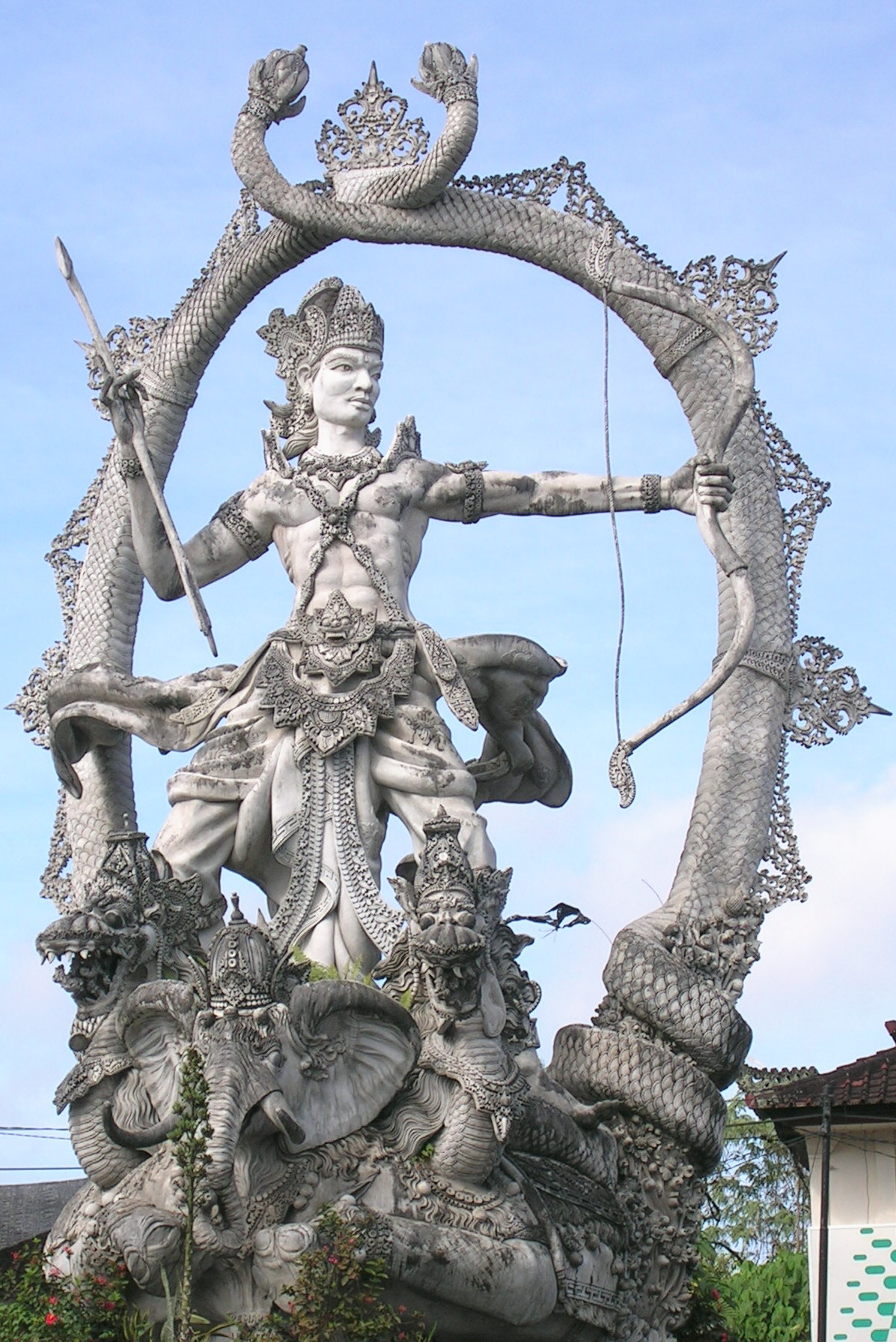
Balinese Statue of Arjuna with Gandiva in hand.  Photograph by Ilussion.
I believe this is one of John Howe's earlier attempts at The Bridge of Khazad-dûm.


Heroes do not get their weapons at Walmart.  Their weapons are not mass-produced in some Chinese factory.  As unique as heroes are, so unique are their weapons.  In mythopoesis, in sub-creating, nothing should be wasted.  The hero's weapon should be a part of world-building, a contributor to characterization, and an element of the plot.  Today's blog is dedicated to famous, named weapons.

We all know that Penelope's suitors do not stack up as men, because none of them can string Odysseus' bow.  And it is this failure that is one of the elements that will allow Odysseus to both reveal himself and slaughter them all.  Elric of Melniboné's evil sword Stormbringer allows him to overcome his genetic weakness and become a great swordsmen, while also dooming his soul and the souls of his loved ones.  Arthur's Excalibur symbolizes his kingship and his otherworldly patronage.  When Gandalf draws Foe-hammer against the Balrog at the Bridge of Khazad-dûm, we remember its discovery in the troll hoard, and the fear it inspires among goblins (orcs), but the real Middle Earth fanatic will tell you this sword of Gondolin was wielded by Turgon, the only elf to be King of Gondolin, in his wars against the orcs.  It is ancient, it is powerful, and it confirms Gandalf's -- or Mithrandir's -- connections with the elves as well as his own nature as an ancient power.  It is notable in this case that it is not given to him, but found as an apparent accident.  Where other writers make a point of handing such weapons over to their heroes in a weighty scene, Gandalf bumbles into Glamdring.  (Try counting up the accidents that make all the difference in The Lord of the Rings sometime.)  And finally, Gandiva: the bow of gods and heroes, against whom no foe can stand, whose release resounds with thunder.  When it slips from Prince Arjuna's hand as he stands across the field from the Dhritarashtran forces in the Bhagavad Gita, we know that the power to make war has slipped from the mighty warrior's hands, until it can be restored to his limbs by a god, just as the bow itself came to him by the hands of a god.

These weapons, have names like important characters do, and they have a history of their own that makes them a feature of their worlds-of-origin.  They compliment the characters they are paired with: interacting with their strengths and weaknesses, fulfilling our desire to wield part of the enchantment of Faerie in our hands through our identification with the character, providing the character with motivations.

Anybody looking forward to Marvel's film version of Thor?  I recently saw that the toys are already out in anticipation of its release.  Guess what I saw at Walmart?  Yeap.  Two different versions of Mjölnir.  I mean, what wouldn't I do if I had Thor's hammer...

Monday, March 14, 2011

Luminous Beings and Crude Matter


"Luminous Beings are we...not this crude matter." Yoda to Luke in The Empire Strikes Back


"It is written, 'Man shall not live by bread alone, but by every word that proceedeth out of the mouth of God.'"  Jesus to the devil in Matthew 4:4


It is perhaps not mere coincidence that these two lines resonate for me.  Presuming that the Hero's life follows a common pattern, note that Yoda speaks on the wild planet of Dagoba, where Luke has gone to train under the great Jedi master.  It is here that he is tempted: he fails.  He fails to recognize Yoda; he fails to lift his ship; he fails the trial at the cave; he fails to live with the tempting vision of his friends and leaves with his training incomplete.  In the gospels, Jesus speaks in the wilderness of Judea, where he is fasting and being tempted by the devil.  There is a certain parallel between the journeys of the two heroes.  It's been widely discussed that Lucas was, at some point, strongly influenced by Joseph Campbell. Taking theories like Campbell's, or the earlier attempt by Lord Raglan, one must proceed with caution.  The specific details of a hero's journey are at least as significant as the broad pattern in which any Hero's journey falls.  In the crafting of a heroic journey, one must ask not only about the path, but the destination, whether in the telling of a story or in the living of a life.

More important than Campbell's influence, Campbell was influenced by Jung.  Yoda's retort to Luke when he doubts his ability to use the Force to pull his ship out of the bog is, perhaps, Lucas' objection to a strict materialism that is tempting to many in our time.  This calls to mind the attraction of Jung to gnosticism.  Though always objecting that he was forming his psychology on an empirical basis, Jung clearly valued something metaphysical beyond its physical ties and manifestations: the Self.  Is the Self beyond bodies?  Expressed in bodies?  Or is it hidden and trapped in bodies?

The assertion as it stands gives us a classic case of the false dichotomy: either we are matter or we are not-matter (candidates here are such as spirit, soul, or mind).  If our essence is matter, then we turn to the lower tiers of Maslow's hierarchy: matter calleth unto matter.  If our essence is not-matter, then we must look beyond the material realm for a meta-motivation to satisfy the human heart, as for example Augustine of Hippo does in his Confessions.  But gnosticism tended and tends to make an absolute dichotomy between crude matter and the true essence of humanity, unlike classical forms of Christianity which posit a union between matter and spirit.  So the one that Christians take for the divine Logos incarnate does not say that human beings do not live by bread, but that they do not live by bread alone.  There's a struggle between the two to be sure, but it is not a struggle that is to result in the elimination of matter.  There must be cooperation and even a transformative union between the two for traditional Christian systems to work.  Maybe Lucas moves closer to this position in the later prequel trilogy, where he creates a physical correlate for the Force: the midichlorians.  Maybe he was already struggling in that direction with all his talk of the immanent Force:  "Here, between you...me...the tree...the rock...everywhere!  Yes, even between this land and that ship!"  And yet, are we betrayed back to body-denying gnosticism by the ghostly specters of the dead Jedi at the end of Return of the Jedi?  It is hard to be sure.

The key issue is this: Does the agon of the hero overcome crude matter in favor of the divine spark trapped within it?  Does the hero strive against the illusion of something other than matter?  Or does the hero strive for some kind of synthesis between the divine and the mundane?