Showing posts with label Bible. Show all posts

Monday, December 31, 2012

Raiders of the Dead Sea Scrolls!

Dr. Jones & the Case of the Fishian Tablets


Before the Christmas holidays, I got in town just in time to see the Dead Sea Scrolls exhibit in Fort Worth.  Last year, Google announced their sponsorship of the project to digitize the scrolls.  Consequently, the most important site for study of the scrolls now is the Leon Levy Dead Sea Scrolls Digital Library.  Instead of succumbing to the easy out of making directly for the Wikipedia article, I invite you to check out some of the links below to learn more.


Naturally, the trip excited not so much any temptation I entertained as a young man to devote myself to textual criticism (God bless those so committed, who preserved me from such an occupation that would have strained my eyes and likely driven me insane), but the ol’ mythopoeic mind.  These old scrolls, fragile and some incredibly difficult to read, are worth an incredible amount of money even in fragmentary condition.  So, take away #1: scrolls are treasure.  Sound familiar, gamers?  Spell-casting classes certainly value scrolls for their ability to replicate spell-casting and as supplements to the power of such classed characters.

DSS scholarship is, among other things, one of the most massive efforts in human history to reconstruct the texts that were represented in the scrolls.  Technology has gone a long way to extend naked human powers in recovering texts that would have otherwise been unrecoverable.  What would things be like in another world, one in which these were magical texts and the reader had the ability to cast Read Magic?  I like the idea of ancient scrolls that were in such a condition that only by casting Read Magic could the spells on them be accessed.  I like to imagine illegible characters on a darkened parchment clearly shining with arcane power and lacunae caused by insects or environment being filled-in by ghostly runes.  Take away #2: Read Magic could be cool in-game.


Biblical texts, compendiums and commentaries on biblical texts, and other texts which governed the DSS community make up the majority of the scrolls.  But a stand-out among them is the Copper Scroll.* That’s right, not a scroll of parchment (animal hide) or papyrus (the ANE forerunner of paper)—or other likely candidates as needed according to milieu such as rice paper, stone, or clay—but of copper.  And unlike the other texts, the Copper Scroll is essentially a verbal treasure map for multiple locations.  Take away #3: Get creative with the materials of special scrolls.  And take-away #4: Yes, sometimes scrolls can be treasure maps or media to provide other sorts of clues or information that PCs need.  (In addition to the image above, check out this portion of the scroll before cleaning.)

As always, I advocate learning more about our own world to inform our construction of other worlds.  A cache of texts could make an entire treasure horde.  And if Doctor Who and Avatar the Last Airbender are heeded, a library can make a great adventure setting.  I once GMed an adventure in which an ancient culture put all of their secrets in symbolic knot-work (inspired by Incan Quipu) that were preserved on frames in their treasure vault, protected by a dungeon complex.  What creative uses have you made or seen of texts as treasure?

Happy last Mythopoeic Monday of 2012, and to all Ramblers and readers, a very Happy New Year!

*And yes, Jim Barfield sounds kind of crazy to me.  Have fun!

Monday, April 30, 2012

Z is for ZOOMORPHIC ANGELS II


Well, here we are at the end of April 2012's A-Z blogging challenge.  Last year's final post, Z is for Zoomorphic Angels, is my second most popular post of all time, so, I'm revisiting the subject this year.  If you missed it, I recommend going back and reading that one first (linked above) and then coming back for this year's.

Unlike the anthropomorphic ("human-shaped") angels that dominate the occasions of hierophanies or angelic visitations to humans in the Old Testament/Hebrew Bible, there are two species or classes of angels that are definitely zoomorphic.  These monstrous angels are the cherubim and seraphim (note the plural forms in Hebrew end in -im).  While we do not have Hebrew images of these creatures, we know do have the Phoenician images that were made for Egyptian and Assyrian markets, and the images made with a visual imagination dominated by Egyptian and Assyrian conceptions seem to have been the same images that were sold in Israel by Phoenicians. 

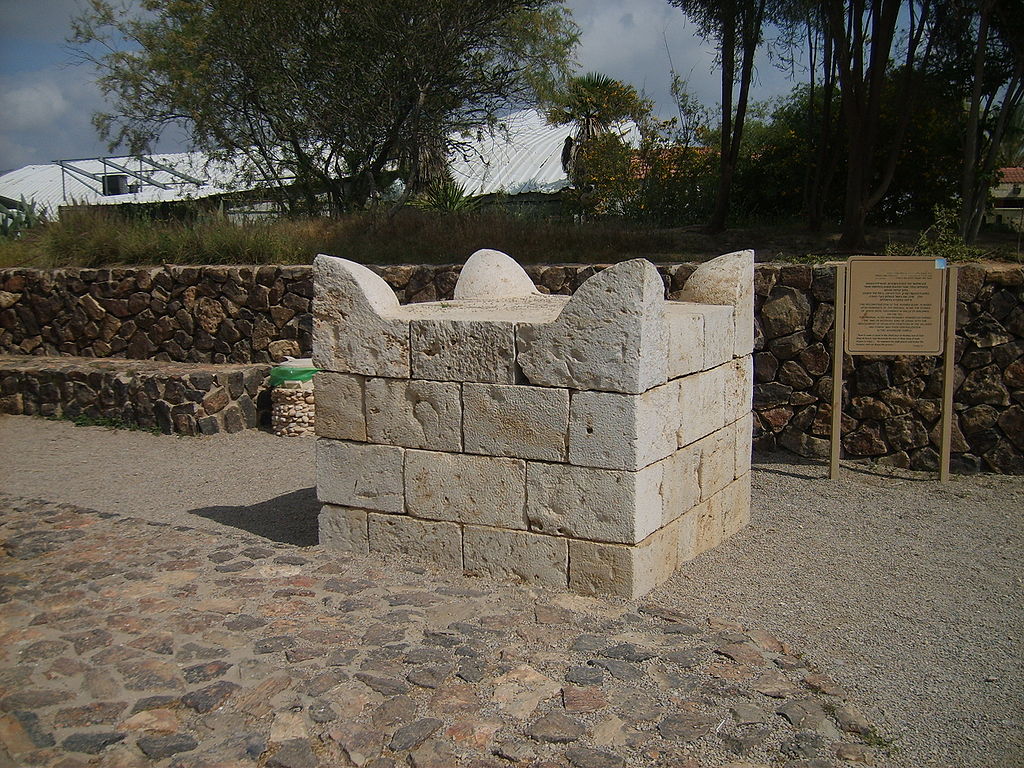
The cherubim get a lot more references than the seraphim, which I believe are only clearly and explicitly referenced in Isaiah.  The image at the bottom of the page, found in nearby Syria, has the requisite six wings and holds a serpent in each hand (check biblical references below).  In addition to the images in the archaeological record and the rather idiosyncratic descriptions in Ezekiel,  we can tell that the cherub is like a winged bull, sphinx, or griffin because YHWH is pictured as using one as a mount in the book of Psalms.  Celestial creatures of this type were popular in Mesopotamia and called karibu/kuribu, "intercessor."  King Hiram of Byblos had cherubim flanking his throne and incense altars have been found in Taanach and Meggido flanked by them.  It is not surprising them that they are said to have flanked God's throne and the Ark of the Covenant.  The parallelism of Psalm 18 may suggest that they were associated with the winds.  It is clear that both cherubim and seraphim were "angels of the presence," but they do not seem to have the messenger function of anthropomorphic angels.  I can't help but feel that the Bible does not make full use of the potential of these monstrous angels.  Why don't we ever seem them tearing into the enemies of God's people?  Maybe the God of Israel really does not have as bloody tastes as others of us do.  Certainly, in mythopoesis that was inspired by scripture, that's how I see myself using zoomorphic angels.  Maybe their occurrences in liturgical and mystical contexts instead of smiting contexts should be telling us something that I have yet to pick up on.


Scripture References
Genesis 3:24
Exodus 25:18-20; 37:6-9
Numbers 7:89
I Samuel 4:4
II Samuel 22:11
I Kings 6:23-28; 8:6-7
Psalms 18:10; 80:1
Isaiah 6:2-6; 30:6 (cf. Num. 21:6-8; Deut. 8:15)
Ezekiel 1:4-28; 10:3-22; 28:14,16

Syrian Figure from Tell Halaf

Wednesday, April 11, 2012

J is for JEZEBEL


Sexy.  Promiscuous.  Proud.  Defiant.  Queen Jezebel (1 Kings 16 - 2 Kings 9, see also), who has entered our speech in the phrase, "painted Jezebel" and has a woman's magazine named after her, has passed from being the evil Phoenician Queen of an evil Israelite King, a biblical symbol of idolatry, to a cultural symbol of the desirable, tempestuous, powerful siren.  She appeals to that part of men who are torn on that particular horn of the mother-virgin-whore trilemma.  Hey, she inspired Robert E. Howard to bad poetry!  There are, of course, plenty of women trading on the Jezebel image in our media culture.  They're female Bryons: mad, bad, and dangerous to know.  In other words, they have plenty to recommend them in the crafting of narrative if they are handled with a bit of sophistication to keep them interesting.  I think of Diana Villiers in the Aubrey-Maturin novels: she certainly has some of Jezebel about her character, although O'Brian develops her beyond the Jezebel aspect to make her interesting.  It's been a long time, but I wonder if I wouldn't also think of Colleen MacCullough's Servilia Caepionis.  You wouldn't want to handle this in a heavy handed, predictable reversal, like a Western's harlot with a heart of gold, but flashing the obvious signal for the stock character and then filling her corset out with some unpredictable and complicated curves (okay, sorry for the possible visuals) could make for an enjoyable, textured subversion of the trope that would keep the reader guessing.

Friday, April 6, 2012

F is for FOURTEENTH OF NISAN


Exodus 12
 1And the LORD spake unto Moses and Aaron in the land of Egypt saying, 2“This month shall be unto you the beginning of months: it shall be the first month of the year to you. 3Speak ye unto all the congregation of Israel, saying, ‘In the tenth day of this month they shall take to them every man a lamb, according to the house of their fathers, a lamb for an house: 4And if the household be too little for the lamb, let him and his neighbour next unto his house take it according to the number of the souls; every man according to his eating shall make your count for the lamb. 5Your lamb shall be without blemish, a male of the first year: ye shall take it out from the sheep, or from the goats: 6And ye shall keep it up until the fourteenth day of the same month: and the whole assembly of the congregation of Israel shall kill it in the evening. 7And they shall take of the blood, and strike it on the two side posts and on the upper door post of the houses, wherein they shall eat it. 8And they shall eat the flesh in that night, roast with fire, and unleavened bread; and with bitter herbs they shall eat it. 9Eat not of it raw, nor sodden at all with water, but roast with fire; his head with his legs, and with the purtenance thereof. 10And ye shall let nothing of it remain until the morning; and that which remaineth of it until the morning ye shall burn with fire. 11And thus shall ye eat it; with your loins girded, your shoes on your feet, and your staff in your hand; and ye shall eat it in haste: it is the LORD's passover. 12For I will pass through the land of Egypt this night, and will smite all the firstborn in the land of Egypt, both man and beast; and against all the gods of Egypt I will execute judgment: I am the LORD. 13And the blood shall be to you for a token upon the houses where ye are: and when I see the blood, I will pass over you, and the plague shall not be upon you to destroy you, when I smite the land of Egypt. 14And this day shall be unto you for a memorial; and ye shall keep it a feast to the LORD throughout your generations; ye shall keep it a feast by an ordinance for ever.’”


Thursday, April 5, 2012

E is for EBENEEZER


Most people in the English-speaking word, I wager, would be completely unfamiliar with the name Ebeneezer if it were not for Charles Dickens' Scrooge in A Christmas Carol.  Dickens, however, got this perfectly fine English name from the English Old Testament.  In origin, then, it is a Hebrew name and one likely to have been popular among the somewhat Puritanically inclined segment of the English population given its relative exoticness and lesser popularity.  The origin of the name, however, is what is of interest for us.

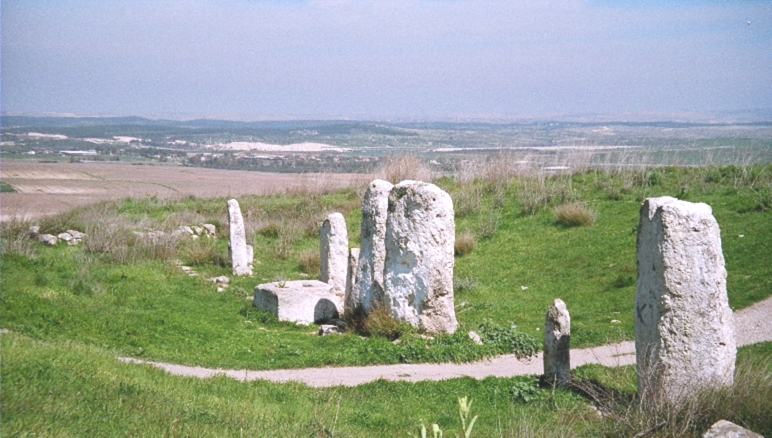
The Standing Stones in Gezer, Israel

The name means "Stone of Help."  There were two locations that had stone memorials raised in Canaan/Israel with that name, mentioned in 1 Samuel chapters 7 and 41.  These stones or massebah may have been pillars, stele, cairns, altars, or perhaps even odd naturally occurring stones that served as a landmark in various cases.  They were often given theophanic names celebrating an appearance or act of deity.  Identification of memorials stones set up by earlier Israelite heroes may have later fallen afoul of idolatrous associations, especially as cultic centralization increased in the period of the kingdoms, but earlier strata of the Old Testament seem to accept these as perfectly acceptable expressions of Yahwism.  The practice, of course, resonates with the practice of various forms of stone memorials of religious and geographic significance in other cultures.

Markers such as these in the production of narrative or gaming worlds are useful as landmarks and for world-building atmosphere.  Readers or players develop associations with background stories and character events, while description works the enchantment that weaves the sense of concrete place.  So pick a place, create the stone or stones, and explain how they got there, when, why, and by whom.  Who knows?  At some point in contemporary time, the characters themselves may mark a spot, raise a pillar, and exclaim, "hither by thy help I come."

Tuesday, April 3, 2012

C is for Covenant

From blood yesterday, we move rather naturally to covenant today.  We use the term covenant to refer to a solemn agreement.  In the times of the ancient Hebrews, the equivalent terms to our Franco-Latinate English word were used not only by them but by all the people of the ancient Near East to refer to a pact, alliance, treaty, or contract.  In ancient times, there could be no covenant without the spilling of blood.  For this reason, those being bound by the covenant would sacrifice, call on their gods, and share in the sacrificial meal.  To cut a covenant (cf. our English, "cut a deal"), something had to be cut. Note that the sign of the covenant between God and Jews is circumcision.  See the instructive entry below from the Jewish Encyclopedia (1906).  I find the bit about sucking blood highly speculative not only because I have never heard that before, but because of the lack of evidence.  The mingling of blood by slashing hands and shaking is certainly known today.  Compare also the entry in SHERK.

Horned altar at Tel Be'er Sheva, Israel.

COVENANT (= ; Septuagint, διαΘήκη; Vulgate, testamentum).

—Biblical Data: An agreement between two contracting parties, originally sealed with blood; a bond, or a law; a permanent religious dispensation. The old, primitive way of concluding a covenant (, "to cut a covenant") was for the covenanters to cut into each other's arm and suck the blood, the mixing of the blood rendering them "brothers of the covenant" (see Trumbull, "The Blood Covenant," pp. 5 et seq., 322; W. R. Smith, "Religion of the Semites," pp. 296 et seq., 460 et seq.; compare Herodotus, iii. 8, iv. 70). Whether "berit" is to be derived from "barah" =to cut or from a root cognate with the Assyrian "berit" = fetter (see Nathauael Schmidt, in Cheyne and Black,"Encyc. Bibl." s.v."Covenant"), or whether both Assyrian and Hebrew come from "barah"= to cut (compare "asar" = covenant and bracelet in Arabic; see Trumbull, l.c. pp. 64 et seq.), can not be decided here. A rite expressive of the same idea is (see Jer. xxxiv. 18; compare Gen. xv. et seq.) the cutting of a sacrificial animal into two parts, between which the contracting parties pass, showing thereby that they are bound to each other; the eating together of the meat, which usually follows, reiterating the same idea. Originally the covenant was a bond of life-fellowship, where the mingling of the blood was deemed essential. In the course of time aversion to imbibing human blood eliminated the sucking of the blood, and the eating and drinking together became in itself the means of covenanting, while the act was solemnized by the invocation of the Deity in an oath, or by the presence of representative symbols of the Deity, such as seven animals, or seven stones or wells, indicative of the seven astral deities; whence ("to be bound by the holy seven") as an equivalent for "swearing" in pre-Mosaic times (see Gen. xxi. 27, xxvi. 28, xxxi. 54; Herodotus, iii. 8; Josh. ix. 14; II Sam. iii. 12-20; W. R. Smith, l.c. pp. 252 et seq.). Salt was especially selected together with bread for the conclusion of a covenant (Num. xviii. 19; see W. R. Smith, l.c. p. 252; Trumbull, "The Covenant of Salt," 1899).

Saturday, December 24, 2011

Christmas Eucatastrophe, Mythopoesis, and Life


I have said it before.  Undoubtedly, I will say it again: Tolkien's On Fairy Stories should be required reading on more than one reading list, but it should be at the top of the list for mythopoets.  If you are not familiar with his theory of eucatastrophe, then I highly recommend getting hold of the lecture in some form and digesting it thoroughly (and for greater reasons that that this blogpost will assume a familiarity with it).  In his epilogue, he included a statement on the faith that underlay all his work.  For in the end, eucatastrope was both the spring of his creativity and his thought, and also the deep hope of his life.

I would venture to say that approaching the Christian Story from this direction, it has long been my feeling (a joyous feeling) that God redeemed the corrupt making-creatures,  men, in a way fitting to this aspect, as to others, of their strange nature.  The Gospels contain a fairy-story, or a story of a larger kind which embraces the essence of fairy-stories.  They contain many marvels--peculiarly artistic, beautiful, and moving: "mythical" in their perfect, self-contained significance; and among the marvels is the greatest and most complete conceivable eucatastrophe.  But this story has entered History and the primary world; the desire and aspiration of sub-creation has been raised to the fulfillment of Creation.  The Birth of Christ is the eucatastrophe of the Man's history.  The Resurrection is the eucatastrophe of the story of the Incarnation.  This story begins and ends in joy.  It has pre-eminently the "inner consistency of reality."  There is no tale ever told that men would rather find was true, and none which so many sceptical men have accepted as true on its own merits.  For the Art of it has the supremely convincing tone of Primary Art, that is, of Creation.  To reject it leads either to sadness of wrath.

When I consider the general notions of what Christianity is about that are popular currency in the world today, and especially in America with which I am most familiar, whether those notions are entertained by Church people of various stripes or by the people who despise them, I am tempted to conclude some very unflattering things.  But then I remember that, despite my supposedly informed upbringing, I held similar notions.  These notions tend to center on a cluster of Sin, Faith (a rather peculiar notion of what faith is, honestly), the Death of Jesus, and the Bible.  Having been raised with this cluster in a version of its popular configuration, Christianity failed to make sense to me well into my adult life, until during my second graduate degree program in the field of religion, a professor assigned a little book from the fourth century: On the Incarnation of God by Athanasius of Alexandria.

This book revolves around the axiom that God became human so that humans might become divine.  The axiom is rooted in the New Testament and the key to the Nicene Creed.  If, this Christmastide, you find yourself wondering why a Galilean peasant and his fellow Jewish followers so transformed the world with a story that took the Mediterranean world by storm, consuming and displacing other stories and cultuses on an empire-wide and then a global level, I am not aware of a way to be more helpful when it comes to reading material than to recommend Athanasius' On the Incarnation (that, and skipping the chapters that are diatribes against Jewish conversationalists).  It is free in an old and difficult translation, and cheap in a new and easier translation.  Both normatively and descriptively, I would argue that it provides in a compact volume a formulation of what the Christian mythos and ethos are all about.

Wishing you all the blessings of the season,
Theodric

Monday, December 19, 2011

What is Victoria's Secret?


My most popular post of all time has been, for some time, Z is for Zoomorphic Angels.  I suspect that there is more than one reason for this, but around the time of the Victoria's Secret TV special a few weeks back and forward, some of the most popular searches that find my blog are various searches for Victoria's Secret angels.  So, here I go being all opportunistic, by posting late on this Mythopoeic Monday on the Secret.*  Now, the appeal of heavenly bodies, such as Lily Donaldson's pictured above is no secret at all, is it?  Isn't everything rather on display?  Where's the secret?

I do not think that the intuition or instinct reflected in the name of what surely must be the most successful lingerie company in the world is off, at all. The opposite sex has always represented some irreducible mystery, whichever gender one is.  Mona Lisa's smile has become a symbol of the mystery that women represent to men.  Jung theorized that men and women both have a transgendered aspect in their psyches (the anima in men and the animus in women) that correspond to the opposite sex -- an aspect buried in their individual unconscious. 

Few things garner interest like a secret.  Children who were lucky enough to read E.L. Konigburg's From the Mixed-up Files of Mrs. Basil Frankweiler were treated to an extended exploration of the value of a secret.  It is something that we are driven to uncover, and yet, may also be driven to hide from others.  The feeling that we share a secret binds us to another and heightens our own sense of interiority.  In the second chapter of the Apocalypse (Revelation), Christ promises to give those who are faithful from Pergamum a white stone with their secret name written on it.  Value is based on rarity, and what is rarer than a secret?  If knowledge is power, then knowledge of a secret is power of a greater degree.

Mystery novels and shows do not seem to have lost their popularity over the years.  In recent times, conspiracy theories have exploded in popularity.  The element of secrecy is sure to increase interest and dramatic tension in any story or game.  But I think that there is an element of depth, of mystery, that must be present in the best secrets.  The idea I am trying to get across here goes back to my use of the Victoria's Secret angel.  We looked at her and I dared to say, isn't it all on display?  No.  The mode of revelation covers even as it uncovers.  Disclosures are always partial.  We are shown enough to know something, to feel the pull of something, to identify a presence, but the presence is also an absence.  There is a hint of something more.  If a secret is so shallow that it may be revealed in a single proposition or a single glance, then the secret is consumed in its entirety.  Not so the deeper things, which is what our plots should strive for.  Knowing how to include human mystery -- or even mystery that is somehow deeper than humanity -- in a plot's secret is the way to hold interest with a richness that draws but is never fully exhausted or realized.  Perhaps that is part of Victoria's Secret.  By giving the models the wings of celestial beings, their transcendence is symbolized, so that suggesting that they are not women emphasizes their womenhood: that there is an attracting secret of the feminine that can never be fully known or possessed, even in the knowing and possessing.  The display tantalizes with its revelation, and by revealing, reminds us of what is covered, and of the fact that howsoever much one may discover, there will always be something more.


* I'm behind because the last week of the semester was as one would expect.

Monday, August 1, 2011

The Ouroboros

The image of a serpent (snake or dragon) with its tail in its mouth is ancient, pervasive, and arresting. Frankly, it's also one of my favorites. The serpent itself is popular in symbolism in its own right, but something about the ouroboros makes it stand out.  While obviously the circle itself is suggestive and useful, I propose moreover that it is because the ouroboros introduces an irreducible ambiguity that creates tension and narrative.

The Rub: what is the serpent doing?  The Greek name of the symbol tells us literally that "he eats the tail."

But is the serpent eating his own tail?  
Why would the serpent be eating itself?  Is it an expression of the death wish?  The greed or gluttony which consumes itself? Total Self-Sufficiency (or the futility of the notion)?
Certainly, the alchemists were attracted to this symbol (as were Hermeticists and Gnostics) from time of the second century Chrysopoeia ("Gold Making") of Cleopatra, and so it was reproduced throughout the Middle Ages.  In the version in the Chrysopoeia, it is accompanied by the Greek inscription, "One is All."  Yet, the failure of the attempt to transmute base metals into gold by discovering the quintessence, the philosopher's stone, can't help but cast such proclamations in a futile light.  For the quest to have value, once must spiritualize alchemy as Jung and his followers have.


In contemporary tales of alchemy (see the Full Metal Alchemist and FMA: Brotherhood franchise of manga and anime), the symbol might implicitly indicate the tendency of the state to consume the people it uses as weapons and the fundamental ambivalence of power, in contrast to a principle of equivalent exchange.  If the state destroys all its members in the perpetuation of itself, where then is the state?


One final note: if a snake does mistake it's own tail for a meal, the results are disastrous for it apart from human intervention.   If human beings had come across such a snake in an ancient context, the primitive mind would have likely latched on to such a prodigy as a potent omen.  There is at least one more good candidate in nature for the inspiration behind the ouroboros.


Or is he curling up and holding on?
There is a species of lizard in Africa that has adapted a peculiar antipredator behavior:

Armadillo Lizard (Cordylus cataphractus).  Photo by Cindy Shuttleworth
 So the serpent might be protecting itself, rather than engaging in autosarcophagy.  Inscribing something inside the serpent might, however suggests that serpent is protecting something else.  Or is it?  One of the most common instances of the encircling serpent is the Midgard serpent of Norse lore.  Jörmungandr is usually understood as threatening the world with an encirclement of doom.  Are we trapped?  Will we be crushed?  But beside a native hostility to the snake, the encirclement might be an embrace rather than assault.  Perhaps he girds us to guard us.

Or is he shedding his skin?
The snake's shedding of his skin seems to have fired the human imagination early on.  Does he go on shedding his skin, renewing his youth, ever-growing and ever-living?  Oh for the power that we might do so!  So it seems that some have latched onto the ouroboros as a symbol of reincarnation, eternal life, or related concepts.  I don't know that any snake actually engages in biting the tail to assist itself in moulting, but the ancients may well have thought as much.  It fits with the circle as a symbol of infinity or eternity.

Ultimate Ambivalence
Finally, the ambivalence of the ouroboros symbol calls to mind another serpent symbol.  There is a serpent encircling a tree.  How do know it is the serpent tempting you to disobedience, forbidden knowledge, and death?  What if your knee-jerk identification of the serpent as Satan mislead you from the appearance of Christ on his cross (Nehushtan*)?  Is this the wise serpent that poisons or that saves?

Sébastien Bourdon, Moses and the Brazen Serpent, 1653. The Prado, Madrid.

Until the next time our rambles cross, I wish you a merry Mythopoeic Monday!


*Numbers 21:4-9; John 3:14-15.  Cf. the rod of the healer Aesculapius.

Monday, June 20, 2011

King James Rules for Mythopoesis!


This year is the four-hundredth anniversary of the translation of the Bible authorized by King James I of England and Scotland.  Popularly known as the King James Version or the King James Bible,* for over half of its history it was known in English contexts simply as, the Bible, so much so that when an English bishop in the mid-nineteenth century reminded his clergy as he held it aloft that "This is not the Bible," he drew audible gasps.  Along with the works of William Shakespeare, this Bible is both the foundation of and the pinnacle of English literature: the only two works that deserve the designation of primary classics in the English canon.  While this is true of its substance as well as of its language, I am going to set substance aside with an assertion whose truth can rather easily be discovered by those who have yet to learn it: one cannot meaningfully enter the thought world of the English tradition of literature in ignorance of it.  To the extent that you want to locate your mythopoesis in this sphere of cultural interaction, you must have mastered this classic text.  Having dealt with that in one sentential swoop, I am going to focus on other lessons that can be learned from King James' translation.  These fall into two groups: 1. Historical (with an RPG rule suggestion) and 2. Linguistic.


1. The Historical
There are a number of excellent books about the story of the King James Bible available in this anniversary year.  I have just finished Alister McGrath's In the Beginning, and can recommend it as a good and informative read with only two major criticisms.  First, it is much lighter on the reception of the text than it is on its background and production and it would have benefited from the final two chapters being expanded.  Second (and this is probably the fault of Anchor Books rather than the author), though it is written by a scholar, its pitch at a popular audience resulted in its being shorn of foot- or end notes.  Even as a popular work, it should have assumed an educated audience and had minimal notes.

McGrath points out a crucial development that played a part in the transformation from Medieval to Early Modern Europe: the rise of the middle class.  The rise of the middle class resulted in a cycle of more literacy/more demand for affordable books.  And it was this complex of increasing demand and developing the technology to supply that demand that led to the availability of printed codices of translations of the Bible into the vernacular languages (which, by the way, was a significant business interest).

Now, for the fantasist working on setting or world-building, I have often seen the concern raised about the existence of gunpowder and how to handle (i.e., usually eliminate) that.  But this history raises another concern: how widespread is literacy and how is it concentrated in your setting?  How is it related to the existence of a sizable middle class?  Answering these questions will be important for identifying what kind of world it is and how things work in that world, as well as what it will tell you about your characters.

When it comes to fantasy RPGs, these questions are no less important.  Thinking about PCs and NPCs, are they more likely to come from the aspiring, upwardly mobile middle class, the desperate peasants looking to break out of poverty, or failed members of the upper class?  Are they more or less likely to be literate?  Here is an optional rule I have been playing around with: to represent literacy as an accomplishment, require one language slot of a PC to speak a language and a second slot to read and write it, unless the PC is a magic-user [wizard/mage] or cleric.  I will likely try this rule out in the (delayed but hopefully still happening) Ygg campaign.

2.  The Linguistic
If you want to be able to produce exalted, majestic English, all of the King James Bible and a good deal of Shakespeare are your greatest sources.  If you want to produce archaic English, the Bible is a better source than Shakespeare.  Though the two are roughly contemporaneous (Shakespeare starts some years earlier than 1611), the Bible is purposefully archaicizing.  The King's translators were charged not only with producing the most accurate translation based on the scholarship of the day, but with changing as little as possible of the wording of the already existing (but not popular) Bishop's Bible (1568).  Furthermore, the translators recognized the excellence of the work of William Tyndale (1522-1537) and relied heavily on his work as well.  These translations were themselves genealogically related, and coming as they did in a period before changes in the English language accelerated, retaining their constructions meant retaining an earlier form of English (this accelerated phase of linguistic change may be observed in Shakespeare, who is not consistent about using the singular [thou] and plural [you] forms of the second person pronouns and the old verb endings that go with them and who often uses the modern forms [you] we are familiar with today).

It is not easy for someone such as myself, who was raised reading Biblical English, to deal with one of the most lamentable facts of our failing culture: many people cannot read Early Modern English.  My students have forced me to accept this fact.  I expected to find it at the community college, but when I found it at the seminary, I will not describe the extreme acts that tempted me.  So we live in a day where use of the old classic is diminishing, but also in which Shakespeare is paraphrased for college English classes and Richard Hooker is paraphrased for Anglican seminarians.  Speaking for a moment only to native English speakers, cutting ourselves off from our literary past is a severe cultural impoverishment, rendering us only partly literate in our own tongue.

For those wanting to avoid this sad fate, there is no cure other than reading to increase proficiency.  Happily, we live in a day where the best version of the King James Bible ever is available: the New Cambridge Paragraph Bible -- and in cheap formats!  Some folks may also be interested in one of the anniversary reprints that seem to be springing up everywhere.  While these reproduce some important parts of the 1611 printing exactly, the biblical text itself is a reprint of the 1611 text from 1833.  This gives them an old look and reproduces the old spellings, but provides the advantage of a text in Roman type.  I can't imagine modern readers struggling with both the language, the spellings, and Blackletter typeface at the same time.  So if you prize "feel" over easy readability and scholarship, get a commemorative reprint, but if not, go for the NCPB.  However, even if you start with a run-of-the-mill printing like a Gideon Bible, you are entering a world of style and diction that will elevate your own poetry and prose, as well as open up a body of literature that is becoming increasingly a treasure hidden from the masses.  As always, thanks for stopping by, and I hope you profited from this week's Mythopoeic Monday.


NB: The NKJV or New King James Version is not what you are looking for.  Move along.

* Abbreviated variously: KJV, KJB, and AV for Authorized Version.

Saturday, April 30, 2011

Z is for Zoomorphic Angels

Sphinx. Phoenician, 899–700 B.C.  Ivory.*

Zoomorphic entry from Merriam-Webster.

zoo·mor·phic adj \ˌzō-ə-ˈmȯr-fik\


1 : having the form of an animal

2 : of, relating to, or being a deity conceived of in animal form or with animal attributes

— zoo·morph noun

Origin of zoomorphic: International Scientific Vocabulary. First Known Use: 1872


Wikipedia notes with helpful brevity the breadth of zoomorphism's usage.


Zoomorphism is the shaping of something in animal form or terms. Examples include:
  • Art that imagines humans as animals
  • Art that portrays one species of animal like another species of animal
  • Art that creates patterns using animal imagery, or animal style
  • Animal-deities, such as exist in Egyptian mythology
  • Therianthropy: the ability to shapeshift into animal form
  • The tendency of viewing human behaviour in terms of the behaviour of animals, analogous to anthropomorphism, which views animal behaviour in human terms

The word derives from the Greek ζωον (zōon), meaning animal, and μορφη (morphē), meaning shape or form.


In the list above, we see many issues to attract the mythopoet and keep him or her busy for periods of time that will mystify spouses and frighten co-workers, but for today I want to exorcize a spirit that has been stuck in my craw for as long as I can remember.  I mean the evil that is Chubby Angel Babies, known to the experts as putti.  I loathe them.  The Italian Renascence (IR) generally brought us many good gifts, but unfortunately, the putti, who by some evil asexual reproduction reached disturbingly high numbers during the Mannerist and Baroque periods to follow, and were not stamped out by Neo-classicism by any means, is among its most enduring and ubiquitous.  In the Neo-Gothic Apocalypse that I pray for, they will be remembered only in nightmares and perhaps bad horror movies.

Note that I am using the word "angel" in its popular usage to cover "all heavenly servants of God."  They are popularly pictured today as humans with wings.  Even such angels and putti are, strictly speaking, zoomorphic: they have bird-wings.  But I do not think that angels are ever described as appearing like anything other than "men" in the Bible when the term "angel" is explicitly used.  Further, the two kinds of angels I am discussing today, Cherubim and Seraphim, are never called angels in the Bible.  They are called "living creatures."  (And yes, in the Septuagint or Greek OT, zōōn is the word for living creature.)  But whereas winged humans are okay, and winged babies or baby heads (eww!) are terrible, winged composite creatures are awesome.  Let this be our guiding principle: More Zoomorphic = More Better.


Cherub (s), Cherubim (pl)
Instead of the revolting little rosy-cheeked, bare-bummed cupids that the God of the IR employed, imagine being confronted with a sphinx or a shedu.  The God of the OT is a kick-ass deity who means business.  This God is not saying, "Burp my messenger," but "The playing field is not level; watch your step."  Or "Danger: God at Work Ahead."  Given the archaeological record in which Egyptian-style sphinxes were popularized from Judah and Samaria (Israel) to Assyria by Phoenician and Syrian ivory artists on furniture and household items, the use of an Assyrian cognate of "cherubim" to refer to the category of representations to which the shedu belonged, and the descriptions given in the book of the prophet Ezekiel, scholarship seems pretty unanimous in offering images like the sphinx and the shedu as confidently close to the ancient Hebrew imagination of the cherub.  (And if you have never read Ezekiel, by all means, correct that ASAP!)

Even when the Greeks make the head a woman's and add breasts and shrink the sphinx down in size, it's just a devious strategy of distraction.  Putti are going to shoot you with nerf arrows and giggle and moon you.  Cherubim are going to tear you up.

Gustave Moreau's Sphinx

Seraph (s), Seraphim (pl)


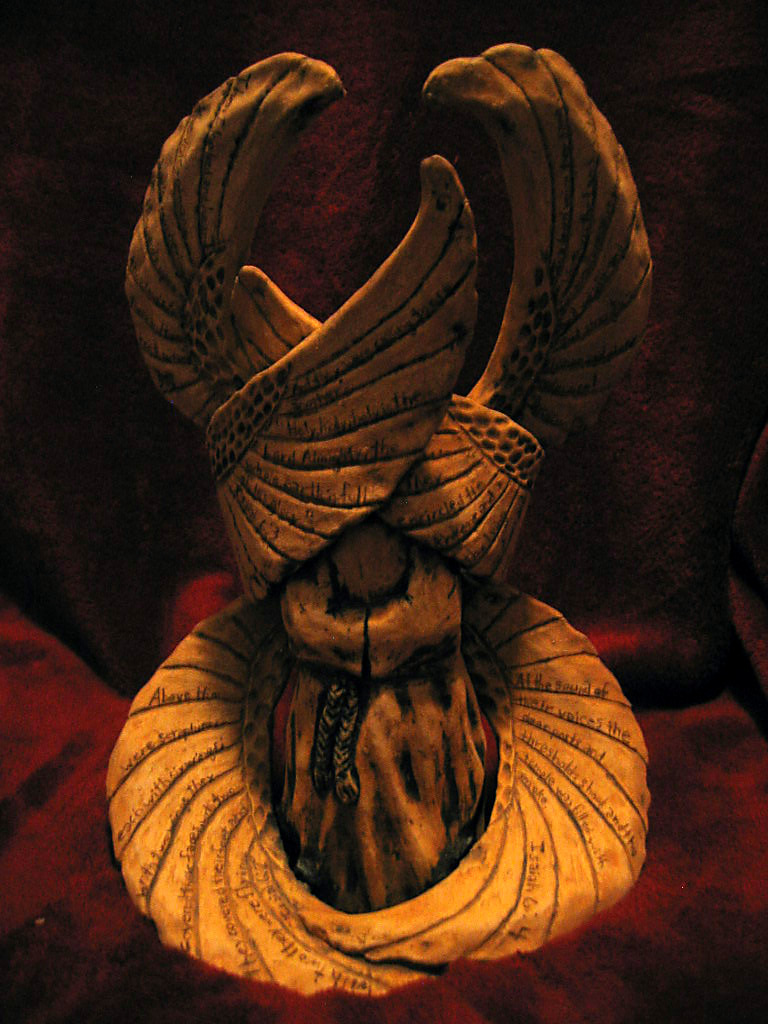
Literally, "the fiery ones," it is difficult to know whether the ancient Hebrews imagined them as being flaming figures or whether they envisioned them to be like poisonous serpents.  (In the Hebrew Bible, poisonous snakes are regularly referred to as "fiery," likely due to the burning sensation of poison.)  They are described as being six-winged.  They are in God's presence in Isaiah 6, flying with one set of wings, and of the other two sets using one to cover their faces and the other to cover their feet (which may in Hebrew indicate their feet, but could also be used euphemistically to refer to their private parts.)  So only their bodies are showing, but we get not description of those bodies other than the their multi-wingedness and the possible hints of flame and serpent.  Their covering of their faces and their angelic privates indicate humility before YHWH, whom they are praising.  They deal in purifying fire.


Being the kind of mythopoet that I am, my tendency is to decide that indications call for both fire and scale, on the More Better principle invoked above.  it is ashamed that it is so difficult to find interesting images of seraphim online.  Early Christian and Byzantine iconographers felt the difficulty, and while giving us the six wings in red, they contravene their own source material and give us the face uncovered.  Below is a modern example that gets this detail right, but follows the contemporary trend of imagining angels to dress like ancient Israelites or monks.  We need flames and scales, people!  


The above source material gives us the bases upon which to mythopoeisize.  Noting that in medieval tradition, they are strongly identified with love (caritas), we can make a connection with the covering of the "feet."  No wonder they are covering up -- their impressive equipment is not meant for human eyes!  Hey, let's also give them a gaze attack: they've beheld glory in heaven that they've assimilated through their gaze.  If they uncovered their faces, the radiance would have unfortunate consequences for frail mortals.  They carry tongs (a pair of arms hidden underneath the middle set of wings?) that hold a coal of purifying fire from the heavenly altar.  Also in the medieval tradition, they are of a higher rank than cherubim (obviously a higher hit dice/CR monster, for the gamers among us).

I hope today's post offers some inspiration and initial ideas for zoomorphic angels in your world-building.  I also hope that the next time you think of biblical angels (broadly speaking), you see that many of them fit better among Tibetan angry gods or gargoyles than they do with the contemporary images of angels.  How much better angel art could be if it saw them as God's monsters, ready to kick evil's ass, than the insipid new age angel images that has been so popular for the past decade or the putti of Western art.  If those are the choices, then I'd rather just forget such pseudo-angelic banality and look at this:

A Victoria's Secret Angel