Showing posts with label History. Show all posts

Monday, December 31, 2012

Raiders of the Dead Sea Scrolls!

Dr. Jones & the Case of the Fishian Tablets


Before the Christmas holidays, I got in town just in time to see the Dead Sea Scrolls exhibit in Fort Worth.  Last year, Google announced their sponsorship of the project to digitize the scrolls.  Consequently, the most important site for study of the scrolls now is the Leon Levy Dead Sea Scrolls Digital Library.  Instead of succumbing to the easy out of making directly for the Wikipedia article, I invite you to check out some of the links below to learn more.


Naturally, the trip excited not so much any temptation I entertained as a young man to devote myself to textual criticism (God bless those so committed, who preserved me from such an occupation that would have strained my eyes and likely driven me insane), but the ol’ mythopoeic mind.  These old scrolls, fragile and some incredibly difficult to read, are worth an incredible amount of money even in fragmentary condition.  So, take away #1: scrolls are treasure.  Sound familiar, gamers?  Spell-casting classes certainly value scrolls for their ability to replicate spell-casting and as supplements to the power of such classed characters.

DSS scholarship is, among other things, one of the most massive efforts in human history to reconstruct the texts that were represented in the scrolls.  Technology has gone a long way to extend naked human powers in recovering texts that would have otherwise been unrecoverable.  What would things be like in another world, one in which these were magical texts and the reader had the ability to cast Read Magic?  I like the idea of ancient scrolls that were in such a condition that only by casting Read Magic could the spells on them be accessed.  I like to imagine illegible characters on a darkened parchment clearly shining with arcane power and lacunae caused by insects or environment being filled-in by ghostly runes.  Take away #2: Read Magic could be cool in-game.


Biblical texts, compendiums and commentaries on biblical texts, and other texts which governed the DSS community make up the majority of the scrolls.  But a stand-out among them is the Copper Scroll.* That’s right, not a scroll of parchment (animal hide) or papyrus (the ANE forerunner of paper)—or other likely candidates as needed according to milieu such as rice paper, stone, or clay—but of copper.  And unlike the other texts, the Copper Scroll is essentially a verbal treasure map for multiple locations.  Take away #3: Get creative with the materials of special scrolls.  And take-away #4: Yes, sometimes scrolls can be treasure maps or media to provide other sorts of clues or information that PCs need.  (In addition to the image above, check out this portion of the scroll before cleaning.)

As always, I advocate learning more about our own world to inform our construction of other worlds.  A cache of texts could make an entire treasure horde.  And if Doctor Who and Avatar the Last Airbender are heeded, a library can make a great adventure setting.  I once GMed an adventure in which an ancient culture put all of their secrets in symbolic knot-work (inspired by Incan Quipu) that were preserved on frames in their treasure vault, protected by a dungeon complex.  What creative uses have you made or seen of texts as treasure?

Happy last Mythopoeic Monday of 2012, and to all Ramblers and readers, a very Happy New Year!

*And yes, Jim Barfield sounds kind of crazy to me.  Have fun!

Monday, April 30, 2012

Z is for ZOOMORPHIC ANGELS II


Well, here we are at the end of April 2012's A-Z blogging challenge.  Last year's final post, Z is for Zoomorphic Angels, is my second most popular post of all time, so, I'm revisiting the subject this year.  If you missed it, I recommend going back and reading that one first (linked above) and then coming back for this year's.

Unlike the anthropomorphic ("human-shaped") angels that dominate the occasions of hierophanies or angelic visitations to humans in the Old Testament/Hebrew Bible, there are two species or classes of angels that are definitely zoomorphic.  These monstrous angels are the cherubim and seraphim (note the plural forms in Hebrew end in -im).  While we do not have Hebrew images of these creatures, we know do have the Phoenician images that were made for Egyptian and Assyrian markets, and the images made with a visual imagination dominated by Egyptian and Assyrian conceptions seem to have been the same images that were sold in Israel by Phoenicians. 

The cherubim get a lot more references than the seraphim, which I believe are only clearly and explicitly referenced in Isaiah.  The image at the bottom of the page, found in nearby Syria, has the requisite six wings and holds a serpent in each hand (check biblical references below).  In addition to the images in the archaeological record and the rather idiosyncratic descriptions in Ezekiel,  we can tell that the cherub is like a winged bull, sphinx, or griffin because YHWH is pictured as using one as a mount in the book of Psalms.  Celestial creatures of this type were popular in Mesopotamia and called karibu/kuribu, "intercessor."  King Hiram of Byblos had cherubim flanking his throne and incense altars have been found in Taanach and Meggido flanked by them.  It is not surprising them that they are said to have flanked God's throne and the Ark of the Covenant.  The parallelism of Psalm 18 may suggest that they were associated with the winds.  It is clear that both cherubim and seraphim were "angels of the presence," but they do not seem to have the messenger function of anthropomorphic angels.  I can't help but feel that the Bible does not make full use of the potential of these monstrous angels.  Why don't we ever seem them tearing into the enemies of God's people?  Maybe the God of Israel really does not have as bloody tastes as others of us do.  Certainly, in mythopoesis that was inspired by scripture, that's how I see myself using zoomorphic angels.  Maybe their occurrences in liturgical and mystical contexts instead of smiting contexts should be telling us something that I have yet to pick up on.


Scripture References
Genesis 3:24
Exodus 25:18-20; 37:6-9
Numbers 7:89
I Samuel 4:4
II Samuel 22:11
I Kings 6:23-28; 8:6-7
Psalms 18:10; 80:1
Isaiah 6:2-6; 30:6 (cf. Num. 21:6-8; Deut. 8:15)
Ezekiel 1:4-28; 10:3-22; 28:14,16

Syrian Figure from Tell Halaf

Tuesday, April 24, 2012

U is for URBAN SETTING II


Due to losing some family storage, I've recently had to go through a lot of old things (see my Nostalgia post).  I came across the remnants of what was once a mighty collection of illustrated children's books of the better kind.  The collection was shared between my daughter (the child in question) and myself (for use in the classroom in my previous incarnation -- okay I shared the books with my students as well, but they were taught to be careful with books from Dr. Obscure's Special Collection).  Sorting through them, I kept a few for myself, a few for my daughter, and the rest went to the shelves of Half Price Books.  Among those that I kept were two really cool books -- A Seaport through History: from the 10th Century BC to the 20th Century and A Central American City through the Ages: San Rafael.  These books by Hernandez, Ballonga, et al. are out of print and appear to have been published under somewhat different names by different publishers.  They trace a fictional Mayan city and  a Low Countries seaport through their histories, showing maps and cross-sections, with relevant information about them that would be enviable in a game setting book.  The fact that they are historical and yet fictional would make them perfect for just such a purpose, so I intend to eventually use them for just that.  It looks like there is at least one more book they did together, so I'm going to try to remember to keep an eye out for the one on the Islamic city.

Note that I just snuck in a Tomeful Tuesday, which we haven't had in a while!  Finding good material for an urban setting in unlikely or perhaps just new places, especially for cheap or free, is quiet satisfying.  I've used old National Geographics in the past, but I really like that the unique characteristics of these two books, and that they have the feel without the danger of being recognized as real places.  What resources have you found for creating urban settings?

Saturday, April 21, 2012

S if for SAGE

The images of Zeno of Citium and Confucius provide two strongly contrasting images of the sage from two classical societies that valued the wisdom of the wise, while disagreeing internally over the nature of wisdom and the man who wielded it.  The sage is important in the real, external world as the rare possessor of valuable knowledge.  They have a correspondingly high place in our internal and secondary worlds.  For Jungian investigations, you will want to look under the term senex.  Both as teachers and as figures, their value extends beyond their lifetimes.


Where is the wise? where is the scribe? where is the disputer of this world?


1 Cor 1:20


Correspondingly, the sage has had an important role in fantasy role-playing, as well -- both in the primary world of the player or gamer, and in the secondary world of the game or characters.  There is the sage who knows the way of gaming, and so dispenses wisdom to the gamers.  The late Jean Wells was one of the original sages, dispensing wisdom in our Dragon Magazine feature, Sage Advice.  There are also sages as NPCs in the game itself.  They serve as an expensive resource for characters who need help solving a problem with knowledge to which they have no other access.  They can also serve as a nice plot device for GMs who want to present players with an option for play.

Sages to the Seventh Power
If one sage is good, then seven sages must be awesome.  Many cultures have thought so.  Sumeria had theirs.  Ancient India had the saptarishi.  Pre-Socratic Greece had their seven sages.  Three Kingdoms China had their Seven Sages of the Bamboo Grove.  Finally, there is the fascinating case of the fictional Seven Sages of Rome, a cycle of early European romances that appear to have Sanskrit, Persian, and Hebrew origins.  This makes me want to create my own council of the wise!

Tuesday, April 10, 2012

I is for INANNA

If you are unfamiliar with the goddess Inanna, I recommend giving her a look.  She is a Sumerian goddess, much of whom seems to have been assimilated into the Akkadian Ishtar.  Her journey to the Underworld has been reconstructed due to a greater availability of the fragmentary sources and the subject of much treatment.  For a popular/scholarly reconstruction and treatment, see Wolkstein & Kramer's book.  It is not known with certainty if the Old Babylonian image below is of Inanna/Ishtar, Ereshkigal, or Lilitu/Lilith.

© Trustees of the British Museum, Used by Permission.

Sunday, April 1, 2012

A is for Albertus and Agrippa

A: Albertus, Agrippa, [Avatar]

I noticed that these two medieval men, one a scholarly saint and the other a wandering magician, have some interesting things in common.  They both developed a reputation as famous wizards in folklore and literature after their death.  Agrippa was born in the same city 205 years and 10 months after the death of Albertus.  So here is my mythopoeic idea: there must be even more connections between the two!  One story has Albertus discovering the philosopher's stone.  Maybe he used to extend his life hundreds of years and he took different names, one of them, Agrippa.  Maybe he cloned himself or reincarnated himself, to awake in the future as Agrippa.  Another story has him inventing a brazen head.  Maybe Agrippa discovered or inherited the brazen head and learned all his magic from it.


Albertus Magnus, Doctor Universalis

Died: 15 November 1280; Cologne

Appearances: Mary Shelley's Frankenstein, Nathaniel Hawthorne's The Birth-mark, Herman Melville's The Bell Tower, Terry Pratchett's Discworld novels, Walter M. Miller Jr.'s A Canticle for Leibowitz
St. Albertus Magnus' body is reported to be incorrupt.  That's a great idea for your mythopoeic holy man, but if he is a wizard, then I'd start poking around for that philosopher's stone.  If you base a wizard on Albertus, just don't make him a specialist.  A character based on him should share the original's universal learning.


Agrippa, Heinrich Cornelius 

Born: 15 September 1486; Cologne

Appearances: Thomas Nashe’s The Unfortunate Traveller, Mary Shelley’s Frankenstein "The Mortal Immortal,"  Herman Melville's "The Bell-tower," Sergei Prokofiev's opera The Fiery Angel, James Joyce's  A Portrait of the Artist as a Young Man, Jorge Luis Borges' Labyrinths in the story "The Immortal," George MacDonald’s Phantastes: A Faerie Romance, J.K. Rowling’s Harry Potter and  the Philosopher’s Stone, and Harry Potter and the Chamber of Secrets
Way beyond the occasional rumor, Agrippa is known as one of the great wizards of the late middle ages, very influential on Renaissance occultism. Check out some of his works here.  


Colonia Claudia Ara Agrippinensium

Saturday, December 31, 2011

Debtors and Dead Men

Lately, I've been taking mental vacations to the lands of Steampunk Sherlock (saw the current film) and Dickens' London, as well as a side trip to 18th century Hammervania.  It seems to me that considerations of 17-18th century England and Europe are not out of order for many fantasy settings, where great age and magic would allow for developments beyond feudal fare.  In particular, I have been struck by two institutions that deserve consideration for your fantasy setting: debtor's prison and resurrection men.

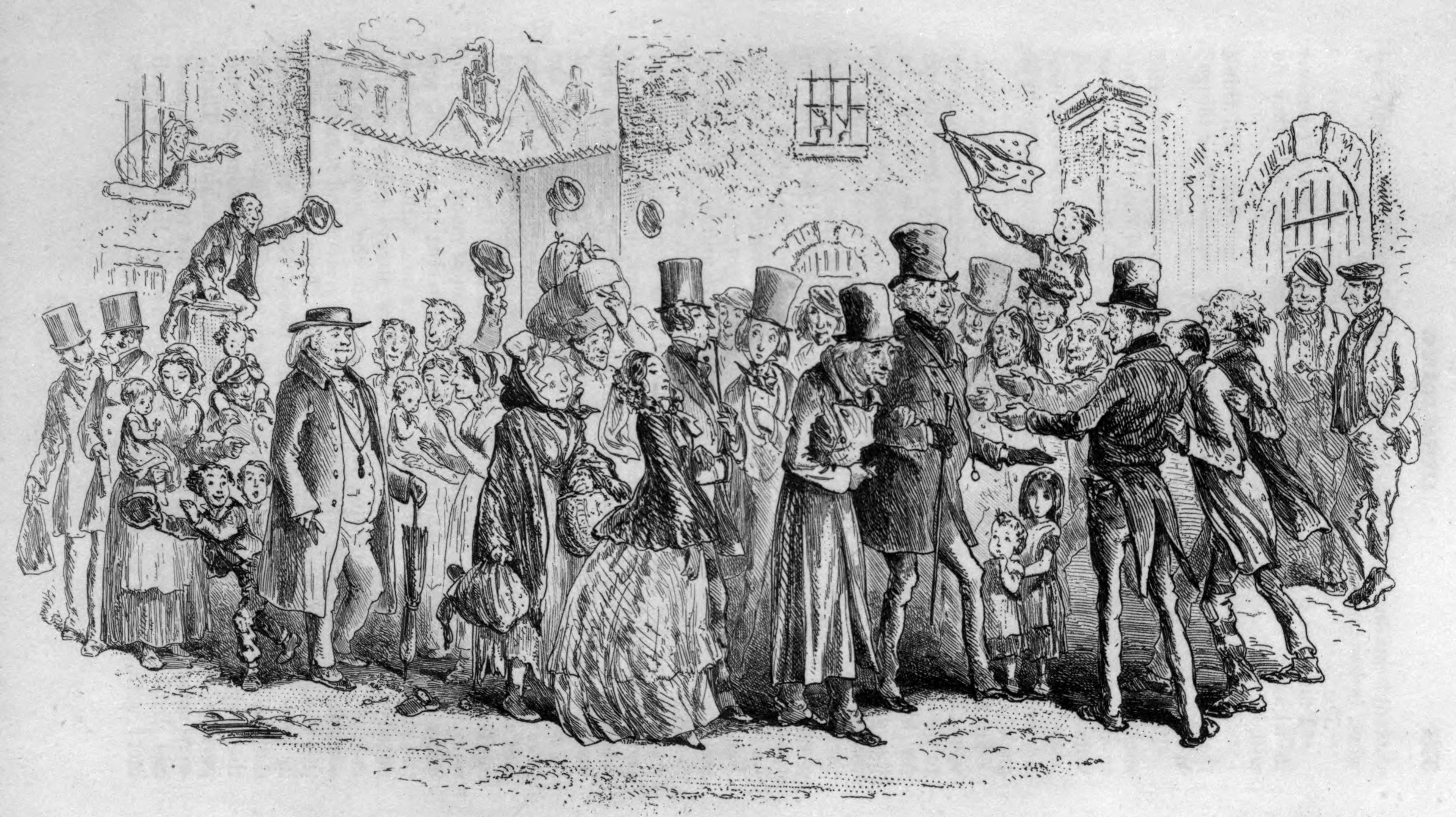
Illustration of the Marshalsea from Dickens' Little Dorrit
Many may choose to shy away from slavery in their world-building, for various reasons, although this is the most ancient and perhaps obvious solution to the problem of outstanding debts.  In such a cased where temporary servitude to work off debt (yes, so barbaric!  And so different from the world we live in!) is not a favorable option, then one might want to consider debtor's prison.  One then has the character(s) in a relatively controlled setting, if so needed.  Depending on their conditions of their imprisonment, they may be a liberty during the daytime to work.  Needed NPCs could be held there, needing to be busted out or bailed out -- it introduces a whole new sphere to plot Trouble with the Authorities.  It might also be an effective place to hide.  In gaming, it could be a punishment for bad behavior or consequences of failure -- as well as a motive to participate in a get-rich-quick-scheme, such as dungeon delving.  I think places like the Marshalsea and the Fleet, as horrible as they are, add color and shade to a fictional city.

Detail of a Thomas Rowlandson illustration showing a resurrectionist
We associate corpse snatching with the robbing of the body from its grave, and furthermore, with the work of Dr. Frankenstein.  But it was a widespread problem in the 18th-19th centuries, and supplied mundane anatomy needs and not simply the work of a single mad natural philosopher.  Now, add in all the needs for bodies that a fantasy setting would require beyond ordinary needs we saw in our own past, and you will quickly realize that resurrection men would have an even more booming business in a fantasy world.  No one would want their body or its parts floating around for various uses (including a tool for pestering them with questions in the other world), much less reanimated as a construct or a walking undead -- or perhaps used for the reincarnation of another.  No, ordinary people would not submit to it willingly, so only the corpses of criminals would be offered for legal purposes.  If we assume, as on Earth, these will not be enough to meet demands, and add on to that a much larger demand from illegal practices such as necromancy, then the ranks of the resurrectionists swell, and so do their methods.  History tells us that fresher bodies were worth more money, and that bodies would be gained by women pretending to be mourning relatives.  If your setting uses the convention of the thieves guild, the resurrection men could be members or they could be practitioners of an independent and slightly more legal, um, livelihood.  For more on the practice, see this post.

As you ponder these institutions past for your mythopoecizing, I hope they will not only add fuel to the fire but cheer to the new year.  For as we say good-bye to 2011 and look forward to 2012, we can all be thankful that we are not dead nor denizens of debtor's prison.

Saturday, November 12, 2011

Review of Immortals


I saw Immortals last night with my stepson and my opposite-taste-continuum wife, and we all liked Immortals, so that bodes well for its reception by a general audience.  The main thing I can see going against it in this context is violence, and since I think most people these days seem to be pretty comfortable with their blood-thirsty side, I doubt that will hold it back.  If human-on-human violence bothers you, then I bet you'd already know not to go see Immortals, anyway.  I may come back to the issue of violence, but let me also note that if 300's thin storyline bothered you, there's a little more to 300. 

Now for the grousing.  The premise and the plot are still pretty thin in some places.  Why are the Heraklions such jerks?  Why do they want to follow a psychopath to wipe out the Hellenes?  Why would they put up with the stuff Hyperion does to them?  Who made him the boss of us?!

My wife couldn't understand the grousing.  Here I was having seen the kind of movie that I like, it was a good movie, and she was there with me and actually enjoyed it.  Beyond some complaints about story-telling, I think it is all goes back to our current zeitgeist, which prefers radical reinterpretations that have little to no relationship to traditional material beyond a bare minimum. I understand the desire to put your own spin on old material, and this become more important when material has gotten tired and overly familiar, but when it comes to anything demanding Classical knowledge, folks today are hyper-ignorant.  When you look a the picture of Poseidon from the movie above, you know (or guess) it is him from the trident (and this puts you in the top percentile of the population in terms of classical knowledge).  However, I chose to use the only Greek god in the entire film that is indicated by traditional symbology: Zeus has a fiery whip, Athena has either curved daggers or those Japanese one-handed scythes (I know, I'm not in the mood to look up the real name), Ares has a war hammer.  What the Tartarus?  Meanwhile {¡SPOILER ALERT!} the famous Greek hero Theseus, second only to Hercules, has one adventure and then dies?  {Here endeth the spoiler.}  Pffft.  I counter that the contemporary audience is so classics-poor that most of it will seem new to them anyway.  Reinterpretation should happen for reasons, not just for postmodern masturbatory buzz.  The radicalness of it in Immortals and cases like it goes beyond any real reason.  Why not just make up an original fantasy story?  It will be impossible to keep out some points of classical inspiration, anyway.

In addition to complaints about discontinuity with the source material for no particular reason, there is the extremities of its portrayal of combat.  Now, I know complaints about realism are going to be met with rejoinders about cinema and the style of this certain film, which is fair enough, but I still have some issues here.  I note that on the whole, we are moving to grander and grander spectacle with less realism, and my own counter-current desire for an increase in realism.  Sure, I want to be entertained and blown away, but I have two concerns: eroding our ability to visually and mentally detect the realistic and the threatening of suspension of belief for those of us who retain some measure of verisimil-detection.  Do I hope in vain that we would see more films that strike this balance a bit more satisfactorily?  Or is the zeitgeist so strong in the other direction?  I guess the one glaring example is when outnumbered idiots give up the advantage of standing spread out in the open to fight huge numbers constricted by a narrow tunnel.  No amount of style can excuse that for me.  (Hey, didn't you guys make 300?  What was the tactical point of that film again?)

Some of the blends are interesting.  Christian ideas and Byzantine iconography influence this recasting of Greek myth, which has a certain honesty about it, since Christianity has forever changed the way we think about divine matters.  And I loved that fact that they actually used Greek in the movie, and didn't use a pretend Germanic pronunciation of Greek.  But what alphabet is that used throughout the film?  Certainly not Greek.  Was it designed to look cool?  Why not just invent a new Greek script instead of what is obviously a modern typeface?  And using rebar in the film?  Surely that was another look choice and not a cost-cutting measure, but will people really not recognize rebar?  That with the architectural demands the sets would put on an ancient culture, I found myself fantasizing that this was a post-catastrophic Earth of the future that was replaying religious and mythological scripts of the past.

When it comes to ultimate questions, this movie reminded me more of the Clash of the Titans remake than of 300.  And here is where the real post-Christian nature of the film is evident: Exploration of the idea that the divine needs us. From my theological perspective, this is the ultimate in self-flattery from and for folks who have a terrible crisis in identity and worth.  Is the idea that the divine loves us and doesn't need us at all in any inherent way just way beyond the popular capacity to entertain?

To close, I turn to the miscellaneous: Freida Pinto is drop dead gorgeous.  I demand that she play the iconic oracle in any future Pathfinder film.  Mikey Rourke, I don't know if it is you or Hyperion or both equally, but it is hard not to enjoy seeing you beat up.  For pleasures of grand spectacle, genre, and venal indulgence, I recommend Immortals.  It's enough that these days I'm getting some of the kind of movies that I enjoy made and made well, even if they give me a lot to complain about.  And if anybody can find me more information on that typeface/alphabet used in the film, I would really appreciate it.  Yeah, sometimes I go for the eye-candy, too, Phaedra.

EDITED: For clarity.

Friday, November 4, 2011

Remember, Remember...


Remember, remember, the fifth of November:
The gunpowder, treason, and plot.
I know of no reason why the Gunpowder Treason
Should ever be forgot.


Who all our there uses political coups (failed or successful) and conspiracy theories (true or false) in their story lines?  I've found them to be a great element in games and stories, bringing with them tension, suspense, and getting caught up in events and powers beyond one's control.  They also provide one with an opportunity to identify with causes or reflect on the problematic of political causes.

Tuesday, October 11, 2011

Looking for Something to Read?

Fanart of Jake Wyatt after Craig Thompson.  See link below.


Read the NPR fantasy/sci-fi top 100 and its accompanying flowchart?  Didn't find anything new or arresting therein to whet your fiction appetite?  Take a look at Bud Webster's response over on Black Gate for some suggestions.  For that matter, am I actually directing people to Black Gate?  Their blog is a must-read by my lights for anyone interested in the subjects of this blog, and I hope to reward all their great work by subscribing one of these days to the magazine.  If by any chance there is anyone that doesn't check Black Gate's site regularly, I encourage you to do so.  Theirs is one of the sites that I can count on to regularly feed the mythopoet within.  (Yeah, I know, he's not that far down.  But still.)

The Siren's Call recommends some spooky and fantastical circus stories.

The New York Times reviews a book on the other Michelangelo -- Caravaggio.  A dark and fascinating character in every sense of the word, dark.  And yet, brilliancy broke through here and there, even in the darkness of his art.  Not only of interest in and of himself, he'd also make a great inspiration for a mystery story or for a particularly gritty character.

If you are still looking to stock up on reading for Halloween, I recommend taking a look at this Top Gothic Books list. Rarely do I see any contemporary pieces of so-called horror fiction that I think hold a candle to the gothic classics. 

If you are looking for something in the graphic novel department, Craig Thompson's Habibi promises to be a visually striking tale of suffering and love that capitalizes on the beauties of Islamic art.  I've never heard of the author/artist before, but his website sure makes the book look enticing.  As always, I'd love to hear from you any feedback or additional recommendations.  Happy reading!

Thursday, October 6, 2011

A Correction to my October Reading


In my book shuffling, I made a mistake that I corrected once I started reading and my eyes crossed "Kublai Khan."  "Kublai," I said to myself, with my mastery of Mongolian historical chronology and the biology of human reproduction, "came after Genghis.  That's how it is with grandsons."  I took a look at the second book, and sure enough, that was the book set in the time of Genghis.  So even though it messed with my plan of how the tone of the reading should progress, I switched the order of the first two books.  I'm not sure how much difference it is really going to make to tone, as the vampire St. Germain seems to be a good vampire.  So the new reading order is

1.  Chelsea Quinn Yarbro's Path of the Eclipse, the tale of a Chinese female Warlord and a good Europoean vampire in the context of Chinese resistance to Temujin's invading Mongolian horde.

2.  Avram Davidson and his wife Grania Davis' Marco Polo and the Sleeping Beauty, which tells the tale of the quest that Polo must undertake for Kublai Khan before he can depart the fantasy Khanate for his Venetian home.

I am already into Yarbro's book, and I hope that its TOR Horror imprint indicates that the Halloween spirit won't be ruined by presence of a good vampire as a major character.

Monday, August 15, 2011

Myth-Making & the Spirit of Inquiry

An Artist Who is Looking for Commissions

For why-wolves, possessed as we are by both the spirit of Inquiry and the spirit of Bloodlust, it is natural to ask why have humans engaged in the making of myths?  For the historically-minded, answering this question would, among other things, give us historical context in which to ask why do humans engage in myth making?  At this point the major attempts to answer this question that are still popular seem to me to fall out into five broad tendencies, the last one, arguably, ahistorical.


  Five Kinds of Mythological Theory
  1. Humans created myths due to confusion about the past. (Euhemerism, F. Max Müller)
  2. Humans created myths as hypotheses to explain their world and how it works.  Myths have Ritual as their corollary.  (Edward B. Tylor, James G. Frazer)
  3. Humans created myths to create group identity and control behavior.  Myths are a major feature of Society.  (Plato, Karl Marx, Emile Durkheim, Bronislaw Malinowski)
  4. Humans created myths because they were inspired to receive important encoded truths.  (Plutarch, Origen of Alexandria, Eusebius of Caesarea, C. S. Lewis -- and in very different ways, Rudolf Bultmann and J. R. R. Tolkien)
  5. The creation of myths is actually an expression of the Human Sub/Unconscious. (Sigmund Freud, Carl Jung -- and thence, perhaps, Joseph Campbell)
Now, if you are one of those people whose eyes start glazing over when conversation turns historical, think about this.  If you want to skip history and say, "Who cares?  We make myths because myth-making is fun!"  Then how do you answer this: Why is myth-making particularly fun?  Why not just rather write romance novels, comic strips, cartoons, horror short stories, TV Western scripts, screenplays for blockbuster action movies?  Further, as significant as enjoyment is, there are questions of power and resilience entwined with considerations of entertainment: myths are a lot older than the other genres, and signs suggest that they are not declining any time soon.  Beyond that is the possibility that they exercise a profounder pull, a deeper reach, and not merely a longer lasting and more popular appeal.

Wrestling with theorists on the one hand and my own attempts to make various kinds of sense (history being but one way) out of mythos (originally "story, narrative, plot")  on the other, I am always alternating between fascination and frustration.  One the one hand, there is an abiding sense (or at least suspicion) that there is a unified something behind or beneath mythology, whether that something is human or divine or both.  On the other there are the errors of the theorists, their prejudices (both good and bad), and the resistant particularity of any given mythological datum.  Perhaps the fascination and the frustration are just two sides of the same coin.  Lack of consensus on whether the categories true/false apply to mythos, what it is, what it is about, what it is for, and how it works does not dampen the attraction of the mythic field and thus makes the search for theoretical answers persist in the face of such a lack of consensus.

The Encyclopedia of Religion and Society has a number of helpful entries that are worth checking out, including many of the figures named above.  Sadly, there is no entry for Myth.  But there is for Demythologizing!  Really, editors?  Still, I am happy that at least one contemporary reference work of religion is available for free online.  Theoretical entries fall in an area where dating is a more serious problem in older works, such as the New Schaff-Herzog Encyclopedia of Religious Knowledge.

I hope this week's Mythopoeic Monday stirs your interest in such questions.  One place to begin furthering such interest is to start with Robert Segal's Very Short Introduction: Myth (Oxford), though this work will only introduce you to modern theorists.  Finally, I'd like to thank Trin and Droz for taking time in their post-Gen Con recovery to blog about their experiences in Indianapolis early this month.  Thanks again, guys!

According to at least one mythos, all questions stop with the Cosmic Owl.

Monday, August 1, 2011

The Ouroboros

The image of a serpent (snake or dragon) with its tail in its mouth is ancient, pervasive, and arresting. Frankly, it's also one of my favorites. The serpent itself is popular in symbolism in its own right, but something about the ouroboros makes it stand out.  While obviously the circle itself is suggestive and useful, I propose moreover that it is because the ouroboros introduces an irreducible ambiguity that creates tension and narrative.

The Rub: what is the serpent doing?  The Greek name of the symbol tells us literally that "he eats the tail."

But is the serpent eating his own tail?  
Why would the serpent be eating itself?  Is it an expression of the death wish?  The greed or gluttony which consumes itself? Total Self-Sufficiency (or the futility of the notion)?
Certainly, the alchemists were attracted to this symbol (as were Hermeticists and Gnostics) from time of the second century Chrysopoeia ("Gold Making") of Cleopatra, and so it was reproduced throughout the Middle Ages.  In the version in the Chrysopoeia, it is accompanied by the Greek inscription, "One is All."  Yet, the failure of the attempt to transmute base metals into gold by discovering the quintessence, the philosopher's stone, can't help but cast such proclamations in a futile light.  For the quest to have value, once must spiritualize alchemy as Jung and his followers have.


In contemporary tales of alchemy (see the Full Metal Alchemist and FMA: Brotherhood franchise of manga and anime), the symbol might implicitly indicate the tendency of the state to consume the people it uses as weapons and the fundamental ambivalence of power, in contrast to a principle of equivalent exchange.  If the state destroys all its members in the perpetuation of itself, where then is the state?


One final note: if a snake does mistake it's own tail for a meal, the results are disastrous for it apart from human intervention.   If human beings had come across such a snake in an ancient context, the primitive mind would have likely latched on to such a prodigy as a potent omen.  There is at least one more good candidate in nature for the inspiration behind the ouroboros.


Or is he curling up and holding on?
There is a species of lizard in Africa that has adapted a peculiar antipredator behavior:

Armadillo Lizard (Cordylus cataphractus).  Photo by Cindy Shuttleworth
 So the serpent might be protecting itself, rather than engaging in autosarcophagy.  Inscribing something inside the serpent might, however suggests that serpent is protecting something else.  Or is it?  One of the most common instances of the encircling serpent is the Midgard serpent of Norse lore.  Jörmungandr is usually understood as threatening the world with an encirclement of doom.  Are we trapped?  Will we be crushed?  But beside a native hostility to the snake, the encirclement might be an embrace rather than assault.  Perhaps he girds us to guard us.

Or is he shedding his skin?
The snake's shedding of his skin seems to have fired the human imagination early on.  Does he go on shedding his skin, renewing his youth, ever-growing and ever-living?  Oh for the power that we might do so!  So it seems that some have latched onto the ouroboros as a symbol of reincarnation, eternal life, or related concepts.  I don't know that any snake actually engages in biting the tail to assist itself in moulting, but the ancients may well have thought as much.  It fits with the circle as a symbol of infinity or eternity.

Ultimate Ambivalence
Finally, the ambivalence of the ouroboros symbol calls to mind another serpent symbol.  There is a serpent encircling a tree.  How do know it is the serpent tempting you to disobedience, forbidden knowledge, and death?  What if your knee-jerk identification of the serpent as Satan mislead you from the appearance of Christ on his cross (Nehushtan*)?  Is this the wise serpent that poisons or that saves?

Sébastien Bourdon, Moses and the Brazen Serpent, 1653. The Prado, Madrid.

Until the next time our rambles cross, I wish you a merry Mythopoeic Monday!


*Numbers 21:4-9; John 3:14-15.  Cf. the rod of the healer Aesculapius.

Friday, June 24, 2011

Documentary Grist for the Mythopoeic Mill

Free for Netflix Subscribers


Netflix Watch Instantly is the mythopoet's friend.  Lately I have been watching David Starkey's "Monarchy," which is like fine historical candy for the anglophile.  (The first two series are available.)  Very watchable, thought-provoking, and packed with historical nuggets presented from Starkey's strong perspective -- many of which I think will be new to the general reader/viewer who has been fed textbook views.

The Spanish Conquistadors by Michael Dialynas

I have avoided commenting on the OSR's most recent brouhahas, one of which directly relates to another documentary available to watch on Netflix: player characters as heroes vs anti-heroes vs villains.  I think basically I will continue this avoidance, but here is a resource for the anti-hero who enriches himself in disregard for others: Conquistadors.  This series by Michael Wood (I'm less of a fan of his, compared to Starkey) explores those who may be the most obvious real world parallel to fantasy adventurers who dare the unknown to kill, conquer, and plunder, yet whose violence wins them favor rather than outlawing.

Auguste Rodin's La Porte de l'Enfer by Trey Ratcliff

Documentary from Hell

So much for the good, yet even bad documentaries may be sources of inspiration.  I turn to The History Channel.  Now, The Gates of Hell is not the worst show on The History Channel by any means, as that continuum goes disturbingly low, indeed.  So while you are almost always better off watching the Smithsonian Channel, The National Geographic Channel, or even Planet Green, it just goes to show that it is not only the excellent that can be a source for thinking and creating.  My advice is, never mind the constant plastering over the vast and important differences between Hell, the realm of Hel, Sheol, Tartarus, Hades, Xibalba, Gehenna, the Egyptian Netherworld, and any other visions of the Underworld and what it comprises.  Soak up the images, and above all, think about all the claims that are being made.  Here are the claims that most intrigued me on one particular occasion: the Underworld as Prison versus the Underworld as a nigh-impossible destination.

As I watched and listened to the descriptions of the Underworld/Hell as a place that is exceedingly difficult to get to, guarded by trials, dangers, difficulties and so forth, I thought, Why would the Underworld be difficult to get to?  After all, "Enter ye in at the strait gate: for wide is the gate, and broad is the way, that leadeth to destruction, and many there be which go in thereat: Because strait is the gate, and narrow is the way, which leadeth unto life, and few there be that find it" (Matthew 7:13-14).  If the Underworld wants souls, it should make it as easy to get to as possible.  Besides, if the Underworld is a Prison, it should be impossible to get out of, not impossible to get into. 

At least a part of what lies behind this disjunction is the conception of the Underworld as a place forbidden because it holds riches (say, gold and magic for RPGers or secret knowledge for Odysseus and Aeneas) versus the Underworld as a place forbidden because it is a penal institution for wayward spirits.  So a question for those pondering their own Underworlds: Is the Underworld difficult to get into because the Power[s]-that-be is/are trying to protect the denizens above from the evils that lie below?  Or is the Underworld difficult to penetrate because it is filled with the precious objects of the Quest?  Pondering these two possibilities, is it any wonder that Pluto can be either Pluton, another name for the god Hades, or Plutos (Plutus) the god of wealth?*  Deciding how one is going to distinguish or conflate these two aspects may be an important step in the construction of one's mythic Underworld.


* This division in the Roman mythos is taken up by the figures of Orcus and Dis Pater, respectively.

Monday, June 20, 2011

King James Rules for Mythopoesis!


This year is the four-hundredth anniversary of the translation of the Bible authorized by King James I of England and Scotland.  Popularly known as the King James Version or the King James Bible,* for over half of its history it was known in English contexts simply as, the Bible, so much so that when an English bishop in the mid-nineteenth century reminded his clergy as he held it aloft that "This is not the Bible," he drew audible gasps.  Along with the works of William Shakespeare, this Bible is both the foundation of and the pinnacle of English literature: the only two works that deserve the designation of primary classics in the English canon.  While this is true of its substance as well as of its language, I am going to set substance aside with an assertion whose truth can rather easily be discovered by those who have yet to learn it: one cannot meaningfully enter the thought world of the English tradition of literature in ignorance of it.  To the extent that you want to locate your mythopoesis in this sphere of cultural interaction, you must have mastered this classic text.  Having dealt with that in one sentential swoop, I am going to focus on other lessons that can be learned from King James' translation.  These fall into two groups: 1. Historical (with an RPG rule suggestion) and 2. Linguistic.


1. The Historical
There are a number of excellent books about the story of the King James Bible available in this anniversary year.  I have just finished Alister McGrath's In the Beginning, and can recommend it as a good and informative read with only two major criticisms.  First, it is much lighter on the reception of the text than it is on its background and production and it would have benefited from the final two chapters being expanded.  Second (and this is probably the fault of Anchor Books rather than the author), though it is written by a scholar, its pitch at a popular audience resulted in its being shorn of foot- or end notes.  Even as a popular work, it should have assumed an educated audience and had minimal notes.

McGrath points out a crucial development that played a part in the transformation from Medieval to Early Modern Europe: the rise of the middle class.  The rise of the middle class resulted in a cycle of more literacy/more demand for affordable books.  And it was this complex of increasing demand and developing the technology to supply that demand that led to the availability of printed codices of translations of the Bible into the vernacular languages (which, by the way, was a significant business interest).

Now, for the fantasist working on setting or world-building, I have often seen the concern raised about the existence of gunpowder and how to handle (i.e., usually eliminate) that.  But this history raises another concern: how widespread is literacy and how is it concentrated in your setting?  How is it related to the existence of a sizable middle class?  Answering these questions will be important for identifying what kind of world it is and how things work in that world, as well as what it will tell you about your characters.

When it comes to fantasy RPGs, these questions are no less important.  Thinking about PCs and NPCs, are they more likely to come from the aspiring, upwardly mobile middle class, the desperate peasants looking to break out of poverty, or failed members of the upper class?  Are they more or less likely to be literate?  Here is an optional rule I have been playing around with: to represent literacy as an accomplishment, require one language slot of a PC to speak a language and a second slot to read and write it, unless the PC is a magic-user [wizard/mage] or cleric.  I will likely try this rule out in the (delayed but hopefully still happening) Ygg campaign.

2.  The Linguistic
If you want to be able to produce exalted, majestic English, all of the King James Bible and a good deal of Shakespeare are your greatest sources.  If you want to produce archaic English, the Bible is a better source than Shakespeare.  Though the two are roughly contemporaneous (Shakespeare starts some years earlier than 1611), the Bible is purposefully archaicizing.  The King's translators were charged not only with producing the most accurate translation based on the scholarship of the day, but with changing as little as possible of the wording of the already existing (but not popular) Bishop's Bible (1568).  Furthermore, the translators recognized the excellence of the work of William Tyndale (1522-1537) and relied heavily on his work as well.  These translations were themselves genealogically related, and coming as they did in a period before changes in the English language accelerated, retaining their constructions meant retaining an earlier form of English (this accelerated phase of linguistic change may be observed in Shakespeare, who is not consistent about using the singular [thou] and plural [you] forms of the second person pronouns and the old verb endings that go with them and who often uses the modern forms [you] we are familiar with today).

It is not easy for someone such as myself, who was raised reading Biblical English, to deal with one of the most lamentable facts of our failing culture: many people cannot read Early Modern English.  My students have forced me to accept this fact.  I expected to find it at the community college, but when I found it at the seminary, I will not describe the extreme acts that tempted me.  So we live in a day where use of the old classic is diminishing, but also in which Shakespeare is paraphrased for college English classes and Richard Hooker is paraphrased for Anglican seminarians.  Speaking for a moment only to native English speakers, cutting ourselves off from our literary past is a severe cultural impoverishment, rendering us only partly literate in our own tongue.

For those wanting to avoid this sad fate, there is no cure other than reading to increase proficiency.  Happily, we live in a day where the best version of the King James Bible ever is available: the New Cambridge Paragraph Bible -- and in cheap formats!  Some folks may also be interested in one of the anniversary reprints that seem to be springing up everywhere.  While these reproduce some important parts of the 1611 printing exactly, the biblical text itself is a reprint of the 1611 text from 1833.  This gives them an old look and reproduces the old spellings, but provides the advantage of a text in Roman type.  I can't imagine modern readers struggling with both the language, the spellings, and Blackletter typeface at the same time.  So if you prize "feel" over easy readability and scholarship, get a commemorative reprint, but if not, go for the NCPB.  However, even if you start with a run-of-the-mill printing like a Gideon Bible, you are entering a world of style and diction that will elevate your own poetry and prose, as well as open up a body of literature that is becoming increasingly a treasure hidden from the masses.  As always, thanks for stopping by, and I hope you profited from this week's Mythopoeic Monday.


NB: The NKJV or New King James Version is not what you are looking for.  Move along.

* Abbreviated variously: KJV, KJB, and AV for Authorized Version.