 |
| Courtesy of Messrss Butterfield, Parker, & Honigmann |

Showing posts with label Anglophilia. Show all posts
Showing posts with label Anglophilia. Show all posts
Tuesday, February 5, 2013
Real Old School D&D


Tuesday, April 24, 2012
U is for URBAN SETTING

"A great city is, to be sure, the school for studying life."
— Samuel Johnson
 The city. Urbs. Civitas. Polis. There is something powerful about the packing of places and teeming of characters that make it rich for the imagination to inhabit. Thus it is one of the settings that I love, even for fantasy adventure. It's not because I eschew variety: the hamlet, the wilderness, and -- especially the Underworld -- all have their charms. But a well-drawn city matches the well-done Underworld in my book. Dickens' London (to choose one London), lives for me and it is one of the Londons that I love; Rutherford's is another. McCullough's late Republican/early Imperial Rome likewise seems a real place with its own distinctive character. I'd like to find fiction set in Venice and Florence that do the same for those cities in the Renaissance. It's been a long time since I read much Ann Rice, but I think I'd probably say her New Orleans, and perhaps to a lesser extent her Paris, read well. The Thieves World novels made Sanctuary breathe and roar and spit. In game settings, the Free City of Greyhawk, Waterdeep, and Golarion's Absalom (for sale here) are intriguing cities that promise strong sense of place.
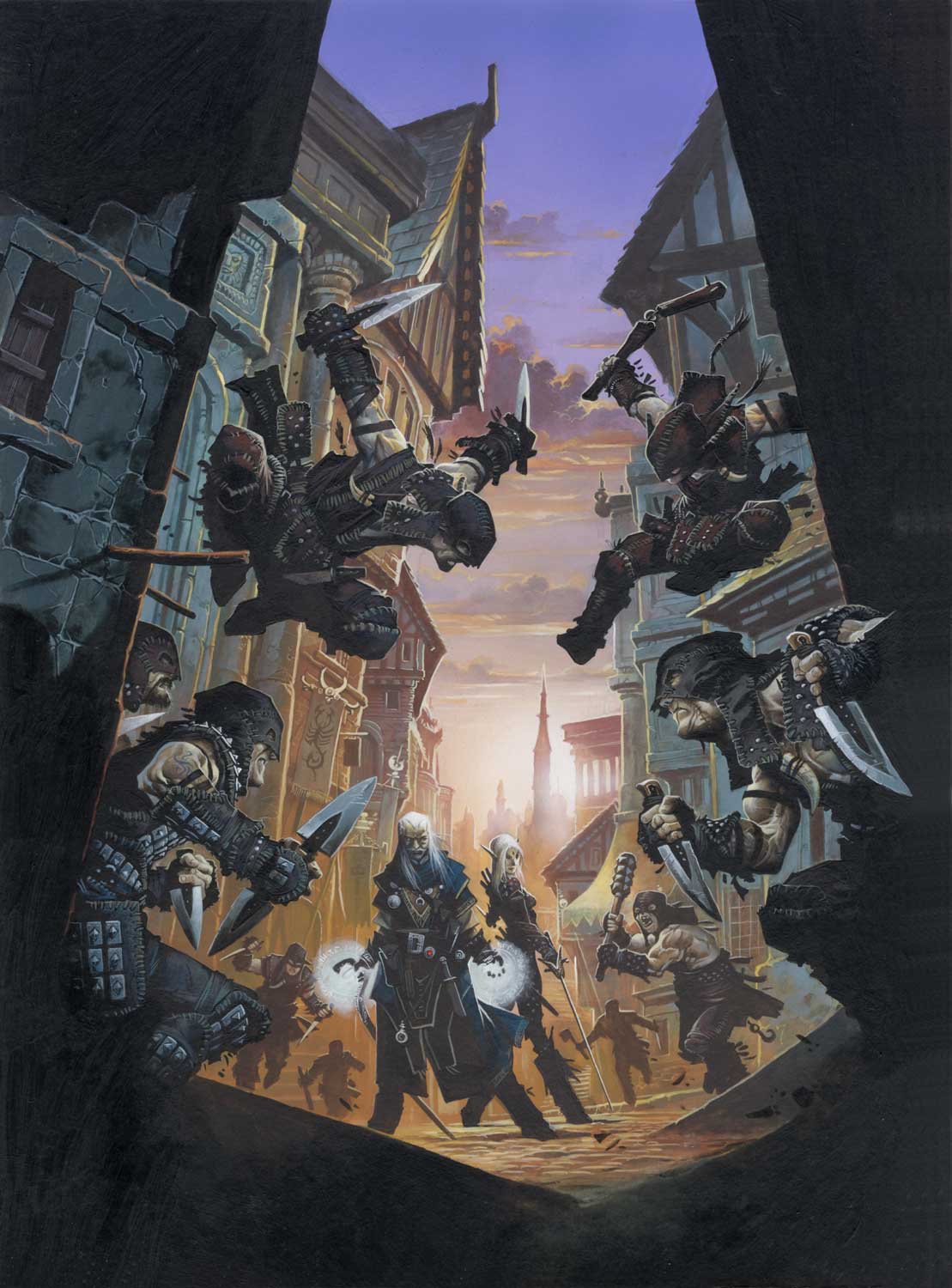
What cities do you love? What materials from fiction or gaming deliver a city in its stones and in its soul to your imagination? What are the touches that make the city seem a unique, living place? Are there equivalences of the double decker bus, the little black cab, the red phone box, and the red royal post box? How do you go about city building in your secondary creations? I would love to hear your thoughts, examples, and recommendations!
Friday, April 20, 2012
R is for ROBINSON CRUSOE

In chapter IV of Orthodoxy, "The Ethics of Elfland," he writes,
I really felt...as if all the order and number of things were remnants from Crusoe's ship. That there are two sexes and one sun, was like the fact that there were two guns and one axe. It was poignantly urgent that none should be lost; but, somehow, it was rather fun that none could be added. The trees and the plants seemed like things saved from the wreck: and when I saw the Matterhorn, I was glad that it had not been overlooked in the confusion. I felt economical about the stars as if they were sapphires (they are called so in Milton's Eden): I hoarded the hills (116).
...there had come into my mind a vague and vast impression that in some way all good was a remnant to be stored and held sacred out of some primordial ruin (118).I never appreciated the salvaging of goods when I read Robinson Crusoe, though it did make more of an impact on me when I saw the Swiss Family Robinson movie. But after reading Chesterton, I find it unforgettable. Even while I take more of a mythic approach to the story of the Fall than Chesterton did, I believe it resonates with me just as much. It also suggests part of the truth behind humanity as homo mythopoeicus. Our sense of wonder at the things that are and the things that are not find one mode of expression through the sub-creation of secondary worlds. In On Fairy-Stories, Tolkien traces this to the doctrine of the imago Dei: God created beings in his image, that is, image-making creatures.
Wednesday, February 22, 2012
Ashes to Ashes, Dust to Dust
"Remember, O man, that thou art dust, and to dust thou shalt return."
One of the greatest facts of human existence is mortality. Our mortal nature touches our yearning and our dreaming; our loving and hating, our creating and praying. Nothing human completely escapes the cold clay. Any mythopoesis that does not come, as far as it must within the limits of its art, to grips with the finite end of humanity is so far incomplete, imperfect, just as is any life that does not come to grips with it. This Ash Wednesday, I wish you nothing that I do not wish for myself. Death. And life.
One of the greatest facts of human existence is mortality. Our mortal nature touches our yearning and our dreaming; our loving and hating, our creating and praying. Nothing human completely escapes the cold clay. Any mythopoesis that does not come, as far as it must within the limits of its art, to grips with the finite end of humanity is so far incomplete, imperfect, just as is any life that does not come to grips with it. This Ash Wednesday, I wish you nothing that I do not wish for myself. Death. And life.
ASH WEDNESDAY by T. S. Eliot (1930)
I
Because I do not hope to turn again
Because I do not hope
Because I do not hope to turn
Desiring this man's gift and that man's scope
I no longer strive to strive towards such things
(Why should the aged eagle stretch its wings?)
Why should I mourn
The vanished power of the usual reign?
Because I do not hope to know again
The infirm glory of the positive hour
Because I do not think
Because I know I shall not know
The one veritable transitory power
Because I cannot drink
There, where trees flower, and springs flow, for there is nothing again
Because I know that time is always time
And place is always and only place
And what is actual is actual only for one time
And only for one place
I rejoice that things are as they are and
I renounce the blessed face
And renounce the voice
Because I cannot hope to turn again
Consequently I rejoice, having to construct something
Upon which to rejoice
And pray to God to have mercy upon us
And pray that I may forget
These matters that with myself I too much discuss
Too much explain
Because I do not hope to turn again
Let these words answer
For what is done, not to be done again
May the judgement not be too heavy upon us
Because these wings are no longer wings to fly
But merely vans to beat the air
The air which is now thoroughly small and dry
Smaller and dryer than the will
Teach us to care and not to care
Teach us to sit still.
Pray for us sinners now and at the hour of our death
Pray for us now and at the hour of our death.
II
Lady, three white leopards sat under a juniper-tree
In the cool of the day, having fed to satiety
On my legs my heart my liver and that which had been contained
In the hollow round of my skull. And God said
Shall these bones live? shall these
Bones live? And that which had been contained
In the bones (which were already dry) said chirping:
Because of the goodness of this Lady
And because of her loveliness, and because
She honours the Virgin in meditation,
We shine with brightness. And I who am here dissembled
Proffer my deeds to oblivion, and my love
To the posterity of the desert and the fruit of the gourd.
It is this which recovers
My guts the strings of my eyes and the indigestible portions
Which the leopards reject. The Lady is withdrawn
In a white gown, to contemplation, in a white gown.
Let the whiteness of bones atone to forgetfulness.
There is no life in them. As I am forgotten
And would be forgotten, so I would forget
Thus devoted, concentrated in purpose. And God said
Prophesy to the wind, to the wind only for only
The wind will listen. And the bones sang chirping
With the burden of the grasshopper, saying
Lady of silences
Calm and distressed
Torn and most whole
Rose of memory
Rose of forgetfulness
Exhausted and life-giving
Worried reposeful
The single Rose
Is now the Garden
Where all loves end
Terminate torment
Of love unsatisfied
The greater torment
Of love satisfied
End of the endless
Journey to no end
Conclusion of all that
Is inconclusible
Speech without word and
Word of no speech
Grace to the Mother
For the Garden
Where all love ends.
Under a juniper-tree the bones sang, scattered and shining
We are glad to be scattered, we did little good to each other,
Under a tree in the cool of the day, with the blessing of sand,
Forgetting themselves and each other, united
In the quiet of the desert. This is the land which ye
Shall divide by lot. And neither division nor unity
Matters. This is the land. We have our inheritance.
III
At the first turning of the second stair
I turned and saw below
The same shape twisted on the banister
Under the vapour in the fetid air
Struggling with the devil of the stairs who wears
The deceitul face of hope and of despair.
At the second turning of the second stair
I left them twisting, turning below;
There were no more faces and the stair was dark,
Damp, jagged, like an old man's mouth drivelling, beyond repair,
Or the toothed gullet of an aged shark.
At the first turning of the third stair
Was a slotted window bellied like the figs's fruit
And beyond the hawthorn blossom and a pasture scene
The broadbacked figure drest in blue and green
Enchanted the maytime with an antique flute.
Blown hair is sweet, brown hair over the mouth blown,
Lilac and brown hair;
Distraction, music of the flute, stops and steps of the mind over the third stair,
Fading, fading; strength beyond hope and despair
Climbing the third stair.
Lord, I am not worthy
Lord, I am not worthy
but speak the word only.
IV
Who walked between the violet and the violet
Who walked between
The various ranks of varied green
Going in white and blue, in Mary's colour,
Talking of trivial things
In ignorance and knowledge of eternal dolour
Who moved among the others as they walked,
Who then made strong the fountains and made fresh the springs
Made cool the dry rock and made firm the sand
In blue of larkspur, blue of Mary's colour,
Sovegna vos
Here are the years that walk between, bearing
Away the fiddles and the flutes, restoring
One who moves in the time between sleep and waking, wearing
White light folded, sheathing about her, folded.
The new years walk, restoring
Through a bright cloud of tears, the years, restoring
With a new verse the ancient rhyme. Redeem
The time. Redeem
The unread vision in the higher dream
While jewelled unicorns draw by the gilded hearse.
The silent sister veiled in white and blue
Between the yews, behind the garden god,
Whose flute is breathless, bent her head and signed but spoke no word
But the fountain sprang up and the bird sang down
Redeem the time, redeem the dream
The token of the word unheard, unspoken
Till the wind shake a thousand whispers from the yew
And after this our exile
V
If the lost word is lost, if the spent word is spent
If the unheard, unspoken
Word is unspoken, unheard;
Still is the unspoken word, the Word unheard,
The Word without a word, the Word within
The world and for the world;
And the light shone in darkness and
Against the Word the unstilled world still whirled
About the centre of the silent Word.
O my people, what have I done unto thee.
Where shall the word be found, where will the word
Resound? Not here, there is not enough silence
Not on the sea or on the islands, not
On the mainland, in the desert or the rain land,
For those who walk in darkness
Both in the day time and in the night time
The right time and the right place are not here
No place of grace for those who avoid the face
No time to rejoice for those who walk among noise and deny the voice
Will the veiled sister pray for
Those who walk in darkness, who chose thee and oppose thee,
Those who are torn on the horn between season and season, time and time, between
Hour and hour, word and word, power and power, those who wait
In darkness? Will the veiled sister pray
For children at the gate
Who will not go away and cannot pray:
Pray for those who chose and oppose
O my people, what have I done unto thee.
Will the veiled sister between the slender
Yew trees pray for those who offend her
And are terrified and cannot surrender
And affirm before the world and deny between the rocks
In the last desert before the last blue rocks
The desert in the garden the garden in the desert
Of drouth, spitting from the mouth the withered apple-seed.
O my people.
VI
Although I do not hope to turn again
Although I do not hope
Although I do not hope to turn
Wavering between the profit and the loss
In this brief transit where the dreams cross
The dreamcrossed twilight between birth and dying
(Bless me father) though I do not wish to wish these things
From the wide window towards the granite shore
The white sails still fly seaward, seaward flying
Unbroken wings
And the lost heart stiffens and rejoices
In the lost lilac and the lost sea voices
And the weak spirit quickens to rebel
For the bent golden-rod and the lost sea smell
Quickens to recover
The cry of quail and the whirling plover
And the blind eye creates
The empty forms between the ivory gates
And smell renews the salt savour of the sandy earth
This is the time of tension between dying and birth
The place of solitude where three dreams cross
Between blue rocks
But when the voices shaken from the yew-tree drift away
Let the other yew be shaken and reply.

Blessed sister, holy mother, spirit of the fountain, spirit of the garden,
Suffer us not to mock ourselves with falsehood
Teach us to care and not to care
Teach us to sit still
Even among these rocks,
Our peace in His will
And even among these rocks
Sister, mother
And spirit of the river, spirit of the sea,
Suffer me not to be separated
And let my cry come unto Thee.
Saturday, December 31, 2011
Debtors and Dead Men
Lately, I've been taking mental vacations to the lands of Steampunk Sherlock (saw the current film) and Dickens' London, as well as a side trip to 18th century Hammervania. It seems to me that considerations of 17-18th century England and Europe are not out of order for many fantasy settings, where great age and magic would allow for developments beyond feudal fare. In particular, I have been struck by two institutions that deserve consideration for your fantasy setting: debtor's prison and resurrection men.
Many may choose to shy away from slavery in their world-building, for various reasons, although this is the most ancient and perhaps obvious solution to the problem of outstanding debts. In such a cased where temporary servitude to work off debt (yes, so barbaric! And so different from the world we live in!) is not a favorable option, then one might want to consider debtor's prison. One then has the character(s) in a relatively controlled setting, if so needed. Depending on their conditions of their imprisonment, they may be a liberty during the daytime to work. Needed NPCs could be held there, needing to be busted out or bailed out -- it introduces a whole new sphere to plot Trouble with the Authorities. It might also be an effective place to hide. In gaming, it could be a punishment for bad behavior or consequences of failure -- as well as a motive to participate in a get-rich-quick-scheme, such as dungeon delving. I think places like the Marshalsea and the Fleet, as horrible as they are, add color and shade to a fictional city.
We associate corpse snatching with the robbing of the body from its grave, and furthermore, with the work of Dr. Frankenstein. But it was a widespread problem in the 18th-19th centuries, and supplied mundane anatomy needs and not simply the work of a single mad natural philosopher. Now, add in all the needs for bodies that a fantasy setting would require beyond ordinary needs we saw in our own past, and you will quickly realize that resurrection men would have an even more booming business in a fantasy world. No one would want their body or its parts floating around for various uses (including a tool for pestering them with questions in the other world), much less reanimated as a construct or a walking undead -- or perhaps used for the reincarnation of another. No, ordinary people would not submit to it willingly, so only the corpses of criminals would be offered for legal purposes. If we assume, as on Earth, these will not be enough to meet demands, and add on to that a much larger demand from illegal practices such as necromancy, then the ranks of the resurrectionists swell, and so do their methods. History tells us that fresher bodies were worth more money, and that bodies would be gained by women pretending to be mourning relatives. If your setting uses the convention of the thieves guild, the resurrection men could be members or they could be practitioners of an independent and slightly more legal, um, livelihood. For more on the practice, see this post.
As you ponder these institutions past for your mythopoecizing, I hope they will not only add fuel to the fire but cheer to the new year. For as we say good-bye to 2011 and look forward to 2012, we can all be thankful that we are not dead nor denizens of debtor's prison.
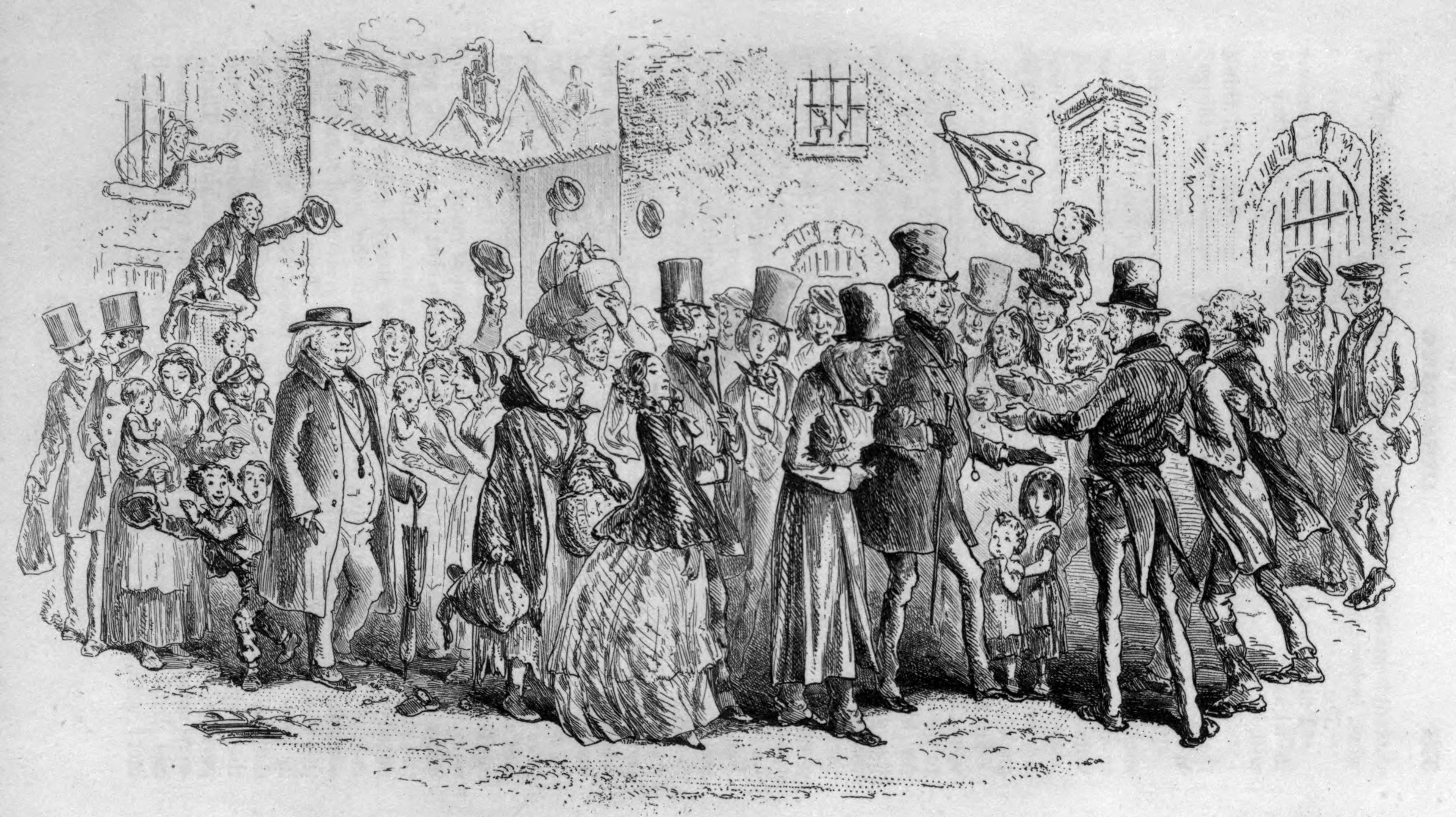 |
| Illustration of the Marshalsea from Dickens' Little Dorrit |
 |
| Detail of a Thomas Rowlandson illustration showing a resurrectionist |
As you ponder these institutions past for your mythopoecizing, I hope they will not only add fuel to the fire but cheer to the new year. For as we say good-bye to 2011 and look forward to 2012, we can all be thankful that we are not dead nor denizens of debtor's prison.
Tuesday, November 29, 2011
Much Better than Ground Steak Covered in Gravy

As Tomeful Tuesday draws to a close, I have to accept that my review of the latest Pathfinder Tales novel is not going to be finished. So, I will trot out an oldy but goody to recommend to anyone who has yet to read it. Salisbury is one of my favorite medieval cathedrals that I've never been to (yet). Sarum is my favorite book about (among other things) one of my favorite cathedrals that I've never been to -- by one of my favorite historical novelists. Rutherford, like Michener and Frank Herbert, covers large periods of time and helps develop the historical imagination. Great historical color and detail, and a great learning tool for people who want to think about how to run extended or inter-related plots or campaigns across time.

Friday, November 4, 2011
Remember, Remember...

Remember, remember, the fifth of November:
The gunpowder, treason, and plot.
I know of no reason why the Gunpowder Treason
Should ever be forgot.

Who all our there uses political coups (failed or successful) and conspiracy theories (true or false) in their story lines? I've found them to be a great element in games and stories, bringing with them tension, suspense, and getting caught up in events and powers beyond one's control. They also provide one with an opportunity to identify with causes or reflect on the problematic of political causes.
Monday, June 20, 2011
King James Rules for Mythopoesis!

This year is the four-hundredth anniversary of the translation of the Bible authorized by King James I of England and Scotland. Popularly known as the King James Version or the King James Bible,* for over half of its history it was known in English contexts simply as, the Bible, so much so that when an English bishop in the mid-nineteenth century reminded his clergy as he held it aloft that "This is not the Bible," he drew audible gasps. Along with the works of William Shakespeare, this Bible is both the foundation of and the pinnacle of English literature: the only two works that deserve the designation of primary classics in the English canon. While this is true of its substance as well as of its language, I am going to set substance aside with an assertion whose truth can rather easily be discovered by those who have yet to learn it: one cannot meaningfully enter the thought world of the English tradition of literature in ignorance of it. To the extent that you want to locate your mythopoesis in this sphere of cultural interaction, you must have mastered this classic text. Having dealt with that in one sentential swoop, I am going to focus on other lessons that can be learned from King James' translation. These fall into two groups: 1. Historical (with an RPG rule suggestion) and 2. Linguistic.

1. The Historical
There are a number of excellent books about the story of the King James Bible available in this anniversary year. I have just finished Alister McGrath's In the Beginning, and can recommend it as a good and informative read with only two major criticisms. First, it is much lighter on the reception of the text than it is on its background and production and it would have benefited from the final two chapters being expanded. Second (and this is probably the fault of Anchor Books rather than the author), though it is written by a scholar, its pitch at a popular audience resulted in its being shorn of foot- or end notes. Even as a popular work, it should have assumed an educated audience and had minimal notes.
McGrath points out a crucial development that played a part in the transformation from Medieval to Early Modern Europe: the rise of the middle class. The rise of the middle class resulted in a cycle of more literacy/more demand for affordable books. And it was this complex of increasing demand and developing the technology to supply that demand that led to the availability of printed codices of translations of the Bible into the vernacular languages (which, by the way, was a significant business interest).
Now, for the fantasist working on setting or world-building, I have often seen the concern raised about the existence of gunpowder and how to handle (i.e., usually eliminate) that. But this history raises another concern: how widespread is literacy and how is it concentrated in your setting? How is it related to the existence of a sizable middle class? Answering these questions will be important for identifying what kind of world it is and how things work in that world, as well as what it will tell you about your characters.
When it comes to fantasy RPGs, these questions are no less important. Thinking about PCs and NPCs, are they more likely to come from the aspiring, upwardly mobile middle class, the desperate peasants looking to break out of poverty, or failed members of the upper class? Are they more or less likely to be literate? Here is an optional rule I have been playing around with: to represent literacy as an accomplishment, require one language slot of a PC to speak a language and a second slot to read and write it, unless the PC is a magic-user [wizard/mage] or cleric. I will likely try this rule out in the (delayed but hopefully still happening) Ygg campaign.
2. The Linguistic
If you want to be able to produce exalted, majestic English, all of the King James Bible and a good deal of Shakespeare are your greatest sources. If you want to produce archaic English, the Bible is a better source than Shakespeare. Though the two are roughly contemporaneous (Shakespeare starts some years earlier than 1611), the Bible is purposefully archaicizing. The King's translators were charged not only with producing the most accurate translation based on the scholarship of the day, but with changing as little as possible of the wording of the already existing (but not popular) Bishop's Bible (1568). Furthermore, the translators recognized the excellence of the work of William Tyndale (1522-1537) and relied heavily on his work as well. These translations were themselves genealogically related, and coming as they did in a period before changes in the English language accelerated, retaining their constructions meant retaining an earlier form of English (this accelerated phase of linguistic change may be observed in Shakespeare, who is not consistent about using the singular [thou] and plural [you] forms of the second person pronouns and the old verb endings that go with them and who often uses the modern forms [you] we are familiar with today).
It is not easy for someone such as myself, who was raised reading Biblical English, to deal with one of the most lamentable facts of our failing culture: many people cannot read Early Modern English. My students have forced me to accept this fact. I expected to find it at the community college, but when I found it at the seminary, I will not describe the extreme acts that tempted me. So we live in a day where use of the old classic is diminishing, but also in which Shakespeare is paraphrased for college English classes and Richard Hooker is paraphrased for Anglican seminarians. Speaking for a moment only to native English speakers, cutting ourselves off from our literary past is a severe cultural impoverishment, rendering us only partly literate in our own tongue.
For those wanting to avoid this sad fate, there is no cure other than reading to increase proficiency. Happily, we live in a day where the best version of the King James Bible ever is available: the New Cambridge Paragraph Bible -- and in cheap formats! Some folks may also be interested in one of the anniversary reprints that seem to be springing up everywhere. While these reproduce some important parts of the 1611 printing exactly, the biblical text itself is a reprint of the 1611 text from 1833. This gives them an old look and reproduces the old spellings, but provides the advantage of a text in Roman type. I can't imagine modern readers struggling with both the language, the spellings, and Blackletter typeface at the same time. So if you prize "feel" over easy readability and scholarship, get a commemorative reprint, but if not, go for the NCPB. However, even if you start with a run-of-the-mill printing like a Gideon Bible, you are entering a world of style and diction that will elevate your own poetry and prose, as well as open up a body of literature that is becoming increasingly a treasure hidden from the masses. As always, thanks for stopping by, and I hope you profited from this week's Mythopoeic Monday.
NB: The NKJV or New King James Version is not what you are looking for. Move along.
* Abbreviated variously: KJV, KJB, and AV for Authorized Version.
Thursday, April 21, 2011
R is for Ricardian
WANTED:
TWO PARTNERS IN LIBELOUS SMEAR CAMPAIGN!
 |
| Sir Thomas More by Hans Holbein the Younger |
 | |||
| The Controversial Cobbe Portrait of Shakespeare |
The men you see above, a secular hero and a religious saint, have filled your head with Tudor propaganda, aimed at legitimizing the Tudor line against the heirs of the House of York. They were both beholden to Tudor monarchs when they produced their works. An important part of the Tudor strategy was to portray the last Plantagenet king, Richard the III, as a physical and moral monster who murdered his nephews in their boyhood. Somebody, in short, like this:
 |
| Richard III, portrayed by Sir Ian McKellen |
Not to worry, my friends. The eccentric faerie land of England has people that still care about the truth, once such causes are long given up as lost. I give you the Richard III Society! And don't worry, my American compatriots, there is an American branch for us as well. All this too much for you? Your head is swimming with the possibility that all you knew about the murdering, lecherous, deceitful hunchback could be wrong? Why not start in the shallow end of the pool, with this wonderful fictional detective story that presents the main lines of the Richardian reconstruction of good King Richard.

Soon, you will join our ranks, my friend! Long live the truth! God save King Richard!


PS. Just for good measure, here are two more Ricardian societies: 1 and 2. Web searches may turn up branches or organizations in your part of the world not linked here.
Wednesday, April 20, 2011
Q is for Queenly Quest
No, I'm not just being cute, nor showing off that I can think of more than one Q word, nor kicking up my consonantal alliterating heels, nor suffering from the inability to choose a subject. I actually have something in mind here: multiple relationships between queens and quests, two classic mythopoeic elements, and if one puts any stock in Jungian theories, two archetypes in and of themselves. What are these combinations?
The Quest to find a Queen
Every king needs a queen, so goes the traditional assumption. It seems to be generally desirable that a king be of a providential temper, and so that he exercise forethought to have a queen-to-be at the ready before his ascension to the throne. Thus all the stories in history, legend, and literature about the prince finding a princess against the day that he takes on the crown and all that pertains thereunto. According to the global media reporting enthusiastically on upcoming nuptials between a certain William Mountbatten-Windsor and his fiancée Kate Middleton, I am lead to believe that such fairy-tale countries as the United Kingdom still observe this nicety. If Jane Austen had written fairy-tales, we might have had this: "It is a truth universally acknowledged, that a single prince in possession of a good kingdom must be in want of a princess." So Hans Christian Anderson gives us "The Princess and the Pea." The concern in this story is the test to identify a real princess. Is she the genuine article? Does she have the potential to become the queen? Perhaps princes are poor judges of such an important matter. Using the principle "it takes one to know one," the queen mother is the one who can discern the young lady who's got the right stuff, and the critical test of the pea underneath a score of mattresses neatly sorts the gentle lady from the look-a-likes. Whatever form the quest to find her takes, the queen is a figure highly desired, and finding her is something quest-worthy.
The Quest to become Queen
Your mind might first go to the all the historical stories of the strong women who set out to rule, but I have more in mind the young lady who sets out on her quest not knowing that it will end with a queenly crown. Maybe it's the extent I've been influenced by fairy-tale thinking, maybe it is just a personal preference or something about my own worldview. Often fairy-tale retellings end with the heart-shaped close-up of the happy couple and a Happily Ever After caption. This seems to me a practical necessity at best, and a damn shame at worst. Even if this the moment she becomes or is revealed to be a princess, this is just one initiation before the ultimate one. The heroine has yet to graduate to queen! I would like to explore the trials that the noble young woman overcomes to achieve her queenship.
The Quest on behalf of the Queen
I'd be willing to bet that this what comes to most people's minds first. My memory is dominated by scenes of favors and jousting, of Sir Lancelot du Lac riding to Guinevere's defense in trial by combat, and of Ivanhoe serving the same for Rebecca the Jewess. But even when queens don't need saving, they are first and foremost a medieval Lady and therefore have a Knight who goes forth at her bidding (see the code of courtly love). I'm tempted to speculate about how women could improve their life and the life of their husbands based on exalting the Honey Do list, but I think I shall steer back towards safer waters. One cool thing about the latest Alice in Wonderland film was seeing Alice appear as the White Queen's Champion.
The Queen going on a Quest
This would seem to be the rarest of all. I'd love to hear of examples people may have of the queen going questing, but all I can think of is Amidala in Star Wars Episode I. First, a queen has to change into a more practical questing outfit, obviously.
As Jungian Archetypes
If the Jungian take is correct, the Queen represents the fully individuated, fully realized female self. She is the embodiment of the ideals and virtues of female wisdom and power, of female maturity and achievement. In other words, she is the goal of the ultimate, lifelong quest for a woman. (Individuation or self-actualization is the quest itself.) That she is worthy of the quest, whether to find her or become her, that she is worthy to command quests in which she takes various parts, is obvious upon accepting this view of her. Perhaps the strong tradition of female domesticity counteracts having lots of stories of the queen going questing herself, but I expect that this will change, if it hasn't already. I mean, who's going to stop her?
- The Quest to find a Queen.
- The Quest to become Queen.
- The Quest on behalf of the Queen.
- The Queen going on a Quest.
 |
| Illustration by Edmund Dulac |
The Quest to find a Queen
Every king needs a queen, so goes the traditional assumption. It seems to be generally desirable that a king be of a providential temper, and so that he exercise forethought to have a queen-to-be at the ready before his ascension to the throne. Thus all the stories in history, legend, and literature about the prince finding a princess against the day that he takes on the crown and all that pertains thereunto. According to the global media reporting enthusiastically on upcoming nuptials between a certain William Mountbatten-Windsor and his fiancée Kate Middleton, I am lead to believe that such fairy-tale countries as the United Kingdom still observe this nicety. If Jane Austen had written fairy-tales, we might have had this: "It is a truth universally acknowledged, that a single prince in possession of a good kingdom must be in want of a princess." So Hans Christian Anderson gives us "The Princess and the Pea." The concern in this story is the test to identify a real princess. Is she the genuine article? Does she have the potential to become the queen? Perhaps princes are poor judges of such an important matter. Using the principle "it takes one to know one," the queen mother is the one who can discern the young lady who's got the right stuff, and the critical test of the pea underneath a score of mattresses neatly sorts the gentle lady from the look-a-likes. Whatever form the quest to find her takes, the queen is a figure highly desired, and finding her is something quest-worthy.
 |
Victoria, Queen of Great Britain and Ireland in the Robes of State by Franz Xavier Winterhalter, 1859 |
Your mind might first go to the all the historical stories of the strong women who set out to rule, but I have more in mind the young lady who sets out on her quest not knowing that it will end with a queenly crown. Maybe it's the extent I've been influenced by fairy-tale thinking, maybe it is just a personal preference or something about my own worldview. Often fairy-tale retellings end with the heart-shaped close-up of the happy couple and a Happily Ever After caption. This seems to me a practical necessity at best, and a damn shame at worst. Even if this the moment she becomes or is revealed to be a princess, this is just one initiation before the ultimate one. The heroine has yet to graduate to queen! I would like to explore the trials that the noble young woman overcomes to achieve her queenship.
 |
| Miniature of George Clifford, 3rd Earl of Cumberland, the Queen's Champion, by Hilliard, c. 1590. |
I'd be willing to bet that this what comes to most people's minds first. My memory is dominated by scenes of favors and jousting, of Sir Lancelot du Lac riding to Guinevere's defense in trial by combat, and of Ivanhoe serving the same for Rebecca the Jewess. But even when queens don't need saving, they are first and foremost a medieval Lady and therefore have a Knight who goes forth at her bidding (see the code of courtly love). I'm tempted to speculate about how women could improve their life and the life of their husbands based on exalting the Honey Do list, but I think I shall steer back towards safer waters. One cool thing about the latest Alice in Wonderland film was seeing Alice appear as the White Queen's Champion.
 |
| Queen Amidala of Naboo, property of Lucasfilm Ltd. |
This would seem to be the rarest of all. I'd love to hear of examples people may have of the queen going questing, but all I can think of is Amidala in Star Wars Episode I. First, a queen has to change into a more practical questing outfit, obviously.
As Jungian Archetypes
If the Jungian take is correct, the Queen represents the fully individuated, fully realized female self. She is the embodiment of the ideals and virtues of female wisdom and power, of female maturity and achievement. In other words, she is the goal of the ultimate, lifelong quest for a woman. (Individuation or self-actualization is the quest itself.) That she is worthy of the quest, whether to find her or become her, that she is worthy to command quests in which she takes various parts, is obvious upon accepting this view of her. Perhaps the strong tradition of female domesticity counteracts having lots of stories of the queen going questing herself, but I expect that this will change, if it hasn't already. I mean, who's going to stop her?
Friday, April 15, 2011
M is for Melchizedek and Merlin

Melchizedek, the priest-king of Salem mentioned in Genesis 14, Psalm 110, and Hebrews 5-7, is a mysterious and attractive figure. "Without father, without mother, without descent, having neither beginning of days, nor end of life; but made like unto the Son of God; abideth a priest continually." This ancient patriarch appears in the Bible from nowhere, receives homage from Abraham, celebrates a sacral meal with him, and then disappears just as mysteriously. One cannot help but wonder if the text is hinting that he has been assumed into heaven bodily, like Enoch, Elijah, and Mary.

Now consider the mysterious figure of Merlin. His origin is a mystery. One rumor held him to be the son of a nun by a/the devil. He doesn't die, but is sealed up in a cave or tree, and there is an expectation that he will return with Arthur in the hour of England's greatest need (don't make me wrestle you to the ground and confess that C. S. Lewis' greatest novel is That Hideous Strength). Now my "What if..."
What if Merlin is Melchizedek?
A figure whose wisdom has been accrued through the ages. Perhaps he is one of the nephilim and that's the source of his non-human origin and the taint of a fall. He could then be a master of angelic powers in addition to the wisdom of the ages. I have figured for years that someone would have made this speculative or imaginative connection, but I have yet to have found that it has been made before. If it has, please point it out to me.
Wednesday, April 13, 2011
K is for the King and his Knights
 |
| N. C. Wyeth's Frontispiece to The Boy's King Arthur |
{Spoiler Alert!}
In the episode, "Loyalty to the King," the Ice King shaves his beard after his latest "romance" with a princess has come to an end with her escape from the Ice Kingdom. Without his major identifying feature, and looking presumably much younger, princesses are suddenly fawning all over him instead of fleeing his sight. Through his quick-witted capitalization on a misunderstanding, he comes to be known as the Nice King. Upon hearing of the arrival of a Nice King, the heroes immediately go to offer to enter his service.
{End of Spoiler}
I am sure that my gentle readers can multiple many examples of the ideal King, but in English-speaking contexts today, as well as for much of European history, the example par excellence is the legendary, perhaps semi-historical, Arthur. He exemplified the virtues of wisdom, learnedness, justice, piety, and courage, skill at arms, and leadership. Chosen by divine providence, and perhaps other numinous indicators, he had the gift of charisma,* like the Israelite leaders of old did. The ideal king is worth being loyal too, and so other men of nobility and gifts are attracted to his court and his rule. Enter the knights.
Is it because even heroes need a hero? Is it that a bunch of gifted and testosterone-heavy, if not violent, men need an alpha male for social purposes? Or is it a common human yearning to make a virtue of necessity: if we must have a leader, we yearn for one of nobility, of destiny, one who is worth-ship-ful? Or is there simply a high degree of success that tended to accrue to past societies who gave immediate and radical obedience to the leader who inevitably has to make difficult and dirty-handed decisions? (A kind of social Darwinian advantage to the theory of the divine right of kings, if you will. Cue Socrates with the Founding Lie.) I've been reading James Branch Cabell lately, and he makes a good deal of fun of the human need for the Redeemer figure. The ideal king can simply be a more secularized version of the Messiah: Jesus had his Twelve Apostles, Arthur had his Knights of the Round Table. Meanwhile, mythopoets in the Lewis-Tolkien school (continuing a tradition from Christian apologists in the late Roman world) might see this as the way that all mythology reflects the truth at the heart of our world, and Jungians would search for the way that it reflects the archetypes of the Self. But whatever the reason, his heart or his shoes, Arthur sat there on Whitsun eve with knights in his mews.** Even Cabell's King Manuel has a Fellowship of the Silver Stallion.
Clearly we expect for knights to be champions of a virtuous king, gathering around him and then dispersing in benevolent errantry throughout the land or being sent on specific quests. Among them there is a fellowship of loyalty, mutual interest, righteous heroism, and dangerous competition for training purposes and for renown -- tournaments. That we still yearn for something that the King and his Knights represent, is evident in that fact that they refuse to disappear from our cinemas and television screens, video games, and comics. To some extent, the Walt Disney empire rests on the foundations of Camelot, as seen by the presence of the storybook castle as the center of his theme parks. But in recent decades, the multiplication of Societies for Creative Anachronism, for training in medieval martial arts, Renaissance festivals, Shakespeare companies, and even restaurants where you root as opposing factions over a faux, live medieval tournament while dining on hearty fare without knives and forks show that our need or our desire for the King and his Knights may be stronger than ever, even in the land that did away with kings and nobility. (So, who's planning on watching William and Kate's wedding?)
 |
| Medieval Illumination of the Knights at Arthur's Round Table |

Whether you build on the assumption that a group of noble, renowned, loyal warriors gather to the banner of the ideal monarch or you choose to question or even subvert it, you are trading on the expectations accrued to this well-known and well-received premise. With the richness of the institution politically, religiously, historically, and mythically, it has a lot to offer in terms of commenting on these dimensions, building setting, developing characters, and it comes with traditional plot elements built in to it. But trade on the desire to develop oneself in heroic directions and to belong to an ideal community are powerful, so caution should be used when taking it in non-traditional directions.
* Note that the common usage of the word (1) is actually derivative from the earlier, more technical usage (2). We have Max Weber to thank for the reintroduction of the term in scholarly discourse outside of theology (further down in the article).
** Eat your heart out, Theodor Geisel.
Wednesday, April 6, 2011
E is for Edmund
 | |||
| EDMUND OF EAST ANGLIA! |
 |
| NO, NOT EDMOND OF NARNIA... |
Edmund, King and Martyr, 855-869 or 870.
There was a campaign several years back to replace the cosmopolitan, nay global, George with one of the two homegrown boys he had displaced on his way to adding Patron of England to his rather lengthy resume. Whether or not he suffered the same perforated end as the apparently sexier-to-many-people Sebastian, his symbol is often given as this: |
| Emblem of King Edmund, stained glass, St Peter and St Paul's Church, Hoxne, Suffolk. Artist: Derek Anson |

It is the three crowns in particular that interest me. Is it one crown for each county? The Oxford website linked above notes that three crowns are associated with him, just as they are with Jesus Christ and King Arthur. One could have wished for a fuller comment.
 |
| Montague Rhodes James, 1862-1936 |
For a helpful instance of synchronicity, see this Clerk of Oxford.
Subscribe to:
Posts (Atom)