Tuesday, February 14, 2012
Valentine's Exaltation of the Flame Princess
James Edward Raggi IV has been appearing in another round of podcasts lately, hawking his Lamentations of the Flame Princess WFRPG: Grindhouse Edition. This was a sign to us of what was to come. It is clear to me that, instead of blowing all his profits from Lamentations on his rock-and-roll lifestyle as I'm sure we all assumed he had, he was actually playing the long game, bribing his way onto the Adventure Time special Valentine's Day episode. If you haven't seen the episode yet, I won't spoil too much: in "Incendium," the Flame Princess (spoilers at link) threatens to displace Princess Bubblegum as Finn's love interest.
Very devious way to insinuate your game into the American market and get around all the not-for-the-kiddies issues, JERIV. Happy Valentine's Day, you filthy animal.
Also, check out Randomistics' fan art.
Paizo's Planet Stories Catalog
I recently gave a plug to the Planet Stories line of novels. I want to follow up on it for today's Tomeful Tuesday by providing a catalog of the line so far. They are listed below by author, and linked to the novel's page on Paizo for convenient consultation or purchase. The collection stands at 33 volumes, and the release of further titles is being held in abeyance while publisher Erik Mona decides on a new strategy for the line. I know while he works out what that new strategy is he has my thanks and well-wishes along with many other fans' for the service he (and Sutter and Watters) has done for the genre and the many hours of pleasure he has provided readers in these classy and classic volumes.
Monday, February 13, 2012
Finding Adventures for Advanced Dungeons & Dragons
So, Wizards of the Coast is reprinting the core rule books for Advanced Dungeons and Dragons. If you are a new player to the first edition of the Advanced version of the world's oldest role-playing game, you might be looking to find some adventures published for it that are still in print. This link will take you to a list of all the adventures compatible with AD&D1e that are available in print or in pdf. And some of these modules are even free! Check out who is offering ongoing support for the game that most of us played for all those years, take advantage of the fruits of their years of experience, and reward them for keeping them faith.
If you are not looking for this resource or none of this is news to you, you might be a blogger who could stand to be reminded of the effort to spread the word. Thanks for stopping by, and happy Mythopoeic Monday.
Sunday, February 12, 2012
Review: The Woman in Black
James Watkins' The Woman in Black opened last weekend, coming in second in terms of sales, but the reviews do not seem to me as good as they should be. This strengthens my impression that many movie goers, unfortunately, do not want genuine, classic horror. I do, however, and I am relieved when a film I was hoping would not be the typical horror drek rises above the level of crap. In this case, the film adaptation of Susan Hills' novel that had gone on to an incredibly successful life on the stage and then a made-for-TV version, does far more than that. As a period piece, as a ghost story, as a film, it succeeds on every level. Acting, writing, sets, costumes, special effects, and cinematography -- all excellent. I wish I could remember more about the sound, but the fact that it faded seamlessly into the experience is probably a good sign. Scary, psychologically sophisticated and with a depth of thought that lingers after the viewing experience, this deserves to stand with the best ghost films made so far.
Now, to the Hammer in the middle of the room: Yes, Hammer Films came back in 2010 with Let Me In, the English language remake of Let the Right One In. It is heresy with many of my friends, but I liked Hammer's version better than the Swedish original. Well, now with The Woman in Black, they are not just back, but they have outdone their historic legacy of horror and produced an atmospheric work of art, a tour-de-force of dread with moments of genuine fear -- not to be confused with mere shock or disgust. Everyone involved is to be congratulated.
If you are the kind of film fan who is not bored by the pace it takes to build real horror, then reward yourself with this dark feast. Yes, fans of the book, there are some changes so let the film stand on its own feet. I, however, found the questions raised by the film's ending to provide the lingering pleasure due to reflections on human nature and the human condition. Longing, grief, dread, fear, hate, revenge, and, yes, love. The more I think about it, the more I suspect that there is an implied theology behind the film, the tension between two interpretations of the ending, and the interpretation that I think is most likely within the confines of the story, aside from a structural element that makes some viewers choose the other interpretation. And the more likely interpretation also is, in my view, the strongest. Very abstract, I know, but I'm not going to spoil here. It's worth working it out on your own.
Saturday, February 11, 2012
The Demonblood Sword
![]() |
| Paris thinks the above looks like a Nabassu. |
Our friends at Adventure Time inspired me once again, and so I issued an Obscure challenge to guest blogger and FoMR Paris Crenshaw. (Another great episode, by the way, Adventure Time crew.) Those navy men don't fool around with this sort of thing: he quickly responded on his blog. He's even tweaked it in response to some comments I gave him. So for a fully written-up Pathfinder version of Finn's family sword (easily converted, if necessary), the demonblood sword that his adopted father apparently made with blood he stole from a demon, head over to Paris blog (linked above). Also, I don't think you can comment on Paris' page, so feel free to leave comments for him here. I like the flavor you have achieved, Paris, but with a drawback as big as a 5% chance that the demon will appear to demand its blood back every time the sword is drawn, I wonder if the power or benefits of the sword ought to be greater.
I will be curious to see if the demonblood sword, AKA the family sword, continues to appear in future episodes. If so, we may learn more of its powers and Paris can look forward to further pesterings. :-)
![]() |
| Will this be the main sword for Finn the rest of the season? |
Tuesday, February 7, 2012
Gary's Gord the Rogue Books
I recently finished the first six Gord books for the first time. With a couple of complaints, I have enjoyed them, and they have probably done more to fire my interest in the Greyhawk setting than anything other than Anna B. Meyer's maps. In the case of the books, it made more interested in the Free City of Greyhawk than any other locale. It's a shame that only the first two books got Elmore covers (although, that is not how Gord should look next to Deirdre Longhand, the cavalier from Hardby) and that the final five books got stuck with those poor quality illustrations.
The picture above shows the preferred reading order that I have arrived at. Now, should I acquire and read the seventh and final book? Or, knowing the destiny or Greyhawk and the reason for that destiny, am I happier leaving well enough alone and stopping with book six?
I know my readers know a LOT more about Greyhawk than I do (going back to an embarrassing episode with my very first AD&D character), so I am curious to hear any specific advice or reactions that you have for me about the books, or about the setting of Greyhawk in general.
Monday, February 6, 2012
Dad's Dungeon
Adventure Time sent Finn and Jake into their second dungeon in tonight's new episode. It's as I said when this cartoon first came out: It's the most D&D cartoon. EV-AR.
Tales from the Junior Front: Playing Pathfinder with my Daughters
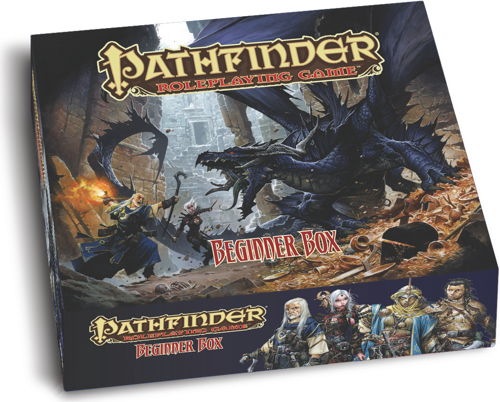
As Theo mentioned in a previous blog post, he and I share an interest in teaching kids to play tabletop RPGs. I have twin daughters, who are currently nine years old. I’ve been playing RPGs with them off and on since they were six. I would have liked to start them off earlier, but they weren’t quite ready. They have minor attention deficit issues and a few other challenges, including mild cerebral palsy, due to the fact that they were born almost three months early.
While they are miraculously free of the worst difficulties that they could have, I have to take their current challenges into account when we do our gaming. Although I’d love to say that my kids are way advanced and are already able to play a full game of Pathfinder, even though the suggested age for the Beginner Box set is 12 and up, the fact is, they aren’t quite ready for the kinds of games we adults tend to run. Playing RPGs with them has taught me a lot about running games for younger players. It's probably no surprise that Theo and I aren’t the only ones interested in this topic.
During PaizoCon 2011, some friends and I had the opportunity to sit down with Lisa Stevens, co-owner of Paizo, and Ryan Dancey. Since playing Pathfinder with my kids has been a longtime goal for me, I wanted to pick their brains about designing things for the Beginner Box that my daughters could play. Ryan told us that Wizards of the Coast had actually commissioned a psychological study to determine the age at which an “average kid” could pick up and play a game of D&D. It turns out that the “12 and up” age suggestion is based on the fact that Pathfinder, D&D and similar games require skills and understanding of concepts that younger kids just haven’t developed, yet. I have found that to be mostly true for my kids.

Although I started my kids out on other games, I’m a Pathfinder fan, at heart, so I played a couple of sessions with my daughters using the full Pathfinder RPG rules. When the Pathfinder Beginner Box came out, I jumped at the opportunity to use a simpler version of the rules to help the girls get the hang of things a little easier. Over the course of several sessions, I’ve learned even more about gaming with my daughters. These experiences fit with the ones Lisa and Ryan were talking about at PaizoCon.
While individual experiences will vary, the following generalities are lessons I’ve learned that many adults can use when preparing and running games for young players.
Patience
First, and foremost, playing games with kids requires even more patience than playing with adults. Every game master knows that players are the most unpredictable and challenging aspect of running RPGs—the dice have nothing on a bunch of players when it comes to generating something random. While that element of uncertainty is part of the fun and challenge of being a GM, in the case of kids, that randomness can be frustrating, because most kids won’t limit themselves to what’s going on in the game.
The party might be in a dragon’s lair, preparing to assault the beast’s inner sanctum, when one player decides that her PC needs to go back to town (which is miles away), so that she can buy a bouquet of flowers to try and make the dragon friendly toward them. Or, she may simply decide that her character wants to go off and find her long-lost brother who mysteriously disappeared after the great battle that killed their parents—nevermind the fact that this is not a part of her character history that you’ve ever heard about or that it has nothing to do with your carefully-crafted plot. You need to be able to work in a variety of “unorthodox” solutions to problems while also keeping them on track toward a current objective, all without losing your temper. (I would like to say that I’ve always managed to do that...but I would be lying if I did.)
You’ll also need that patience to deal with more frequent rules questions and to explain in greater detail how a character takes an action, often more than once. Kids aren’t going to notice or remember all the nuances of how the rules work and they’re going to make dumb tactical choices, because they aren’t paying attention, don’t know the rules well enough, or just think it will be more fun to do things a different way.
It’s tempting in these situations to correct such poor decisions or tell kids what to do. But forcing a young player to change her mind can backfire. It slows the learning process and can even cause the player to rely on you for even more decision-making in the future. Even worse, it can make the game less fun for them, because they feel like they are only allowed to play it the way you want them to.
You need to be able to let them make mistakes to learn through consequences, but at the same time, you don’t want to be too harsh, because that’s not fun, either. If possible, let them succeed despite a poor tactical decision—maybe not all the time, but enough that they aren’t always frustrated. Kids will learn over time, but the overall goal is to have fun, not become tactical prodigies in elementary school.
Characters, not Tactics
The fact is that not only are most kids not aware of the principles of tactical combat, most kids don’t even care about them. When I asked my daughters what their favorite things about playing Pathfinder are, the unanimous response was, “talking to the people and making new friends.” For them, in-character social interaction is at the core of a fun roleplaying game—and it applies in every situation, not just when you head back to town to get your next assignment.
A good example of this came up when we played the adventure in the Pathfinder Beginner Box set. The girls wanted to talk to everything. Even when they clearly understood that they weren’t going to be able to talk their way out of a battle with the creatures in a specific room, they wanted to carry on a conversation while they were fighting. They wanted to hear what the goblins had to say or throw taunts at the monsters.
I had grown to expect that from my kids, with whom I have played other games like Faery’s Tale Deluxe. I enjoy games like these, because I can “do voices” and play characters in a big, exaggerated way without feeling silly. I know I look silly when I do it, but when I’m doing it for my kids and they’re laughing and having a good time, I don’t feel self-conscious, as I would if I tried the same thing with my regular adult gaming group.
The point is, when playing RPGs with kids, you should focus on what the characters are doing and saying. Give them funny voices and mannerisms. Make them memorable because of how they behave, not because of the special abilities they have or how deadly the combat was. Kids will engage more if they can actually interact with a dungeon’s denizens. While this is true for all age groups, really, it’s especially important for kids.
Combat and Victory
When I asked my daughters what their least favorite thing about Pathfinder is, both of them responded with, “Missing.” In other words, they don’t like it when their attacks miss. And I can’t say I blame them. I mean, who does like failure? But for kids, not being able to succeed at every task can be a real obstacle.
In that study that Ryan Dancey told me about, one of the things WotC learned is that kids need to be old enough to accept that failing a roll is okay. Until they reach a certain maturity level, kids will get stuck trying to unlock a specific door, even if they don’t need to get through that door to explore the rest of the dungeon. If they can’t make the roll to open that lock, then they can’t proceed with the rest of the adventure.
Similarly, younger kids have a hard time with the idea that their attacks won’t always hit. One of my daughters specifically pointed out that she wished combat was more like a battle in her Pokemon game on the Nintendo DS. In those battles, the attacks always hit, and it’s just a matter of whether your attacks are stronger and your health is greater than your opponent’s. Understanding that mentality can go a long way to helping your kids understand combat in a game like Pathfinder. Call on that patience that we just talked about, ignore any potential whining, and gently explain that they will get to try again next time.

That doesn’t mean that I’m going to start letting my daughters succeed at every attack roll. Part of learning to play any game is learning to accept that the rules work a certain way. That goes hand in hand with learning some basic tactics to keep from getting killed in every encounter.
What it does mean is that, when running Pathfinder battles for young kids, you need to give them straightforward scenarios with plenty of opportunities to succeed. While older players may be able to appreciate the frustration of having their enemies escape to fight another day, most kids aren’t going to find that satisfying. (It was for that reason that I chose to let them defeat the evil dragon in our adventure, rather than have it escape. The dragon would have been smarter to fly away, but the girls would have been disappointed.)
Objectives: Sometimes Railroading is Good
One of the biggest challenges in playing RPGs with my girls, and probably with a lot of kids, relates to that anecdote about leaving the dungeon in the middle of an adventure. We all know kids can get distracted pretty easily, and not just kids with attention deficits. While a short attention span may not always send your PCs off to far away lands, it can prevent them from making progress through a single location.
Even if a kid is old enough to understand that a locked chest doesn’t have to be opened for them to proceed on with the adventure, she might just as easily get fixated on an otherwise unimportant feature you’ve placed in your dungeon—something you just thought would add ambience and interest—and try heading down a path that has nothing to do with her original mission.
When this happens, you should consider working to change your story on the fly to incorporate the new train of thought, because doing so will make the game feel more interactive and tells the player that she can interact with the game world in a more organic way.
Alternatively, you can avoid complex back stories or intricate details that don’t help the characters focus on the current adventure. That amazing mural on the wall that depicts an ancient civilization at the height of its power may be a great detail about who originally built the dungeon and why, but it also might send the player characters off in search of the powerful artifact in the picture, rather than deeper into the dungeon where the current resident is waiting for them.
Tools and Props
I have to admit that one of the other reasons I love playing games at home with my kids is that it allows me to use a lot of the cool props and miniatures I’ve been collecting over the years. I have tons of miniatures, Paizo Flip-Maps and Map Packs, and an awesome Magna-Map combat mat by Dungeon Life and Alea Tools’ magnetic markers that go great with them. All of those things have found new purpose now that my daughters are playing, and I look forward to sharing those items so my daughters can use them for their own games at some point in the future.
In the meantime, those tools provide a cool hook for them. They love moving their miniatures around the board, and a well-made, full-color map helps them visualize the scenes they are in. The stand-up pawns in the Beginner Box are a great asset, too, providing pictures of their enemies and allies for them to visualize while they interact, especially when that enemy is a cool new monster they’ve never seen. These details make it easier for them to appreciate combat encounters more, which is important when they’d often rather be talking to the shopkeep.
Some of these tools also make the experience better for me. Using nice, pre-printed maps saves me from having to draw things and allows me to focus on telling the story. Having a good mini to represent the bad guy can even help me stay in character. But one other tool has made a significant impact on the quality of our tabletop gaming experience: a dice tower.

I’d never really seen the need for dice towers until I started gaming with my daughters. But youngsters aren’t always known for their great hand-eye coordination and they may not know their own strength. One of my daughters, in particular, takes the term “throw the dice” literally. After numerous re-rolls because the dice ended up on the floor, I realized we needed to do something different. I found a pattern online for making my own dice tower and modified it for use with foam core board. The design worked pretty well and I posted pictures online, which prompted a friend to point out a tower that someone was selling. That design could be taken apart for easier transport. I liked the idea so much, that I modified my own design and decided to share it. (You can get the pattern and directions, here, on my website.)
Using a dice tower has improved our gaming experience, because even my “dice-hurling daughter” can be assured that her rolls are as fair as everyone else’s. And believe me, little details like that make all the difference when you’re gaming with kids.
This, Above All: Have Fun
I love playing RPGs with my kids and look forward to many more adventures with them in any number of fantastic worlds. I hope that they enjoy it enough to take those adventures and make them their own, over time, but even if they don’t, I’ll be glad that we could spend the time together. After all, isn’t that what tabletop RPGs are really about?
About Paris Crenshaw
Paris Crenshaw currently resides with his family in San Diego, California, although his years of service as a Surface Warfare Officer in the U.S. Navy have given him the opportunity to live and work in a variety of locales around the world. While pursuing his Naval career, he has maintained a love of writing and creating, focusing most of his energy on the sci-fi and fantasy adventure genres. Paris’s published work has mainly been in the world of fantasy roleplaying games, including articles in the Earthdawn Journal and freelance development work for West End Games and, more recently, Clockwork Gnome Publishing. He is a member of the Wily Writers and has been a guest editor and contributor to that group’s website. His most recent publications include stories and articles in several issues of Wayfinder magazine, a fanzine for Paizo Publishing’s award-winning Pathfinder Roleplaying Game.
While they are miraculously free of the worst difficulties that they could have, I have to take their current challenges into account when we do our gaming. Although I’d love to say that my kids are way advanced and are already able to play a full game of Pathfinder, even though the suggested age for the Beginner Box set is 12 and up, the fact is, they aren’t quite ready for the kinds of games we adults tend to run. Playing RPGs with them has taught me a lot about running games for younger players. It's probably no surprise that Theo and I aren’t the only ones interested in this topic.
During PaizoCon 2011, some friends and I had the opportunity to sit down with Lisa Stevens, co-owner of Paizo, and Ryan Dancey. Since playing Pathfinder with my kids has been a longtime goal for me, I wanted to pick their brains about designing things for the Beginner Box that my daughters could play. Ryan told us that Wizards of the Coast had actually commissioned a psychological study to determine the age at which an “average kid” could pick up and play a game of D&D. It turns out that the “12 and up” age suggestion is based on the fact that Pathfinder, D&D and similar games require skills and understanding of concepts that younger kids just haven’t developed, yet. I have found that to be mostly true for my kids.
Although I started my kids out on other games, I’m a Pathfinder fan, at heart, so I played a couple of sessions with my daughters using the full Pathfinder RPG rules. When the Pathfinder Beginner Box came out, I jumped at the opportunity to use a simpler version of the rules to help the girls get the hang of things a little easier. Over the course of several sessions, I’ve learned even more about gaming with my daughters. These experiences fit with the ones Lisa and Ryan were talking about at PaizoCon.
While individual experiences will vary, the following generalities are lessons I’ve learned that many adults can use when preparing and running games for young players.
Patience
First, and foremost, playing games with kids requires even more patience than playing with adults. Every game master knows that players are the most unpredictable and challenging aspect of running RPGs—the dice have nothing on a bunch of players when it comes to generating something random. While that element of uncertainty is part of the fun and challenge of being a GM, in the case of kids, that randomness can be frustrating, because most kids won’t limit themselves to what’s going on in the game.
The party might be in a dragon’s lair, preparing to assault the beast’s inner sanctum, when one player decides that her PC needs to go back to town (which is miles away), so that she can buy a bouquet of flowers to try and make the dragon friendly toward them. Or, she may simply decide that her character wants to go off and find her long-lost brother who mysteriously disappeared after the great battle that killed their parents—nevermind the fact that this is not a part of her character history that you’ve ever heard about or that it has nothing to do with your carefully-crafted plot. You need to be able to work in a variety of “unorthodox” solutions to problems while also keeping them on track toward a current objective, all without losing your temper. (I would like to say that I’ve always managed to do that...but I would be lying if I did.)
You’ll also need that patience to deal with more frequent rules questions and to explain in greater detail how a character takes an action, often more than once. Kids aren’t going to notice or remember all the nuances of how the rules work and they’re going to make dumb tactical choices, because they aren’t paying attention, don’t know the rules well enough, or just think it will be more fun to do things a different way.
It’s tempting in these situations to correct such poor decisions or tell kids what to do. But forcing a young player to change her mind can backfire. It slows the learning process and can even cause the player to rely on you for even more decision-making in the future. Even worse, it can make the game less fun for them, because they feel like they are only allowed to play it the way you want them to.
You need to be able to let them make mistakes to learn through consequences, but at the same time, you don’t want to be too harsh, because that’s not fun, either. If possible, let them succeed despite a poor tactical decision—maybe not all the time, but enough that they aren’t always frustrated. Kids will learn over time, but the overall goal is to have fun, not become tactical prodigies in elementary school.
Characters, not Tactics
The fact is that not only are most kids not aware of the principles of tactical combat, most kids don’t even care about them. When I asked my daughters what their favorite things about playing Pathfinder are, the unanimous response was, “talking to the people and making new friends.” For them, in-character social interaction is at the core of a fun roleplaying game—and it applies in every situation, not just when you head back to town to get your next assignment.
A good example of this came up when we played the adventure in the Pathfinder Beginner Box set. The girls wanted to talk to everything. Even when they clearly understood that they weren’t going to be able to talk their way out of a battle with the creatures in a specific room, they wanted to carry on a conversation while they were fighting. They wanted to hear what the goblins had to say or throw taunts at the monsters.
I had grown to expect that from my kids, with whom I have played other games like Faery’s Tale Deluxe. I enjoy games like these, because I can “do voices” and play characters in a big, exaggerated way without feeling silly. I know I look silly when I do it, but when I’m doing it for my kids and they’re laughing and having a good time, I don’t feel self-conscious, as I would if I tried the same thing with my regular adult gaming group.
The point is, when playing RPGs with kids, you should focus on what the characters are doing and saying. Give them funny voices and mannerisms. Make them memorable because of how they behave, not because of the special abilities they have or how deadly the combat was. Kids will engage more if they can actually interact with a dungeon’s denizens. While this is true for all age groups, really, it’s especially important for kids.
Combat and Victory
When I asked my daughters what their least favorite thing about Pathfinder is, both of them responded with, “Missing.” In other words, they don’t like it when their attacks miss. And I can’t say I blame them. I mean, who does like failure? But for kids, not being able to succeed at every task can be a real obstacle.
In that study that Ryan Dancey told me about, one of the things WotC learned is that kids need to be old enough to accept that failing a roll is okay. Until they reach a certain maturity level, kids will get stuck trying to unlock a specific door, even if they don’t need to get through that door to explore the rest of the dungeon. If they can’t make the roll to open that lock, then they can’t proceed with the rest of the adventure.
Similarly, younger kids have a hard time with the idea that their attacks won’t always hit. One of my daughters specifically pointed out that she wished combat was more like a battle in her Pokemon game on the Nintendo DS. In those battles, the attacks always hit, and it’s just a matter of whether your attacks are stronger and your health is greater than your opponent’s. Understanding that mentality can go a long way to helping your kids understand combat in a game like Pathfinder. Call on that patience that we just talked about, ignore any potential whining, and gently explain that they will get to try again next time.
That doesn’t mean that I’m going to start letting my daughters succeed at every attack roll. Part of learning to play any game is learning to accept that the rules work a certain way. That goes hand in hand with learning some basic tactics to keep from getting killed in every encounter.
What it does mean is that, when running Pathfinder battles for young kids, you need to give them straightforward scenarios with plenty of opportunities to succeed. While older players may be able to appreciate the frustration of having their enemies escape to fight another day, most kids aren’t going to find that satisfying. (It was for that reason that I chose to let them defeat the evil dragon in our adventure, rather than have it escape. The dragon would have been smarter to fly away, but the girls would have been disappointed.)
Objectives: Sometimes Railroading is Good
One of the biggest challenges in playing RPGs with my girls, and probably with a lot of kids, relates to that anecdote about leaving the dungeon in the middle of an adventure. We all know kids can get distracted pretty easily, and not just kids with attention deficits. While a short attention span may not always send your PCs off to far away lands, it can prevent them from making progress through a single location.
Even if a kid is old enough to understand that a locked chest doesn’t have to be opened for them to proceed on with the adventure, she might just as easily get fixated on an otherwise unimportant feature you’ve placed in your dungeon—something you just thought would add ambience and interest—and try heading down a path that has nothing to do with her original mission.
When this happens, you should consider working to change your story on the fly to incorporate the new train of thought, because doing so will make the game feel more interactive and tells the player that she can interact with the game world in a more organic way.
Alternatively, you can avoid complex back stories or intricate details that don’t help the characters focus on the current adventure. That amazing mural on the wall that depicts an ancient civilization at the height of its power may be a great detail about who originally built the dungeon and why, but it also might send the player characters off in search of the powerful artifact in the picture, rather than deeper into the dungeon where the current resident is waiting for them.
Tools and Props
I have to admit that one of the other reasons I love playing games at home with my kids is that it allows me to use a lot of the cool props and miniatures I’ve been collecting over the years. I have tons of miniatures, Paizo Flip-Maps and Map Packs, and an awesome Magna-Map combat mat by Dungeon Life and Alea Tools’ magnetic markers that go great with them. All of those things have found new purpose now that my daughters are playing, and I look forward to sharing those items so my daughters can use them for their own games at some point in the future.
In the meantime, those tools provide a cool hook for them. They love moving their miniatures around the board, and a well-made, full-color map helps them visualize the scenes they are in. The stand-up pawns in the Beginner Box are a great asset, too, providing pictures of their enemies and allies for them to visualize while they interact, especially when that enemy is a cool new monster they’ve never seen. These details make it easier for them to appreciate combat encounters more, which is important when they’d often rather be talking to the shopkeep.
Some of these tools also make the experience better for me. Using nice, pre-printed maps saves me from having to draw things and allows me to focus on telling the story. Having a good mini to represent the bad guy can even help me stay in character. But one other tool has made a significant impact on the quality of our tabletop gaming experience: a dice tower.

I’d never really seen the need for dice towers until I started gaming with my daughters. But youngsters aren’t always known for their great hand-eye coordination and they may not know their own strength. One of my daughters, in particular, takes the term “throw the dice” literally. After numerous re-rolls because the dice ended up on the floor, I realized we needed to do something different. I found a pattern online for making my own dice tower and modified it for use with foam core board. The design worked pretty well and I posted pictures online, which prompted a friend to point out a tower that someone was selling. That design could be taken apart for easier transport. I liked the idea so much, that I modified my own design and decided to share it. (You can get the pattern and directions, here, on my website.)
Using a dice tower has improved our gaming experience, because even my “dice-hurling daughter” can be assured that her rolls are as fair as everyone else’s. And believe me, little details like that make all the difference when you’re gaming with kids.
This, Above All: Have Fun
I love playing RPGs with my kids and look forward to many more adventures with them in any number of fantastic worlds. I hope that they enjoy it enough to take those adventures and make them their own, over time, but even if they don’t, I’ll be glad that we could spend the time together. After all, isn’t that what tabletop RPGs are really about?
About Paris Crenshaw
Paris Crenshaw currently resides with his family in San Diego, California, although his years of service as a Surface Warfare Officer in the U.S. Navy have given him the opportunity to live and work in a variety of locales around the world. While pursuing his Naval career, he has maintained a love of writing and creating, focusing most of his energy on the sci-fi and fantasy adventure genres. Paris’s published work has mainly been in the world of fantasy roleplaying games, including articles in the Earthdawn Journal and freelance development work for West End Games and, more recently, Clockwork Gnome Publishing. He is a member of the Wily Writers and has been a guest editor and contributor to that group’s website. His most recent publications include stories and articles in several issues of Wayfinder magazine, a fanzine for Paizo Publishing’s award-winning Pathfinder Roleplaying Game.
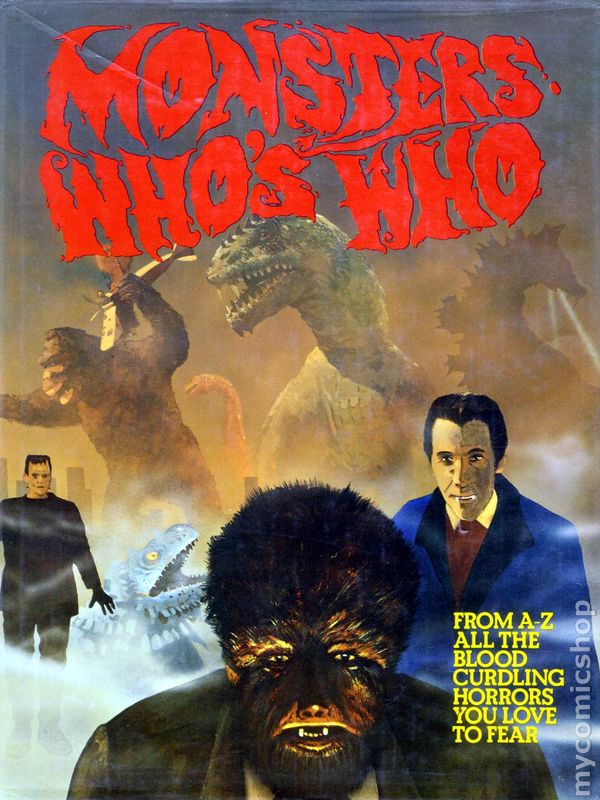
My First Bestiary
![]() |
| MONSTERS, WHO'S WHO: FROM A-Z ALL THE BLOOD CURDLING HORRORS YOU LOVE TO FEAR |
My second bestiary, pictured with it below, was still a good number of years in my future, so this was a formative influence on me of a subject that had always been dear. It is one of the books of my first library that survived for my adult reclamation. I later gave it to my nephews, hoping it would be of interest to them, but on a recent visit I borrowed it so that I could look through it again.
| Almost exactly the size of the Monster Manual, alas the dust jacket is long gone. |
I made a listing of all the entries in it and perused them. Not a page looked unfamiliar to me, I had spent so much time staring at the pictures over the years. Clearly, this book helped populate my imagination's monstrous contents. What surprised me were the entries that I did not remember. Invariably, they were the ones that were squeezed between the illustrations belonging to the other entries. It just goes to show first how visually oriented I was (and basically, still am), and how, to be successful, a bestiary must have an illustration of every monster. Creatures with poor or no illustration are likely to be ignored (another lesson of the first AD&D MONSTER MANUAL, which has been thoroughly learned by its descendents). A monstrum, after all, is a warning or omen. By its essence, it must be seen. In my mind's eye, when I think of the earliest monsters I encountered, they are Ray Harryhausen monsters, a Universal Studios classic monster, an alien from Star Trek, one of the Wild Things from Where the Wild Things Are, or something else from this book.
Thanks for sharing this Mythopoeic Monday with me as I rambled through one the early, dark passages of my imagination. What were your early inspirations?
| Bad things herein...bad things! |
Sunday, February 5, 2012
Tops of the Blog in Year One
Going through the blog's stats for the first year, I have compiled the following in case it is of interest to others besides me. If you helped introduce folks to my blog, I am deeply grateful. I should note that the A-Z April Blogging Challenge brought lots of readers, but I have no way to keep up with that traffic other than its contributions to post popularity and to followers.
TOP TEN POSTS OF 2011-2
TOP NINE GAMING BLOG TRAFFIC DRIVERS
Growth Rate: 39%. If only the economy were doing so well!
Note to UK Readers: Yes, you are the second largest group after US readers, but not by much. How could the lands of my forebears be squeaking by Canada -- Canada, by Her Majesty's frocks and frosty locks! -- and so far lagging behind US readers in a ratio of less than 1:7? I appeal to my people in Kent and Northern Ireland to rally behind the Rambling.
TOP TEN POSTS OF 2011-2
- The Ouroboros
- Z is for Zoomorphic Angels
- P is for Paladin
- King James Rules for Mythopoesis
- Pawns of the Pathfinder Beginner Box
- T is for the Tree of Life
- It's Snowing Villains
- Far over the Misty Mountains cold
- Siren Calls from the City of Angels
- The Thing (2011)
Four Posts that were in the Top Ten Until Recently
Q is for Queenly Quest
H is for Heart
Scoopocalypse! Adventuring News from PaizoCon 2011
Everything American Horror Story: Pilot Review
TOP NINE GAMING BLOG TRAFFIC DRIVERS
- jrients.blogspot.com
- errantgame.blogspot.com
- rathergamey.blogspot.com
- eternalkeep.blogspot.com
- bloodofprokopius.blogspot.com
- daddygrognard.blogspot.com
- risusmonkey.com
- gothridgemanor.blogspot.com
- towerofthearchmage.blogspot.com
Top Game Sites Not Blogs
Paizo Forums
ENWorld
Growth Rate: 39%. If only the economy were doing so well!
Note to UK Readers: Yes, you are the second largest group after US readers, but not by much. How could the lands of my forebears be squeaking by Canada -- Canada, by Her Majesty's frocks and frosty locks! -- and so far lagging behind US readers in a ratio of less than 1:7? I appeal to my people in Kent and Northern Ireland to rally behind the Rambling.
Saturday, February 4, 2012
Nerd Stalker now at the Sams Club
I see you. Yeah, you in the black t-shirt. The one with the flaming two handed sword, capped by a d20, in the refrigerated prepared food section. I circle around to get a better look. You don't look up though. Yeah, I know who you are, even if the woman with you doesn't.
You're one of us.
EDIT: Image added to show what the t-shirt looked like.
HAPPY FIRST ANNIVERSARY!
Today, Mythopoeic Rambling turns one year old. In that year I, along with the help of some generous and talented guest posters and field reporters, posted 257 posts and now have over 90 followers (Welcome, new followers, by the way!) I've broken stories about Paizo releases, in some cases not merely early but first -- and I'm hoping some of you will make plans to text me from Paizo Con again this year to keep that happening!
I've tried to share some of the fruits of my reading, dreaming, and gaming, and some of the riches that I have found shared by other people with similar interests who are creative and thoughtful. I've benefited from the comments that you, my readers, have shared. I think I've learned some things about producing a better blog, and continue to try to improve what I offer to those interested in the exploration and creation of secondary worlds.
Above, all, I want to thank all of you -- readers, commenters, followers, fellow bloggers, and linkers -- for your interest and support. I especially want to thank the FaWTLies, an online group of gamers who have been a tremendous source of encouragement and advice. You gals and guys ROCK! (Not news to you, but I'm still going to say it.)
Cheers! Here is to the next year! May our rambles go on and on.
Friday, February 3, 2012
Upsurge from the Underworld?
Is it just me, or is the number of blogs with "Underworld" in the title proliferating? Personally, I am all in favor of it, captivated as I am by the themes and images of the Underworld. It almost makes wish I'd gone with "Underworld Mythopoet" or something like that.
First there was UNDERWORLD INK, which was joined by UNDERWORLD KINGDOM, then
DANDY IN THE UNDERWORLD, and now UNDERWORLD CLEANING SERVICE. Am I missing any? (Of course, a title alone is not enough for Zenopus, so he worked Underworld into his blog's subtitle.) ;-)
Let me, like Odysseus, offer a libation to conjure up any other heroic shades that might be down there. I'll be checking in from time-to-time, to learn your secrets.
First there was UNDERWORLD INK, which was joined by UNDERWORLD KINGDOM, then
DANDY IN THE UNDERWORLD, and now UNDERWORLD CLEANING SERVICE. Am I missing any? (Of course, a title alone is not enough for Zenopus, so he worked Underworld into his blog's subtitle.) ;-)
Let me, like Odysseus, offer a libation to conjure up any other heroic shades that might be down there. I'll be checking in from time-to-time, to learn your secrets.
Thursday, February 2, 2012
Candlemas 2012
![]() |
| The Presentation of Christ at the Temple by Hans Holbein the Elder |
On a personal note, this has been one of those days in my life were big things have happened coincidentally over the years: both tragic and joyful, so it remains a particular observance for me and for Mrs. Obscure. A Clerk in Oxford has had several recent blog posts that I recommend to increase your medieval knowledge or to simply enjoy the beauties of the day.
Best wishes for bright days ahead,
Theodric
Wednesday, February 1, 2012
More Pathfinder Resources
![]() |
| Yeah, Valeros, I'm kind of creeped out too...but the module looks awesome! |
I've blogged previously about PFRPG resources that can be found online. (See also the essential online tools on my Free Gaming page by clicking and scrolling down the Pathfinder section.) I've put together some more sites that have caught my attention or that I drew from the brains of my secret PF advisory board.
If, like me, you are attracted to the classic Ravenloft setting, whether to mash it with Pathfinder's Ustalav or just convert it to Pathfinder, here are two links you don't want to miss:
Pathfinder in Ravenloft ("Mistfinder")
Thread about the Tarokka and Harrow decks with Wes Schneider
For a crunch heavy game like Pathfinder, many of us like to use software to help speed things up. These have that magic word attached to them: FREE!
HeroLab's free Beginner Box download -- easy-to-use and really impressive!
Combat Manager -- I haven't had a chance to test it yet, but it was recommended to me by a friend and fellow Rambler and it looks promising.
Like the idea of spell cards? Try Perram's Spellbook. Looking for a new podcast to support your play in your off-hours? Give Gamer's Guide to Pathfinder a listen. For the more visually oriented among us, there is a new fanart blog called Golarion Carrion.
You might presume that the majority of the free downloads at the Paizo store are for Pathfinder, but there are plenty of downloads for other games as well. There is a ton of good stuff shared on the Paizo boards, and you can spend a lot of time searching for threads where people are sharing their creativity. One PF fan who has impressed me over the years as having an imagination congenial to my own is Set, who has gathered some of his creations on his website, here. Finally, the Kobold Quarterly blog is a great site to watch for PF content (although, note, it is not Open Content).
Subscribe to:
Posts (Atom)